BTA Drilling Tools Supplier USA | German-Engineered Drill Heads with U.S. Application Engineering
BTA drilling (also called STS drilling, or Single Tube System) is the standard deep hole drilling process for large-diameter bores. Coolant is delivered externally around the tool. Chips are removed internally through a hollow drill tube. That single design difference is what makes BTA drilling reliable at diameters from 7.76 mm to 700 mm and depths up to 100 times the bore diameter.
botek® America supplies BTA drilling tools, application engineering, and process support for U.S. manufacturers. Our tools are engineered in Germany by botek®®. Our engineers are in Roselle, Illinois.
What Is the BTA Drilling System and Why Is It Used for Large-Diameter Deep Holes?
BTA drilling delivers coolant externally and removes chips internally through the drill tube. This is the opposite of gundrilling, where coolant travels through the tool and chips exit through an external V-flute. The internal chip path is what makes BTA drilling the right process for larger bores. At diameters above 20 mm, chip volume exceeds what a V-flute can reliably evacuate. The BTA tube scales with the bore. The V-flute does not.
BTA stands for Boring and Trepanning Association, the industry body that developed and standardized the process. You will also see it referenced as STS drilling in machine specs and tooling catalogs. Both names describe the same system.
The process runs at continuous feed with no peck cycles. BTA drilling achieves feed rates 3 to 7 times faster than gundrilling at the same diameter. Below 20 mm, gundrilling is the right choice. Above 40 to 50 mm, BTA is the only practical process. Between 20 and 50 mm, both work. The right answer depends on your production volume and machine setup.
What BTA Drilling Tools Does botek® America Supply?
botek® America supplies the full range of botek® BTA drilling tools. Brazed drill heads, indexable drill heads, counterboring tools, trepanning heads, and guide pads. Bore diameters from 7.76 mm to 700 mm. All tooling is engineered and manufactured in Germany by botek®. Distributed and supported in the U.S. by botek® America.
Brazed BTA drill heads are ground to final bore diameter at manufacture. Cutting edges and guide pads are fixed. No insert setting, no variation between setups. Best for bore diameters from 7.76 mm to approximately 18 to 20 mm, where indexable geometry becomes impractical. The head is replaced as a unit when worn. Geometry is locked at production, so bore diameter consistency is tight from the first hole.
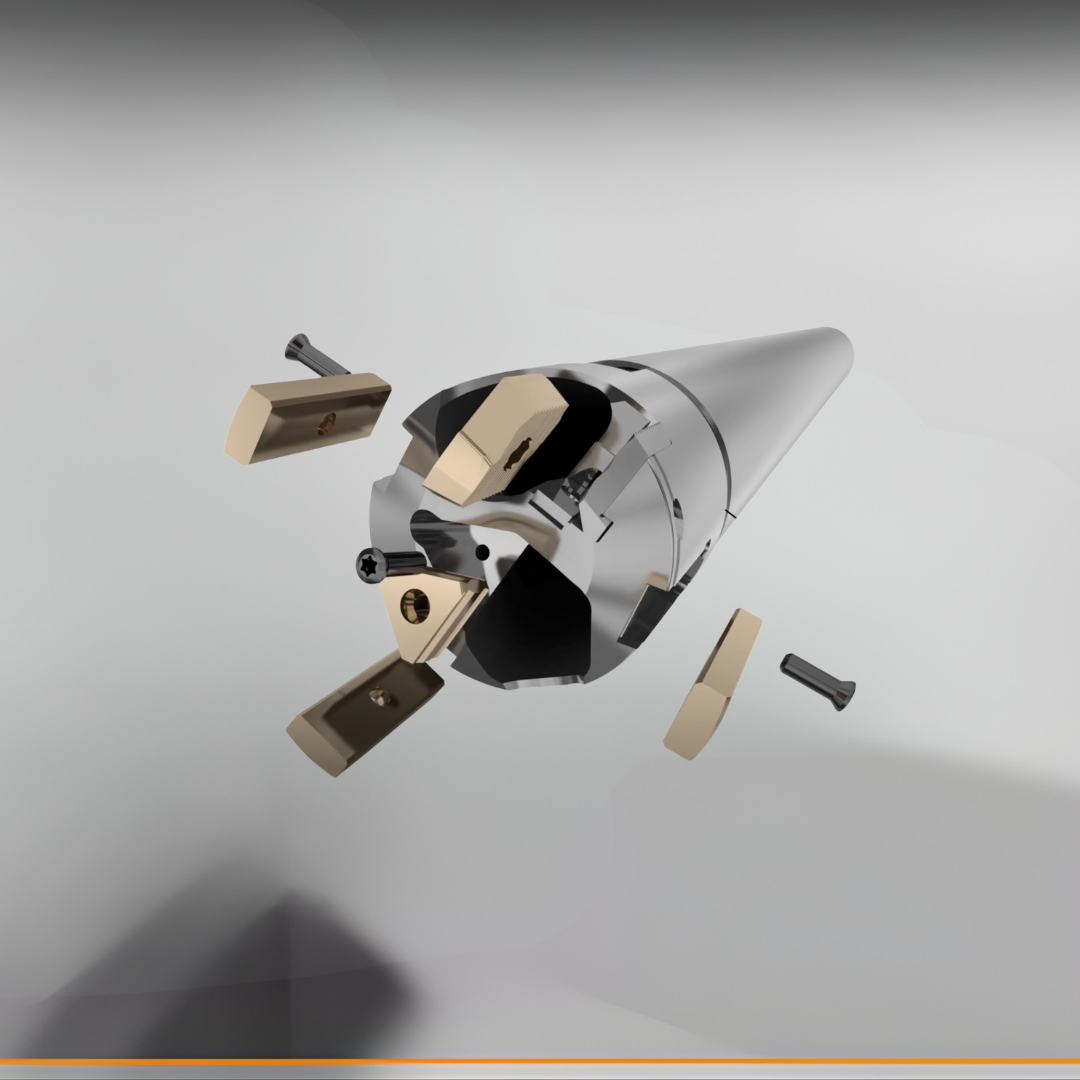
Indexable BTA drill heads use replaceable carbide inserts and guide pads on a reusable body. Available from approximately 18 mm upward. Cartridge-mounted inserts allow micrometer-level diameter adjustment after indexing. This matters for H7 tolerance work. When inserts or guide pads wear, you replace them, reset diameter with a tool presetter, and continue. The headbody stays in service. At larger diameters, this is significantly cheaper than replacing a brazed head.
BTA counterboring tools enlarge an existing bore using the pre-drilled diameter for guide support. Push counterboring advances into the workpiece. Pull counterboring retracts while cutting, used where the geometry restricts forward access. Guide pads pilot off the existing bore and maintain concentricity throughout depth. Common applications include hydraulic cylinder finishing, stepped aerospace bores, and large-diameter energy components. botek® America is a full-service BTA counterboring tools supplier for U.S. manufacturers.
BTA trepanning heads cut a ring around the bore periphery and leave a solid core. The core passes through the tool and is recovered. Available from approximately 55 mm bore diameter and above. In titanium, Inconel, and specialty stainless steel, the recovered core is reused rather than converted to chips. Material cost savings are significant. The core also serves as a test specimen for quality documentation when required.
Production capabilities
What Tolerances and Surface Finish Can botek®’s BTA Drilling Achieve?
Under optimized conditions, BTA drilling achieves bore diameter tolerance to H7, hole straightness of 0.1 mm per 100 mm, and surface finish Ra 0.4 to 3.2 µm. These are production-achievable values with correct tooling, good guide pad condition, and cutting values matched to the workpiece material.
| Parameter | botek® BTA System Capability |
|---|---|
| Bore diameter range | 7.76 mm to 700 mm |
| Depth-to-diameter ratio | Up to 100×D |
| Surface finish | Ra 0.4 to 3.2 µm (application dependent) |
| Hole straightness | 0.1 mm per 100 mm (workpiece rotating) |
| Diameter tolerance | H7 achievable in optimized conditions |
| Roundness / cylindricity | IT6 to IT7 achievable |
| Feed rate vs. gundrilling | 3 to 7 times faster at the same diameter |
Four variables control where your process lands within these ranges: cutting speed, feed rate, coolant pressure and volume, and tooling condition. Change one without reviewing the others and surface finish, bore diameter, or straightness will shift.
botek® America's application engineers set the right cutting values for your bore diameter, depth, material, and tolerance target before production starts. Not after the first batch of scrap.
System architecture
What Does Our BTA Drilling System Consist Of?
Five components make up the BTA drilling system: the BOZA pressure head, the drill head, the drill tube, guide pads, and tube dampers. Incorrectly specify any one of them and the process becomes unstable. Chips pack. The bore drifts. The tool breaks.
The BOZA
The BOZA (Bohrölzuführapparat, or oil pressure head) seals the coolant circuit at the workpiece face and delivers coolant into the annular gap around the drill tube.
The Drill Head
The drill head carries carbide cutting inserts and guide pads. Inserts remove material. Guide pads ride the bore wall, counter lateral cutting forces, and produce the burnishing effect that gives BTA drilling its surface finish quality.
The Drill Tube
The drill tube transmits torque and feed force while chips travel through its bore toward the spindle.
Tube Dampers
Tube dampers suppress vibration in longer boring bars. Without them, bore deviation increases with depth.
Guide Pads
Guide pads are the self-piloting mechanism. They keep the tool tracking straight from first contact to full depth.
botek® America specifies the complete system as part of every application review. Not just the drill head.
The drilling sequence
How Does BTA Drilling Work?
BTA drilling runs at continuous feed. Coolant pressurizes the annular gap around the drill tube, forces chips through the drill head, and carries them out through the hollow tube to the spindle. No peck cycles. No retraction to clear chips.
Here is the sequence:
-
Setup and Sealing
The BOZA is aligned with the spindle axis and sealed against the workpiece face.
-
Entry Guidance
The drill bushing stabilizes the drill head at entry before guide pads engage the bore wall.
-
Coolant Pressurization
High-pressure coolant fills the annular gap and reaches the cutting inserts and guide pads.
-
Cutting and Chip Removal
Inserts engage the workpiece. Chips pass through the drill head openings, into the hollow tube, and exit at the spindle.
-
Depth Advancement
The tool feeds at a controlled, continuous rate. Guide pads self-pilot through depth.
-
Breakthrough and Retraction
Feed rate reduces before breakthrough. Coolant flushes remaining chips. The finished bore is checked for diameter, straightness, and surface finish.
Why Do U.S. Manufacturers Choose botek® America for BTA Drilling Tools?
botek® America is not a general cutting tool distributor carrying BTA tools as a catalog line. Deep hole drilling is the entire business. That matters when your application involves difficult materials, tight tolerances, or a production line that cannot afford a trial-and-error setup phase.
Here is what that specialization looks like in practice:
How Does Working With botek® America Work?
The process is engineering-led, not sales-led. Here is what to expect from first contact to production.
01.
Submit Your Application (10 minutes) Share your bore diameter, depth, material, machine type, coolant pressure, and tolerance target. Upload a drawing if you have one. No purchasing portal. No queue.
02.
Engineering Review and Process Layout (24 to 48 hours) Our application engineers review your submission and develop a full process layout: drill head type, insert grade, guide pad specification, cutting speed, feed rate, and coolant strategy. For advanced materials or non-standard geometries, the U.S. team coordinates with botek® engineers in Germany.
03.
Tooling Quote and Trial Option You receive a clear quote with a specific tooling configuration, not a list of part numbers. For difficult applications or high-volume production commitments, we can schedule an in-house trial at the Roselle facility to validate the process before production begins.
Process comparison
BTA Drilling vs. Gundrilling: Which Process Is Right for Your Application?
The primary decision factor is bore diameter. Below 20 mm, gundrilling is the standard. Above 40 to 50 mm, BTA drilling is the correct choice. Between 20 and 50 mm, both are capable. The decision comes down to production volume, machine availability, and required feed rate.
| Feature | BTA Drilling | Gundrilling |
|---|---|---|
| Bore diameter range | 7.76 mm to 700 mm | 0.5 mm to 51.2 mm |
| Depth-to-diameter ratio | Up to 100×D | Up to 400:1 |
| Coolant delivery | External, through annular gap | Internal, through the tool |
| Chip removal | Internal, through hollow drill tube | External, through V-shaped flute |
| Feed rate at same diameter | 3 to 7 times faster | Baseline |
| Surface finish | Ra 0.4 to 3.2 µm | Ra 0.4 to 1.6 µm |
| Machine requirement | Dedicated BTA machine with BOZA | Dedicated or CNC with through-spindle coolant |
| Overlap zone (20 to 51 mm) | Both processes technically viable | Both processes technically viable |
Above 50 mm, BTA is the standard. Gundrilling at these diameters is not economically or practically viable. Many U.S. manufacturers run both systems in parallel. Gundrilling for small-diameter precision holes. BTA drilling for larger, higher-output work. botek® America supplies and supports both.
Troubleshooting guide
What Are the Most Common BTA Drilling Problems and How Do You Fix Them?
Most BTA drilling failures come from three sources: coolant setup errors, worn tooling, and cutting parameters that have not been matched to the workpiece material.
What Causes BTA Drilling Chip Evacuation Problems?
Chip evacuation failure is almost always a coolant issue first. If pressure or volume is below the minimum for your bore diameter, chips stop moving through the drill tube. They pack. The tool seizes and breaks.
Common causes- Coolant pressure or volume below minimum for the bore diameter
- Feed rate too high, producing oversized chips that cannot pass through the drill head openings
- Coolant emulsion concentration below 10%, causing the lubricating film to collapse
- Filtration failure, allowing recirculated chips to partially block coolant delivery
Fix: Measure pressure at the tool entry point, not just at the pump. Line pressure drop is common and frequently overlooked. Drop feed rate in 10% increments to reduce chip size. Check coolant concentration daily with a refractometer. Maintain 10 to 12% minimum for emulsion. Switch to deep hole drilling oil for titanium, Inconel, and stainless applications.
What Causes BTA Drill Hole Drift?
The most common cause of hole drift in BTA drilling is worn guide pads. As pads lose their contact profile, the self-piloting mechanism degrades. The bore starts to drift. It often happens gradually, which is why the root cause is easy to miss until the bore is out of specification.
Common causes- Worn guide pads that can no longer counter lateral cutting forces
- BOZA misalignment, causing the tool to enter at a slight angle to the bore axis
- Drill bushing diameter mismatch that allows lateral movement at entry
- Uncontrolled boring bar vibration from absent or worn tube dampers
Fix: Replace guide pads on a schedule based on meters of bore drilled, not on visual inspection. Visual checks consistently miss early-stage wear. Verify BOZA alignment at every setup change. Install tube dampers on longer boring bar applications.
How Do You Improve BTA Drilling Surface Finish When Ra Is Above Specification?
When Ra values exceed specification in BTA drilling, check guide pad condition first. Guide pads produce the burnishing effect that creates BTA's characteristic surface finish. Worn pads degrade Ra before insert wear becomes visible.
Common causes- Worn guide pads (most common cause of rising Ra values)
- Boring bar vibration from absent or failed tube dampers, producing chatter marks on the bore wall
- Dull or chipped cutting inserts generating heat and smear rather than clean cuts
- Contaminated coolant with abrasive particles acting as a lapping compound on the bore wall
Fix: Replace guide pads first. Then inspect and replace cutting inserts. Verify tube damper condition. Check coolant filtration. 25 micron or better is the minimum for BTA drilling. Reduce feed rate in 10% steps if Ra is still above specification after addressing the above.
Still experiencing BTA drilling problems?
Ask a botek® America application engineer about your bore diameter, tooling condition, coolant setup, material, and production requirements.
What Industries Use botek® America’s BTA Drilling Tools?
botek® America supports BTA drilling applications in aerospace and defense, hydraulics and pneumatics, energy and power generation, automotive and powertrain, machine and plant engineering, and mold making.
Technical answers
BTA Drilling Frequently Asked Questions
What is the difference between BTA drilling and STS drilling?
There is no process difference. BTA and STS are two names for the same system. BTA stands for Boring and Trepanning Association, the industry body that developed and standardized the process. STS stands for Single Tube System, the descriptive name used in some machine and tooling catalogs to distinguish it from the double-tube ejector system. If a spec sheet or machine manual references STS drilling, it means BTA drilling.
How does BTA drilling compare to gundrilling for large-diameter holes?
Above 20 mm bore diameter, BTA drilling outperforms gundrilling on feed rate, chip evacuation reliability, and process stability. BTA drilling runs 3 to 7 times faster at the same diameter with no peck cycles. Below 20 mm, gundrilling remains the right process. botek® America supplies both and reviews your bore diameter, depth, and production requirements to confirm which process fits before recommending tooling.
What causes BTA tool breakage and how do you prevent it?
Chip jams cause roughly 70 to 80% of all BTA tool breakage. Chips pack the drill tube. The tool seizes under feed force and breaks. Monitor coolant pressure throughout the drilling cycle. A sudden pressure drop during cutting means chip evacuation is failing. Stop the cycle immediately. Other causes include coolant pressure loss mid-cycle, drilling through a cross-hole without reducing feed rate, and running tooling past serviceable life. A proactive regrinding schedule based on meters drilled eliminates most breakage events.
Does botek® America provide application engineering support or just sell tools?
botek® America develops a full process layout before every tooling recommendation. Submit your bore diameter, depth, material, machine type, coolant pressure, and tolerance requirements. Our engineers return tooling selection, cutting values, coolant strategy, and chip form guidance. For difficult materials or new BTA setups, in-house process validation is available at our Roselle facility. After delivery, the same team supports cutting value refinement, troubleshooting, and regrinding. The goal is a stable production process. Not a tool sale.
What is a BOZA and why does it matter?
A BOZA (Bohrölzuführapparat, or oil pressure head) seals the BTA coolant circuit at the workpiece face, delivers coolant into the annular gap around the drill tube, and stabilizes the boring bar at entry. Without a correctly sized and sealed BOZA, coolant pressure drops. Chip evacuation fails. Tool breakage follows. botek® America specifies BOZA configuration as part of every BTA process layout.
Can botek® America supply BTA drilling tools in the USA with short lead times?
Yes. botek® America distributes botek® BTA drilling tools from our Roselle, Illinois facility. Brazed and indexable drill heads, counterboring tools, trepanning heads, guide pads, and BOZA components are available. Standard tooling is stocked or sourced through our direct supply relationship with botek® Germany. Express production support is available for non-stock and custom tooling. Contact botek® America to discuss lead time for your specific bore diameter and configuration.
Application engineering support
Get BTA Drilling Tools and Process Support From botek® America
botek® America's application engineers develop the right BTA tool configuration, cutting values, and coolant strategy for your application. German-engineered tooling. U.S.-based engineering support. In-house trials and regrinding in Roselle, Illinois.
Whether you need a quote, a process review, or validation before production, the starting point is the same. Submit your application.