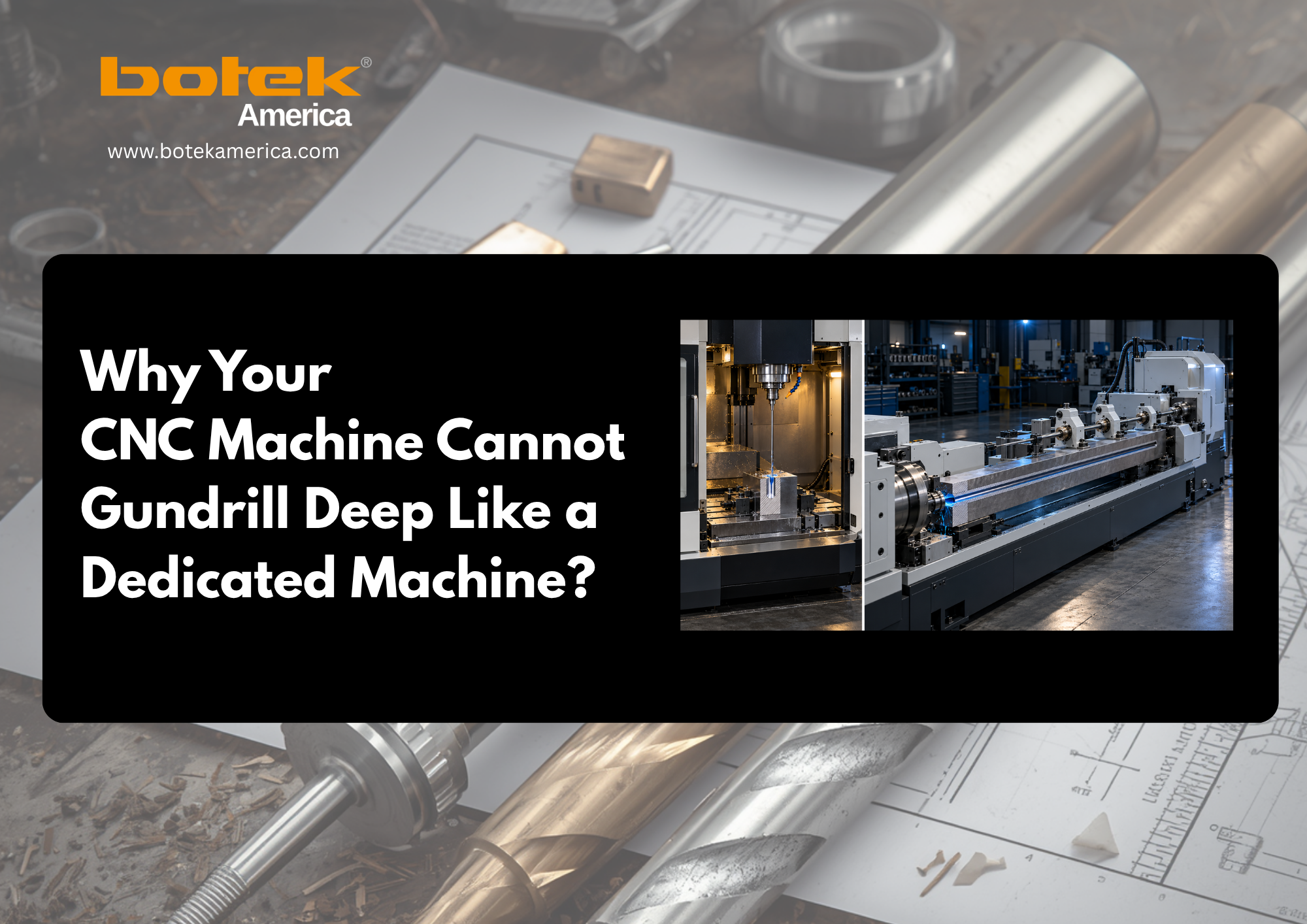
Most shops discover CNC gundrilling limitations the hard way. The hole drifts at 8 inches. Chips pack at 15 inches. The tool snaps at 22 inches. None of it was a tool problem. It was a machine problem.
Your CNC can be gundrilling. But only within a range. Beyond that range, you are fighting machine architecture, not fixing parameters. This guide explains where that line is and what a dedicated deep hole drilling machine does that your CNC cannot.
Hitting the limits of CNC gundrilling? botek® America’s Deep Hole Drilling Systems are built for the applications where CNC machines stop being reliable.
What Is the Real Depth Limit for Gundrilling on a CNC Machine?
CNC machines can gundrilling reliably up to 20:1 to 40:1 depth-to-diameter ratio. Beyond that, the process becomes unstable regardless of tool quality or operator skill.
The L/D ratio is hole depth divided by hole diameter. A 10mm hole at 150mm deep is 15:1, manageable on a CNC. The same hole at 500mm deep is 50:1, not manageable. The 40:1 threshold is where four CNC limitations collide: coolant pressure drops off, chip packing begins, tool deflection compounds, and hole drift accumulates. At that point, no parameter adjustment fixes the problem.
Why Is Coolant Pressure the Biggest CNC Gundrilling Limitation?
Chip evacuation depends entirely on coolant pressure. Most CNC machining centers max out at 70 to 100 bar. Dedicated gundrilling machines deliver 150 to 200+ bar for small diameters. That gap destroys chip flow and breaks tools.
How Much Pressure Does Gundrilling Actually Need?
| Hole Diameter | Required Pressure | Typical CNC TSC Output |
| Under 3mm (0.12″) | 80 to 200 bar (1,160+ psi) | Typically 50 to 70 bar max |
| 3 to 8mm (0.12″–0.31″) | 60 to 120 bar (870+ psi) | Sometimes sufficient |
| 8 to 20mm (0.31″–0.79″) | 40 to 80 bar (580+ psi) | Usually sufficient |
| Over 20mm (0.79″+) | 30 to 60 bar (435+ psi) | Usually sufficient |
For anything under 8mm at depth, a standard VMC is already below the minimum requirement. Chip packing at that point is a certainty, not a risk. External flood coolant makes it worse; it cannot reach the cutting zone once the drill is more than 100mm into the bore. This is also why regrinding intervals shorten when CNC pressure is below spec. If your grinder tool life is suffering, check coolant pressure first.
Read the full breakdown in the botek® America guide on gundrill tool life and wear causes.
Why Does Your CNC Let the Gundrill Walk and Drift?
A dedicated machine guides the tool from a hardened drill bushing sealed against the workpiece at entry. A CNC uses a pilot hole. Any clearance error at the pilot multiplies as drift over depth.
On a dedicated deep hole drilling machine, the guide bushing seals the coolant system, aligns the tool concentrically, and supports it from the first moment of entry. On a CNC, the pilot hole must be 0.013 to 0.025mm oversized. Even slight eccentricity at entry compounds with every inch drilled. On a CNC mill, starting the spindle outside the pilot hole can break the gundrill immediately — the carbide tip is heavier than the tube, and any unsupported rotation at speed is dangerous. Dedicated machines also use anti-whip guides and steady rests along the full tool length. CNC machining centers have none of this. That unsupported tube length is where vibration, TIR runout, and hole drift originate.
What Else Does Your CNC Miss That a Dedicated Machine Gets Right?
Two more gaps separate CNC from dedicated machines: cross-hole management and real-time process monitoring. Both cause failures that operators blame on bad tools.
Cross-holes. When a gundrill breaks into an intersecting cavity on a CNC, coolant escapes through the path of least resistance. Pressure drops instantly, heat spikes, chip evacuation collapses, and the tool breaks inside the bore. Dedicated machines manage this with double jet gundrill designs and real-time flow monitoring. CNC setups have no equivalent.
Process monitoring. A dedicated machine monitors thrust, torque, coolant pressure, and flow rate continuously and stops the cycle when reading shift. A CNC shows a spindle load bar. By the time that bar climbs enough to register a problem, the tool is already failing. Deep hole drilling failures on CNC machines feel random. With the right sensors, they are entirely predictable.
What Can You Actually Do on a CNC vs a Dedicated Machine?
CNC gundrilling works within its limits. Cross them and you pay in scrap, downtime, and broken tools.
| Factor | CNC Machine | Dedicated Machine |
| Max reliable L/D | 20:1 to 40:1 | Up to 400:1 |
| Coolant pressure | 50 to 100 bar typical | 150 to 200+ bar |
| Tool guidance at entry | Pilot hole (operator-dependent) | Hardened drill bushing (sealed) |
| Anti-whip support | None | Full-length guides |
| Counter-rotation | Not available | Standard feature |
| Real-time monitoring | Basic spindle load only | Pressure, flow, thrust sensors |
Use a CNC when:
- L/D ratio is under 30:1, material is aluminum or mild steel, and volume is low or prototype-stage
- Through-spindle coolant is available at 50 bars or higher
- Hole straightness and tolerance requirements are moderate
Move to a dedicated machine when:
- L/D ratio exceeds 40:1 or material is stainless steel, titanium, Inconel, or hardened alloy
- Hole straightness is critical to part function, or you are running production volume
- Cross-holes, thin walls, or interrupted cuts are part of the application
For a full breakdown of coolant requirements, entry guidance, and troubleshooting, see botek® America’s gundrilling process guide.
When Does Your Application Actually Need a Dedicated Machine?
Aerospace and Defense. Titanium and Inconel at 80:1+ L/D for hydraulic passages and structural components. Hole straightness directly affects assembly fit and fatigue performance—CNC cannot deliver repeatable process stability here.
Medical Technology. Small-diameter stainless bores under 3 mm at 50:1+, with surface finish (Ra 0.4 to 1.6 µm) non-negotiable. CNC pressure ceilings produce inconsistent chip evacuation and variable surface quality.
Automotive and Powertrain. Crankshaft oil galleries and camshaft bores at production volume. One scrapped high-cost forging eliminates any cost saving from running on CNC.
Mold and Die Cooling Channels. Long holes in hardened P20 or H13 tool steel at 60:1+. Straightness determines cooling performance and CNC process stability is not there at these ratios in hardened material.
Before committing to production parameters, validate your process through in-house customer testing at botek® America’s Roselle, Illinois facility.
Frequently Asked Questions
What coolant pressure does my CNC need to gundrilling at 30:1 depth-to-diameter?
For a 10 mm hole at 300 mm depth, you need 40 to 80 bar through the spindle. Standard CNC through-spindle coolant typically maxes at 50 to 70 bars. At the edge of your machine’s capability, chip evacuation becomes inconsistent and tool life drops. Reduce the L/D ratio or move that application to a dedicated machine.
Why does my gundrill keep drifting after 4 to 5 inches on my CNC mill?
The pilot hole clearance is too large or slightly eccentric. Check that pilot hole tolerance is 0.013 to 0.025mm oversized and concentric with the spindle axis. Even 0.01mm of spindle TIR runout at entry becomes significant drift at 200mm depth.
Ready to Stop Pushing Your CNC Past Its Limits?
If your application is already at the edge of what your CNC can deliver, drifting holes, accelerating tool wear, scrap you cannot fully explain, those are machine problems, not tool problems.
botek® America supplies precision deep hole drilling systems engineered in Germany and supported in Roselle, Illinois. Application engineering. Custom gundrills. In-house regrinding. Built for the applications where CNC stops being reliable.
What do you get:
- Dedicated deep hole drilling systems for depth-to-diameter ratios up to 400:1
- Application engineering to develop the right process and cutting values before production starts
- Custom single-flute gundrills and twin-fluted drills designed around your material, diameter, and depth
Submit your drilling application or call (630) 893-5300. Our engineers will recommend the right deep hole drilling system for your production needs.