
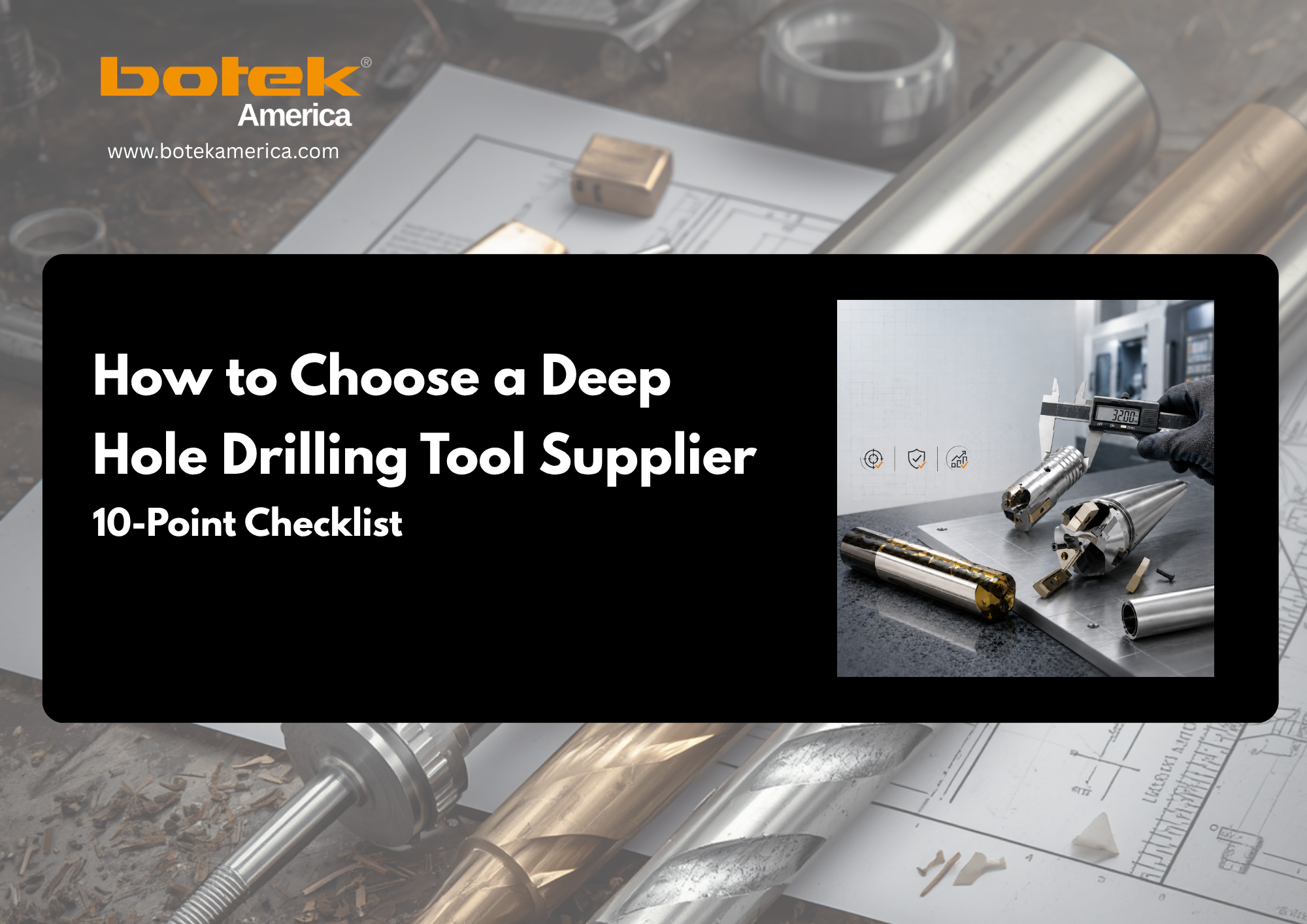
The supplier you choose for your deep hole drilling tools affects every hole you drill. Use this checklist to get the decision right before it costs you production time.
Choosing the wrong deep hole drilling tool supplier is expensive. It shows up in broken tools, inconsistent bore quality, missed deliveries, and production downtime that ripples across your entire schedule.
This guide gives you a practical 10-point checklist for evaluating any deep hole drilling tools supplier. Whether you are sourcing gun drilling tools, BTA drilling systems, or ejector drilling solutions, these criteria apply across every process.
Why Supplier Selection Matters in Deep Hole Drilling
Deep hole drilling is not a forgiving process. Diameter ranges run from under 1 mm to over 600 mm, and length-to-diameter ratios can reach 400:1. You are managing coolant pressure, chip evacuation, hole straightness, and surface finish simultaneously at extreme depths, and the tooling has to be right every time.
A generic cutting tool supplier lacks the application knowledge to support that. Deep hole drilling requires specialized expertise in tool geometry, carbide grades, coating selection, coolant system requirements, and process parameters. Suppliers without that background cannot troubleshoot your process when problems arise, and problems do arise.
The other factor is total cost of ownership (TCO). Purchase price is typically only 4 to 10% of the true cost of precision tooling; the rest is tool life, scrap rate, rework, machine downtime, and engineering time spent fixing problems that better tooling would have prevented.
A structured evaluation protects against these risks and ensures you select a partner with the capability, quality systems, and support structure to keep your drilling operations running reliably.
The 10-Point Checklist for Choosing a Deep Hole Drilling Tool Supplier
1. Assess Technical Expertise in Deep Hole Drilling
Start with expertise. Deep hole drilling covers gun drilling, BTA drilling, and ejector drilling, each with different tooling requirements, coolant specifications, and process parameters. A qualified supplier needs demonstrated knowledge across all three.
Ask how long the supplier has been designing and manufacturing precision gun drilling tools. Ask for examples of applications they have supported in your industry, and look for in-house application engineers who can review part drawings and recommend the right tool specification.
- Minimum standard: 5 or more years of active deep-hole drilling tool production
- Strong indicator: In-house engineering team with documented application support capability
- Red flag: Supplier rebrands imported tools without in-house design capability
2. Evaluate Manufacturing Capabilities
A supplier cannot deliver consistent quality without the right production equipment. Ask about their grinding technology, inspection equipment, and production capacity. Can they handle your diameter range? Can they scale for higher volumes if your needs grow?
- Verify: CNC grinding machines, coordinate measuring machines (CMM), dedicated tool production cells
- Capacity check: Lead times at current volume and peak capacity limits
- Scalability: Ability to support production ramps without quality degradation
3. Verify Product Quality Standards
ISO 9001:2015 certification is a baseline requirement, not a differentiator. Under ISO 9001, suppliers must maintain documented quality controls, run first-article inspections (FAI), and track non-conformances. For aerospace applications, AS9100 certification carries additional traceability requirements.
Beyond certification, ask about their incoming material inspection, in-process measurement controls, and how they handle returns and non-conformance reports.
- Minimum: ISO 9001:2015 certification from an accredited body
- Aerospace and defense: AS9100 or NADCAP approval
- Ask for: Sample inspection reports, certificate of conformance process, non-conformance rate data
4. Review Tool Design and Customization Capabilities
Standard catalog tools work for common applications, but deep-hole drilling applications are often anything but standard. Unusual materials, tight tolerances, non-standard diameters, and extreme L/D ratios all require customized tooling.
A capable supplier can engineer a custom gun drilling tool or BTA drilling head from your specifications. They should have an engineering review process and the ability to produce application-specific geometries, brazed or inserted carbide configurations, and material-matched coatings.
- Key question: What is your standard lead time for a custom tool design?
- Look for: In-house tool design software and documented custom engineering process
- Watch for: Suppliers who redirect all custom requests to a third-party grinder
5. Examine Material and Technology Expertise
Tool performance in deep hole drilling depends heavily on carbide grade selection and coating technology. The wrong carbide grade in titanium or Inconel leads to rapid tool wear and premature failure. The right coating can double or triple tool life in difficult materials.
Ask what carbide grades the supplier uses for your target materials and what coating options they offer for stainless steel, hardened tool steel, titanium, and cast iron for both standard and ejector drilling tooling. A supplier with real material expertise gives specific answers. A supplier without it gives generics.
- Strong supplier: Multiple carbide grades, PVD/CVD coating options, material-specific recommendations
- Red flag: One-size-fits-all carbide with no coating program
6. Assess Process Support and Application Engineering
This is the criterion most buyers skip. It is also the most valuable one. Application engineering means the supplier helps you optimize your drilling process, not just sells you a tool.
A strong application engineering team can review your machine setup, coolant pressure, feed rates, and workpiece fixturing. They can diagnose tool failure modes and recommend parameter changes, helping you hit tolerance and surface finish targets faster and with less scrap. botek® America’s process optimization and application engineering support is a useful benchmark for what this should look like.
- Ask: Do you have application engineers available by phone or on-site?
- Ask: Can you provide feed rate and parameter recommendations for my material?
- Ask: What is your process for troubleshooting a tool performance issue?
7. Analyze Delivery Performance and Lead Times
A tool that arrives three weeks after your planned production start is not a solution. Ask for standard lead times on catalog and custom tools, their inventory policy for fast-moving items, and what happens with emergency requirements.
64% of procurement decision-makers cite supply chain resilience as a top priority (Source: Amazon Business 2025 State of Procurement). Supply chain reliability means your supplier meets your schedule consistently, not just on the first order.
- Benchmark: Catalog tools within 1 to 2 weeks; custom tools 3 to 6 weeks depending on complexity
- Ask for: Documented on-time delivery (OTD) rate from the past 12 months
- Watch for: Suppliers who cannot provide OTD data
8. Evaluate Customer Support and Responsiveness
Support quality reveals itself after the sale. How quickly does the supplier respond to a technical question? Who is your dedicated contact? What happens when a batch of tools does not perform as expected?
A professional B2B supplier has a clear escalation path, responsive account management, and a formal complaint resolution process. Test this before you commit: send a detailed technical inquiry and evaluate the quality and speed of the response.
- Good sign: Named technical contact, response within one business day
- Strong sign: Proactive follow-up after first order, documented complaint resolution process
- Red flag: Generic email responses, no named account contact, unclear escalation path
9. Check Industry Reputation and References
Ask for references from companies with similar applications. A supplier strong in automotive crankshaft drilling may not have the same depth in aerospace titanium components, so match the references to your application.
Look for case studies that describe the problem, the solution, and measurable results: tool life improvement, cycle time reduction, scrap rate improvement. Suppliers with real results can quantify them, whether across aerospace, medical, automotive, or hydraulic deep hole drilling applications.
- Ask for: Two or three customer references in your industry segment
- Look for: Published case studies with specific performance data
- Check: Longevity of customer relationships as an indicator of consistent delivery
10. Conduct a Total Cost of Ownership Assessment
Purchase price is not the right metric for deep hole drilling tooling. The right question is cost per part drilled, which accounts for tool life, rework, downtime from tool failure, and time spent troubleshooting. That is total cost of ownership.
Decisions focused only on acquisition cost produce 30 to 50% higher total expenditure over the tool lifecycle compared to TCO-based decisions (Source: Wiss Manufacturing TCO Analysis).
- TCO inputs: Quoted price, tool life (linear meters per edge), reconditioning potential, scrap rate, downtime frequency
- Ask: Do you offer tool reconditioning and regrinding services to extend tool life?
- Ask: What tool life should I expect at these parameters and in this material?
Supplier Evaluation Scorecard
Score each criterion from 1 (poor) to 5 (excellent). Multiply by the weight to get the weighted score. Total to compare suppliers objectively.
| Evaluation Criterion | Weight | Supplier A | Supplier B | Wtd A | Wtd B |
| Technical expertise in DHD | 15% | ___/5 | ___/5 | ___ | ___ |
| Manufacturing capabilities | 15% | ___/5 | ___/5 | ___ | ___ |
| Quality certifications (ISO/AS9100) | 15% | ___/5 | ___/5 | ___ | ___ |
| Custom tooling design capability | 10% | ___/5 | ___/5 | ___ | ___ |
| Material and coating expertise | 10% | ___/5 | ___/5 | ___ | ___ |
| Application engineering support | 15% | ___/5 | ___/5 | ___ | ___ |
| Delivery performance (OTD rate) | 5% | ___/5 | ___/5 | ___ | ___ |
| Customer support responsiveness | 5% | ___/5 | ___/5 | ___ | ___ |
| Industry reputation and references | 5% | ___/5 | ___/5 | ___ | ___ |
| Total cost of ownership (TCO) | 5% | ___/5 | ___/5 | ___ | ___ |
| WEIGHTED TOTAL SCORE | 100% | ___/50 | ___/50 | ___ | ___ |
Scoring guide: 45 to 50 = preferred supplier. 35 to 44 = acceptable with conditions. Below 35 = do not qualify.
Supplier Comparison Matrix
Use this quick-reference matrix to benchmark supplier profiles against minimum standards.
| Capability | Required | Strong Supplier | Average Supplier | Weak Supplier |
| Gun drilling expertise | Yes | In-house design and manufacturing | Catalog tools only | Resells imported tools |
| BTA drilling tools | Yes | Custom BTA heads available | Standard sizes only | Not offered |
| Ejector drilling | Preferred | Full support with app engineering | Limited range | Not offered |
| ISO 9001 certification | Yes | Accredited, audited annually | Certified, basic QMS | No certification |
| Custom tool design | Preferred | Full in-house design capability | Minor modifications | No custom work |
| Application engineering | Yes | On-site and remote support | Phone support only | Not provided |
| OTD rate | 90%+ | 95% or above, documented | 85 to 94% | Below 85% |
| Tool reconditioning | Preferred | In-house regrind program | Third-party referral | Not offered |
Common Mistakes Buyers Make When Selecting Deep Hole Drilling Suppliers
1. Choosing on Price Alone
Purchase price accounts for a small fraction of true tooling cost. A tool that is 20% cheaper but lasts 40% fewer meters per edge costs more per part drilled. Evaluate cost per hole drilled, not cost per tool purchased.
2. Not Verifying Process-Specific Expertise
Suppliers may claim deep hole drilling capability while only stocking generic gun drills with no BTA or ejector drilling expertise. Verify their specific process capability matches your application before qualifying them.
3. Skipping the Application Engineering Question
Many buyers only ask about price and lead time, skipping the question that matters most: can this supplier optimize my process? Application engineering support is what separates specialist suppliers from resellers.
4. Ignoring Delivery Track Record
A supplier promising short lead times on the first quote may struggle once you are a regular customer. Ask for documented OTD rates, and check references specifically on delivery reliability over 12 or more months.
5. Treating All ISO Certifications as Equal
ISO 9001 is a management system standard, not a product quality guarantee. Ask what the certification covers, when the last audit was, and what their non-conformance rate looks like. Certification without supporting inspection data is not meaningful assurance.
6. Not Asking About Reconditioning Services
Regrinding and reconditioning extends gun drill and BTA tool life significantly. Buyers who never ask about reconditioning leave tool cost savings on the table. A supplier offering in-house reconditioning adds direct TCO value.
Questions to Ask During Supplier Evaluation
Use this question list in supplier conversations and RFQ processes.
Technical Capability:
- What gun drilling, BTA drilling, and ejector drilling tools do you design and manufacture in-house?
- What is your in-house diameter range for gun drilling and BTA tools?
- Can you design a custom tool from my part drawing and tolerance specifications?
- What carbide grades and coatings do you recommend for my specific material?
Quality and Certification:
- Are you ISO 9001:2015 certified? Who is your accrediting body?
- Do you have AS9100 certification for aerospace applications?
- What is your first-article inspection (FAI) process for new tools?
- What is your current non-conformance rate on outgoing product?
Support and Service:
- Do you have application engineers who can review my setup and process parameters?
- What is your standard response time for a technical support request?
- Do you offer tool reconditioning or regrinding services?
- Can you provide two or three references from customers in my industry?
Commercial and Supply Chain:
- What is your on-time delivery (OTD) rate from the past 12 months?
- What is your standard lead time for catalog tools vs custom tools?
- Do you hold safety stock for fast-moving standard items?
- What is your process for handling emergency or expedited orders?
Looking for a Trusted Deep Hole Drilling Tool Supplier?
Choosing a deep hole drilling tool supplier is a strategic decision, not a transactional one. The right supplier reduces scrap, improves tool life, cuts downtime, and provides the application engineering support to optimize your process over time.
botek® America combines decades of precision engineering expertise with purpose-built manufacturing capabilities for gun drilling, BTA drilling, and ejector drilling tools.
What botek® America brings to your operation:
- Application-specific tool design and custom engineering support
- In-house manufacturing with ISO-aligned quality systems
- Application engineering and process optimization guidance
- Gun drilling, BTA drilling, and ejector drilling solutions
- Tool reconditioning services to extend tool life and lower cost per part
Not sure which tool fits your application? The botek® America team can review your part requirements, drilling parameters, and production goals to recommend the most efficient deep hole drilling tool supplier relationship for your operation.
T: (630) 893-5300 | E: info@botekamerica.com