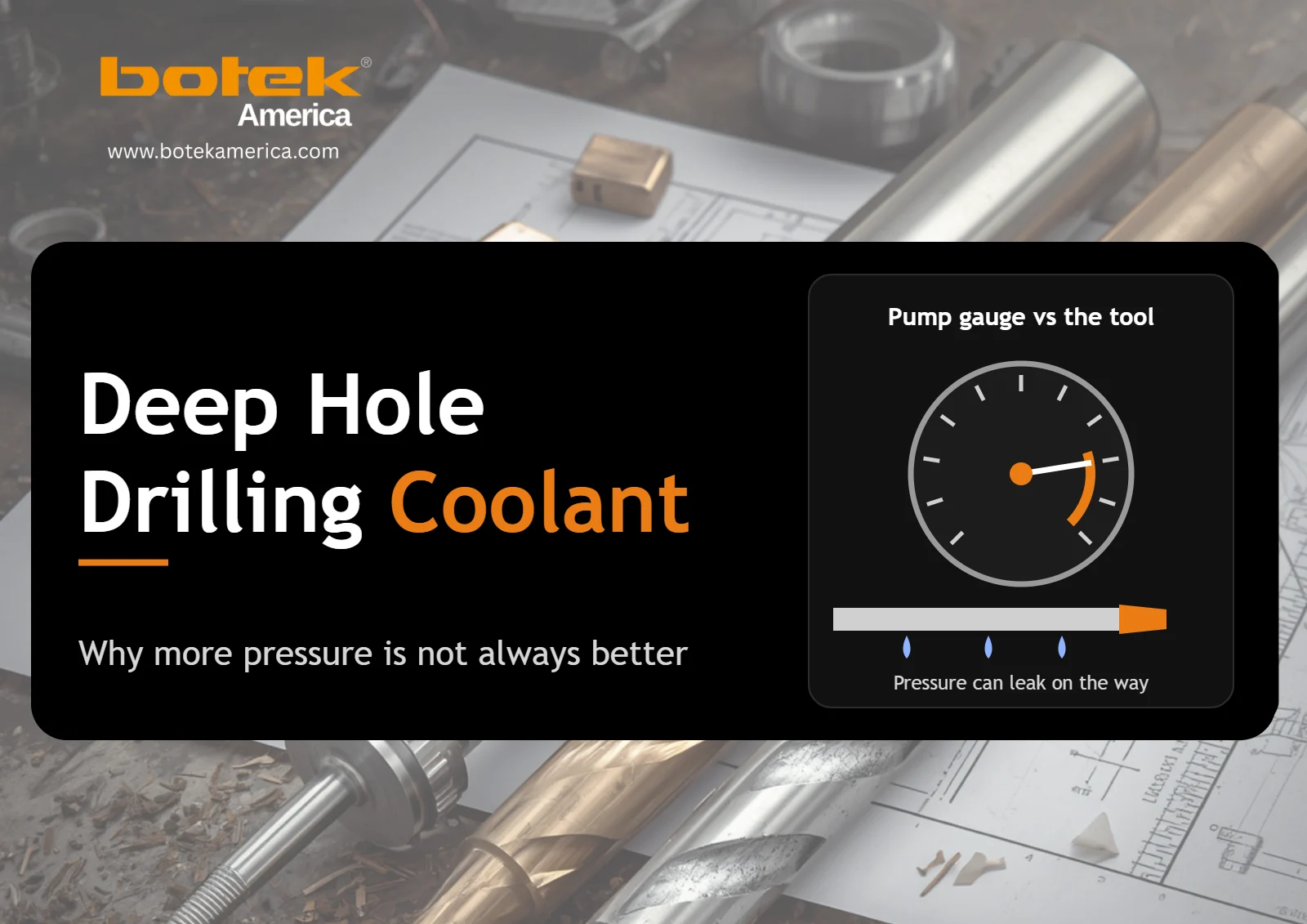
Deep hole drilling coolant can read normal at the pump while the drill packs chips and the bore comes out rough.
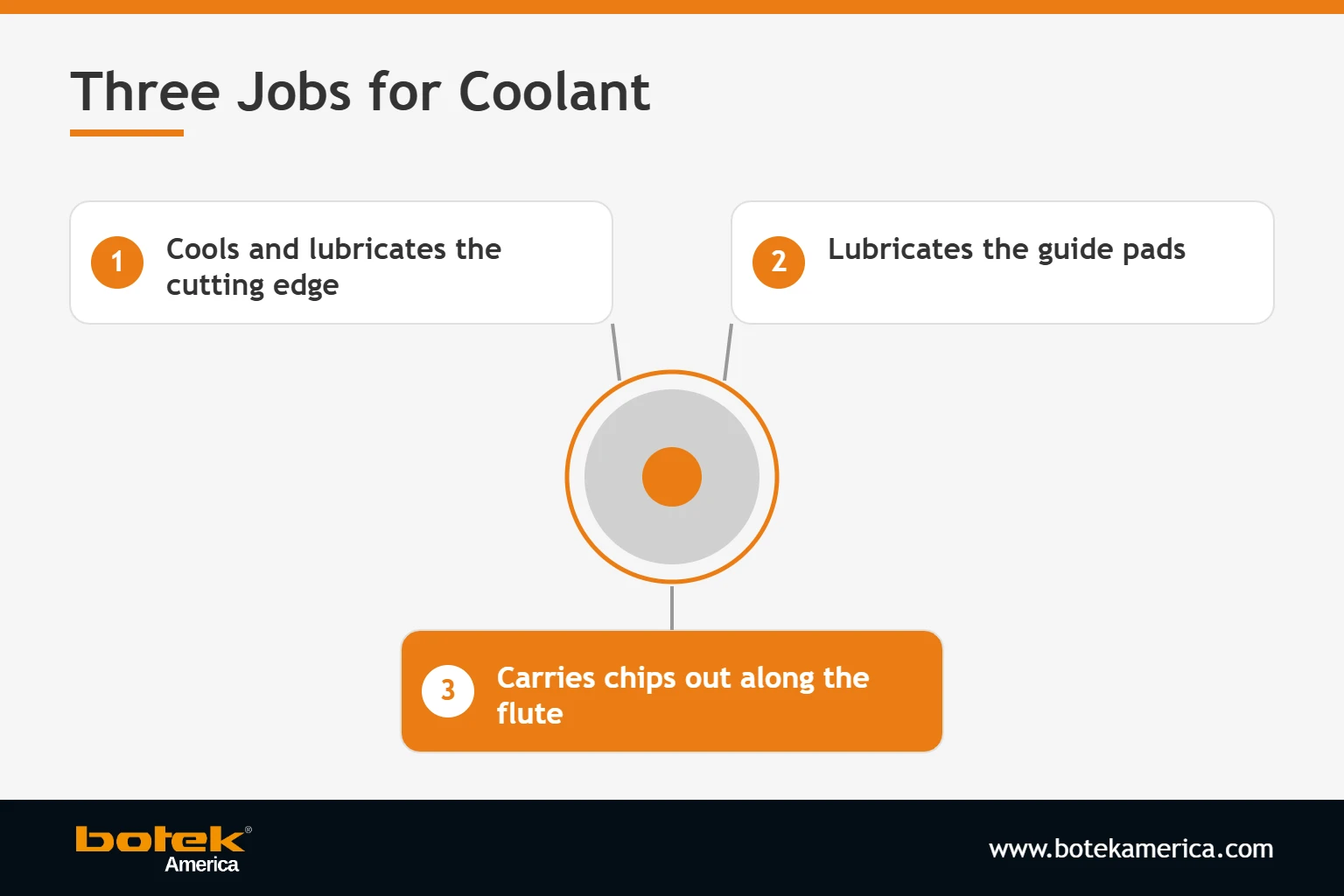
Deep hole drilling coolant does three jobs at once: it cools and lubricates the cutting edge, lubricates the guide pads and carries chips out of the hole. When it falls short, you see a broken drill, a rough bore or a drifted hole, and the cause is often coolant that never reached the tool.
This guide explains how pressure, flow, fluid choice, filtration and temperature work together, what published sources report for each, and where the answer depends on your machine and material. Explore botek® America’s gundrilling solutions for your application.
Why Coolant Problems Hide From the Pump Gauge
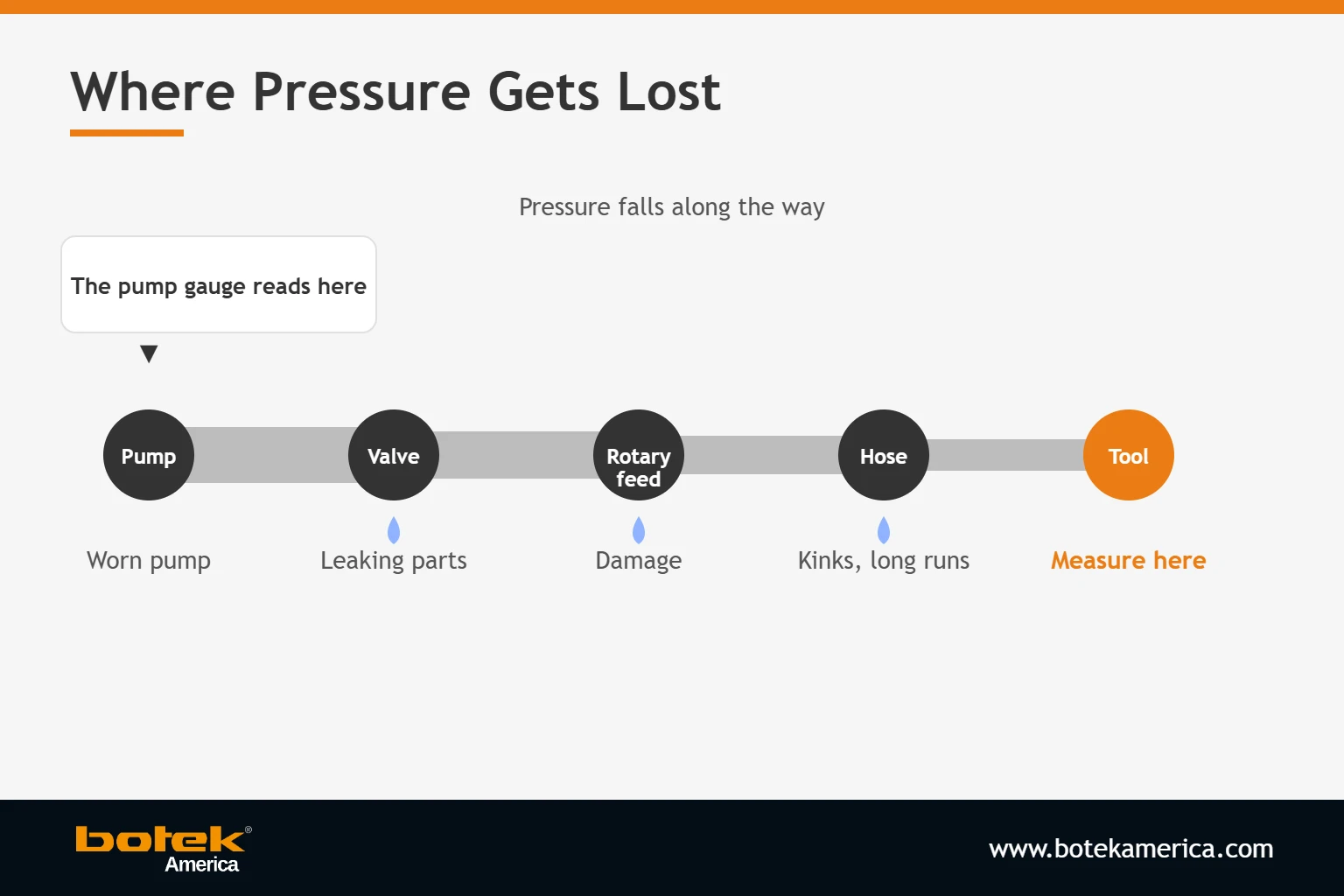
Coolant travels from the pump through valves, a rotary feed and hose to the drill tube before it reaches the cutting head. A leaking valve, a worn rotary feed, a kinked hose or a clogged filter can cut what arrives while the pump gauge still reads normal. Back pressure from a blocked flute can also make a pump reduce its flow.
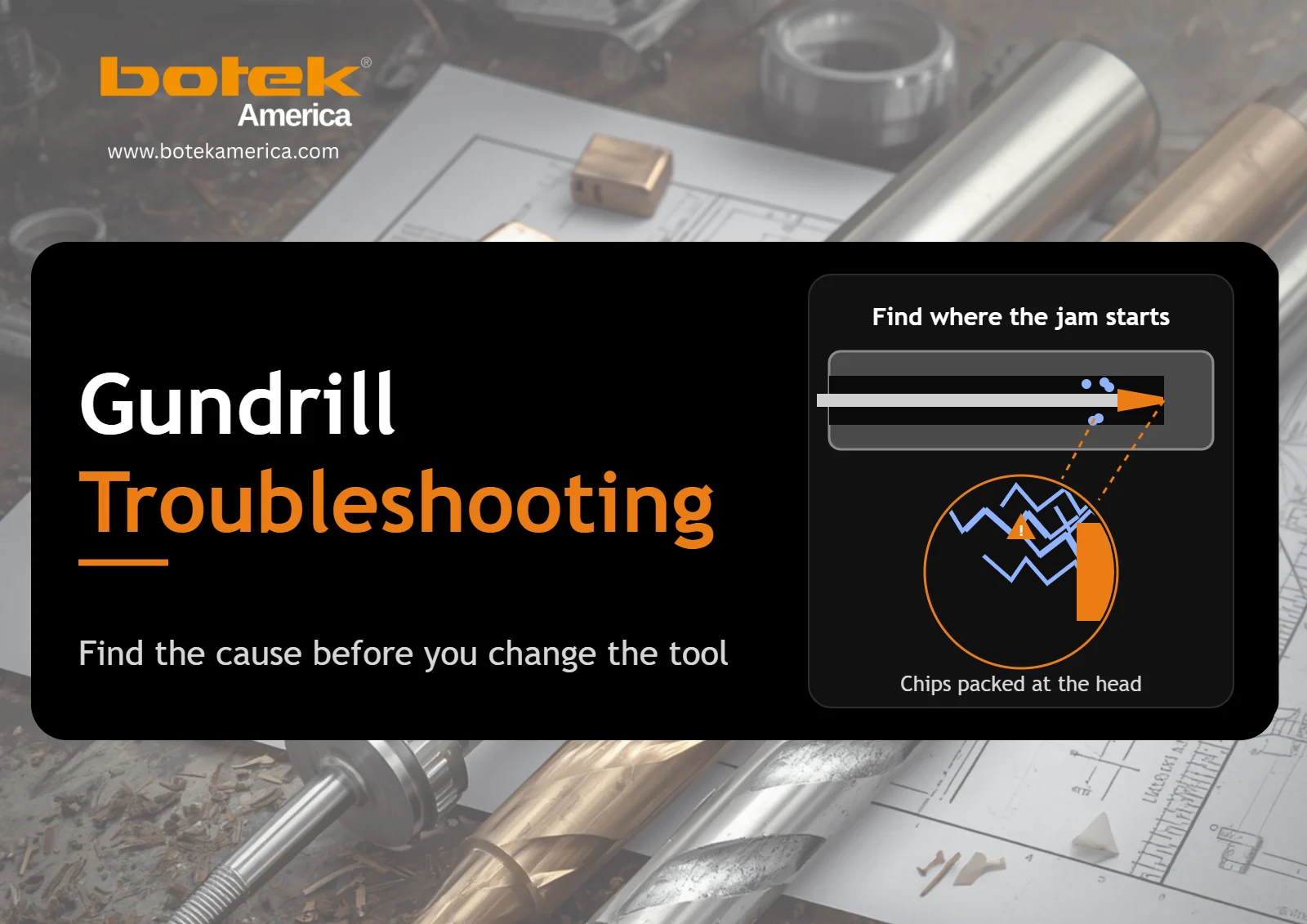
That is why the first check on any coolant-related fault is pressure and flow measured at the tool. Starved coolant is a common route to gundrill tool breakage, because chips pack and heat builds at the edge.
What Deep Hole Drilling Coolant Has to Do
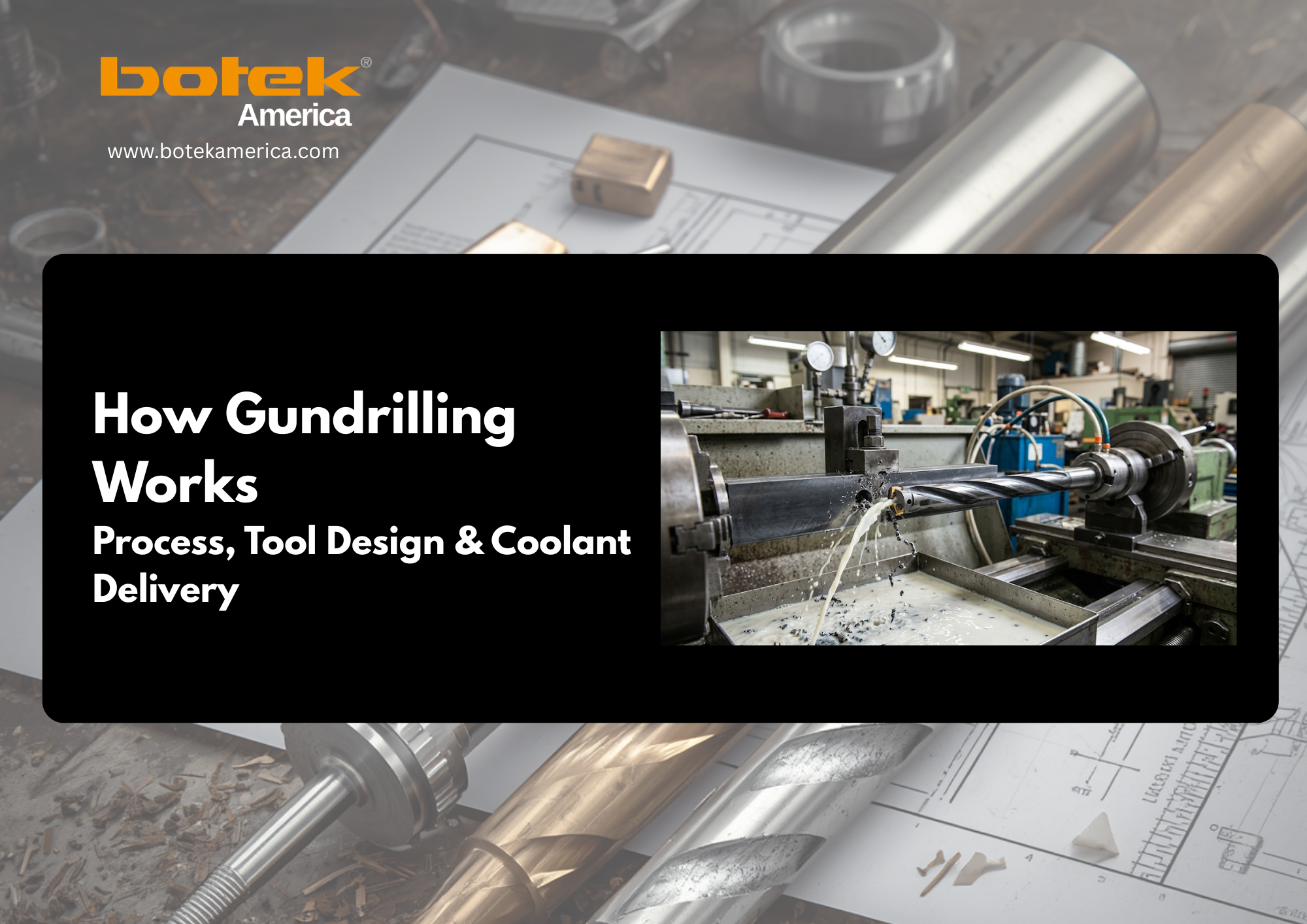
In gundrilling, coolant is pumped through the hollow drill tube to the cutting head, then returns along the outside of the tool, carrying chips out through the flute. That return path is why pressure and flow matter: the fluid that cools the edge is also what moves chips out of the hole. Kip Hanson explains in Cutting Tool Engineering that enough coolant pressure forces chips down the drill body and out of the hole.
BTA and ejector systems route coolant and chips differently, so the figures here come mostly from gundrilling sources. If you are still choosing a method, see our comparison of gundrilling, BTA and ejector drilling.
Deep Hole Drilling Coolant Pressure: What the Numbers Say
What Published Sources Report
Deep hole drilling coolant pressure is not one number. It changes with drill diameter, machine type and fluid. The table collects ranges from Hanson’s 2016 article and from Alan Richter’s 2024 article, A fluid choice. They are reported figures, not botek® America settings.
| Situation | Reported pressure | Source |
|---|---|---|
| CNC machine, drill 2 in. (50.8 mm) or larger | About 200 to 400 psi (14 to 28 bar) may be enough | Hanson, 2016 |
| Swiss-style lathe | About 1,000 psi (69 bar) | Hanson, 2016 |
| Dedicated gundrilling machine | Two to three times the Swiss-style figure | Hanson, 2016 |
| Very small holes, such as medical parts | 1,500 psi (103 bar) and higher | Hanson, 2016 |
| Most spindles and turrets | Cannot handle more than about 70 bar | Richter, 2024 |
| Neat oil systems | Commonly up to 138 bar (2,000 psi) | Richter, 2024 |
The figures overlap and sometimes disagree because each describes a different tool diameter, machine and fluid.
botek® America’s gundrilling guide gives diameter-based ranges: 80 to 200 bar under 3 mm, 60 to 120 bar from 3 to 8 mm, 40 to 80 bar from 8 to 20 mm and 30 to 60 bar above 20 mm. Smaller holes need higher pressure because the coolant channels are smaller. Use these as a starting reference and confirm them for your tool.
Why More Deep Hole Drilling Coolant Pressure Is Not Always Better
Richter quotes Tim Schneider of ATS Systems, who says 70 bar is the best pressure all around in most cases. The article describes a test cut in which a manufacturer got better chip formation at 1,000 psi than at the 3,000 psi it had requested.
The same article says extra pressure is justified mainly when added volume helps, such as with small-diameter drills, and that higher-pressure systems cost more and can be more hazardous to run. A dedicated machine quoted at two to three times the Swiss-style figure in 2016 and a specialist favoring about 70 bar in 2024 are not necessarily in conflict. Confirm any single number against your tool diameter, depth and material.
Where Deep Hole Drilling Coolant Pressure Gets Lost
botek® America lists leaking valve parts, damaged rotary feeds, kinked or excessively long hose lines and worn pumps as common causes of pressure loss that often go unnoticed. Our coolant pressure gauging kit reads the actual pressure at the spindle outlet or at the tool and accounts for the tool’s coolant channel size. Its 160 bar is the instrument’s range, not a process target.
Deep Hole Drilling Coolant Flow: Pressure Does Not Guarantee Volume
Pressure is how hard the fluid is pushed. Flow is how much fluid arrives. Master Fluid Solutions makes the point in its gun drilling technical bulletin: high-pressure systems are often pressure-limited for safety, and back pressure from a blockage can make the pump cut flow, so keep excess volume available.
A Sourced Rule of Thumb for Flow
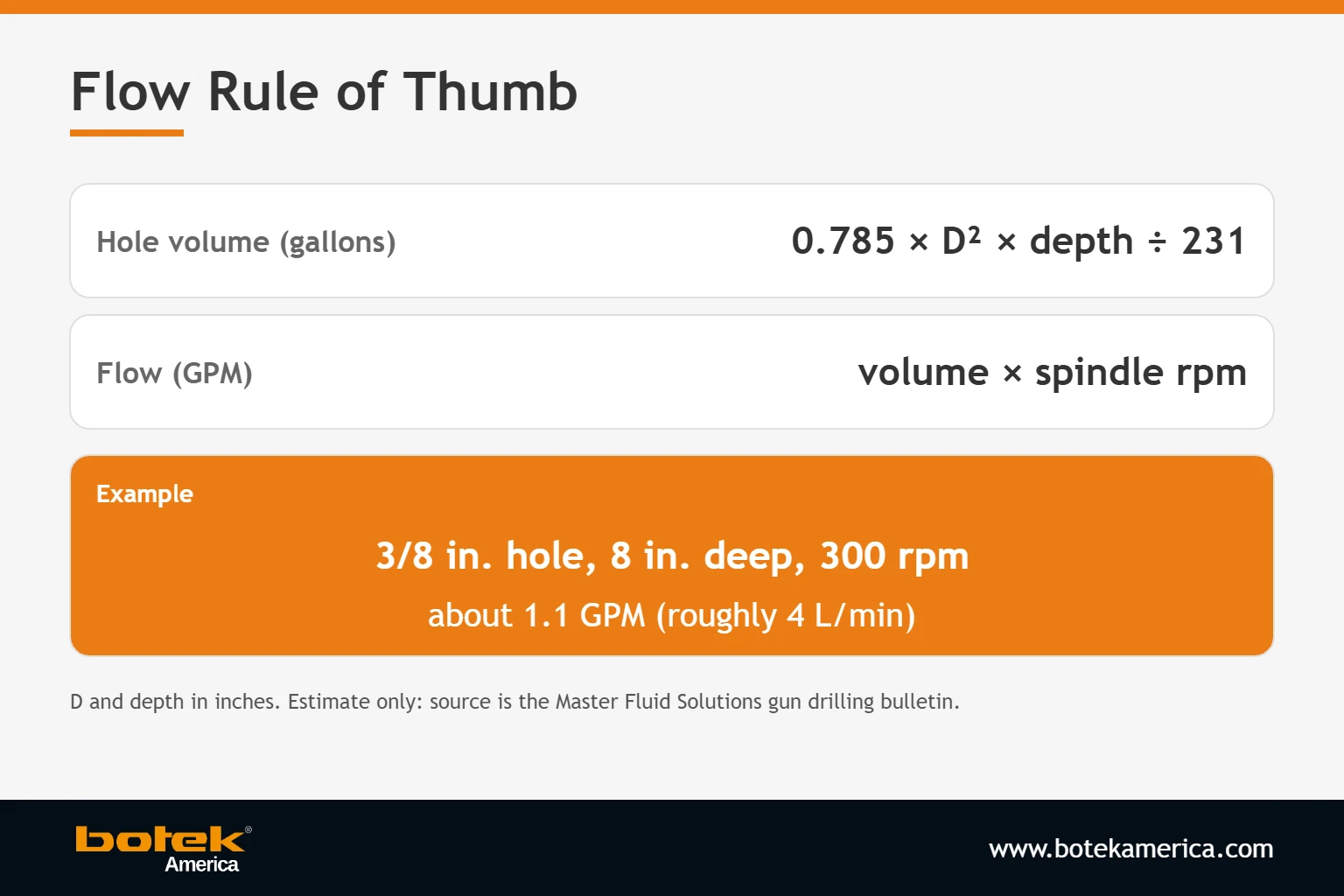
For water-based fluid on CNC machines, the bulletin suggests supplying enough coolant per revolution to fill the volume of the hole. Volume in gallons is 0.785 × diameter squared × depth (in inches) ÷ 231, and flow is that volume times spindle speed. Its example, a 3/8 in. hole 8 in. deep at 300 rpm, works out to about 1.1 GPM (roughly 4 L/min).
Oil moves chips at a lower flow than water-based fluid, while higher-viscosity fluids take considerably more horsepower for the same flow. Treat the rule as an estimate, not a machine setting.
Cross-Holes and Breakthrough
Flow is most at risk where the drill meets a cross-hole. Hanson reports that a single coolant hole can lose flow there, and that a drill with a second coolant hole addresses it. Richter adds a feed tip: halve the feed rate at a cross-hole.
Oil or Water-Miscible Coolant for Deep Hole Drilling
Both fluid families are used for deep hole drilling coolant, and the sources describe where each fits.
| Factor | Straight oil | Water-miscible fluid |
|---|---|---|
| Typical machine | Dedicated gundrilling machines (Master Fluid) | CNC milling machines, as a full soluble oil or emulsion (Master Fluid) |
| Flow needed | Moves chips at a lower flow | Needs more flow for the same chip removal |
| Pressure | Commonly up to 138 bar (Richter) | Limited on most spindles to about 70 bar (Richter) |
| Service life | Neat oil can run five to seven years (Richter) | At least a year if well maintained (Richter) |
Concentration and Mixing
Hanson prefers cutting oil for gundrilling. If a water-soluble fluid must be used, he reports a recommendation of a filtered, nonsynthetic fluid with extreme-pressure additives at a 10 to 12 percent emulsion. Richter puts typical deep hole concentrations at about 10 to 15 percent, so follow your fluid supplier’s data sheet.
The Richter article also warns against two habits. Topping off with water alone reduces the extreme-pressure and anti-foam additives. And the concentrate goes into the water, not the reverse, because reversing the order creates a reverse emulsion that foams. Improper mixing can cut a water-miscible fluid’s life in half or more.
Deep Hole Drilling Coolant Filtration: How Fine Is Fine Enough
Filter rating is where sources disagree most. Schneider sets 10 µm as the upper limit for through-spindle coolant and says filtering finer than 5 µm starts shearing critical molecules from the fluid.
The same article recommends single-digit micron filtration when surface-finish specs are tight, and notes that filtration below 5 µm becomes expensive. For finish-critical holes, see our guide to gundrill surface finish problems.
botek® America’s gundrilling guide recommends 25 microns or better, which is coarser than those figures. The spread shows that the right rating depends on fluid and tool, so confirm it with your fluid maker.
Coolant Temperature in Deep Hole Drilling
Temperature matters because viscosity falls as fluid heats up. Hanson reports that coolant should be kept around 70 to 75°F (21 to 24°C) and not above 130°F (54°C). In a fixed-flow system, the Richter article adds, fluid that bypasses the tool returns as extra heat and can cause thermal problems.
What to Check First When Coolant Is the Suspect
If chips are packing, tools are breaking or the finish is poor, work through the coolant path before changing the tool.
- Pressure at the tool, not at the pump. Measure where fluid enters the tool and compare it with the pump gauge.
- Flow against hole volume. Estimate what the hole needs per revolution and check the system can supply it.
- Hoses, rotary feeds and valves. Look for kinks, leaks and long hose runs.
- Concentration and mixing history. Check whether the fluid has been topped off with water alone.
- Filter rating and fluid temperature. Compare both with the fluid maker’s guidance.
Benchmark the process before you change it; our guide to deep hole drilling process optimization explains how.
Common Deep Hole Drilling Coolant Mistakes
Reading the Pump Gauge as the Truth
The pump gauge shows system pressure, not what reaches the head. Measure at the spindle outlet or the tool.
Raising Pressure to Fix a Chip Problem
More pressure does not always mean better chips, as the 1,000 versus 3,000 psi test shows. If chips still pack, work through the chip evacuation problems checklist.
Topping Off With Water Alone
Plain water dilutes additives and drifts the concentration. Re-mix to the fluid supplier’s data sheet.
Pushing Filtration Finer Without Asking
Sources disagree on the right rating, so ask your fluid manufacturer what your product tolerates.
Questions to Ask Your Fluid Supplier and Application Engineer
- Pressure: What pressure at the tool does this drill diameter need?
- Flow: What flow does the hole volume require, and can my pump supply it?
- Fluid: Straight oil or water-miscible, and what concentration range?
- Filtration: What micron rating does this fluid tolerate?
- Temperature: What tank temperature range protects viscosity?
Frequently Asked Questions
What happens when coolant pressure is too low at the tool?
Chips can pack in the flute, heat builds at the cutting edge and the drill can break. botek® America’s guide says about 80 percent of gundrill breakage starts with a chip jam.
Will a bigger pump fix chip packing?
Not by itself. Back pressure from a blockage can make a pump cut flow, and Richter describes a test where 1,000 psi formed chips better than 3,000 psi. Check flow, filter and feed first.
Can a machining center gundrill with ordinary coolant?
Sometimes. Hanson reports that 200 to 400 psi may be enough for drills 2 in. or larger, that spray mist is an option on open machines without high-pressure coolant, and that very small drills can need 1,500 psi and higher. See why a CNC machine differs from a dedicated machine for deep holes.
What botek® America Brings to Coolant Problems
botek® America imports and distributes botek deep-hole drilling tools and supports them with measurement and engineering.
- Measurement: the pressure gauging kit reads pressure at the spindle outlet or at the tool.
- Application review: send hole size, material, machine and fluid through the drilling application form.
- Trials: customer testing in the research and development department, tailored to your application.
Not sure the coolant is reaching your tool at the pressure you expect? Contact botek® America with your hole size, material and machine, and an application engineer can help you review the setup.
Related Reading
Choosing a tool to match your coolant setup? Start with our gundrills overview, then explore these guides: