Choosing a gundrill supplier goes wrong when buyers compare price lists instead of proof. A good gundrill supplier for a U.S. shop can show that it makes or services the exact tool you need, backs it with application engineering, regrinds it, and puts lead times and quality records in writing. This guide gives ten criteria, a scorecard and a simple way to trial a supplier before you commit. If you already have a hole in mind, you can send your drilling application to botek® America and request advice.
Need a gundrill manufacturer? botek® America offers single-flute gundrills and twin-flute gundrills, with application engineering behind them.
What counts as a Gundrill supplier?
A gundrill supplier is any company that sells, services or applies gundrills, the single-flute and twin-fluted drills used for deep, straight holes. Some suppliers make the tools, some stock them, some regrind them, and some drill parts for you. Knowing which kind you are talking to decides which questions matter.
| Supplier type | What it does | Best fit | Check first |
|---|---|---|---|
| Tool maker | Designs and grinds gundrills, often to a drawing | New or special tools with engineering support | Diameter range, application engineering, regrinding |
| Stocking distributor | Sells standard sizes from stock | Quick replacement of standard tools | Who regrinds, and who answers technical questions |
| Regrind or recoat shop | Resharpens used tools, sometimes recoats | Repeat production where tool cost matters | Which makes it accepts, what tool data it needs |
| Contract gundrilling shop | Drills your parts and ships finished work | Low volume, or no deep-hole machine in house | Capacity, material, tolerances, itemized quotes |
| Machine builder | Sells deep-hole drilling machines | New dedicated capacity | Tooling and process support after installation |
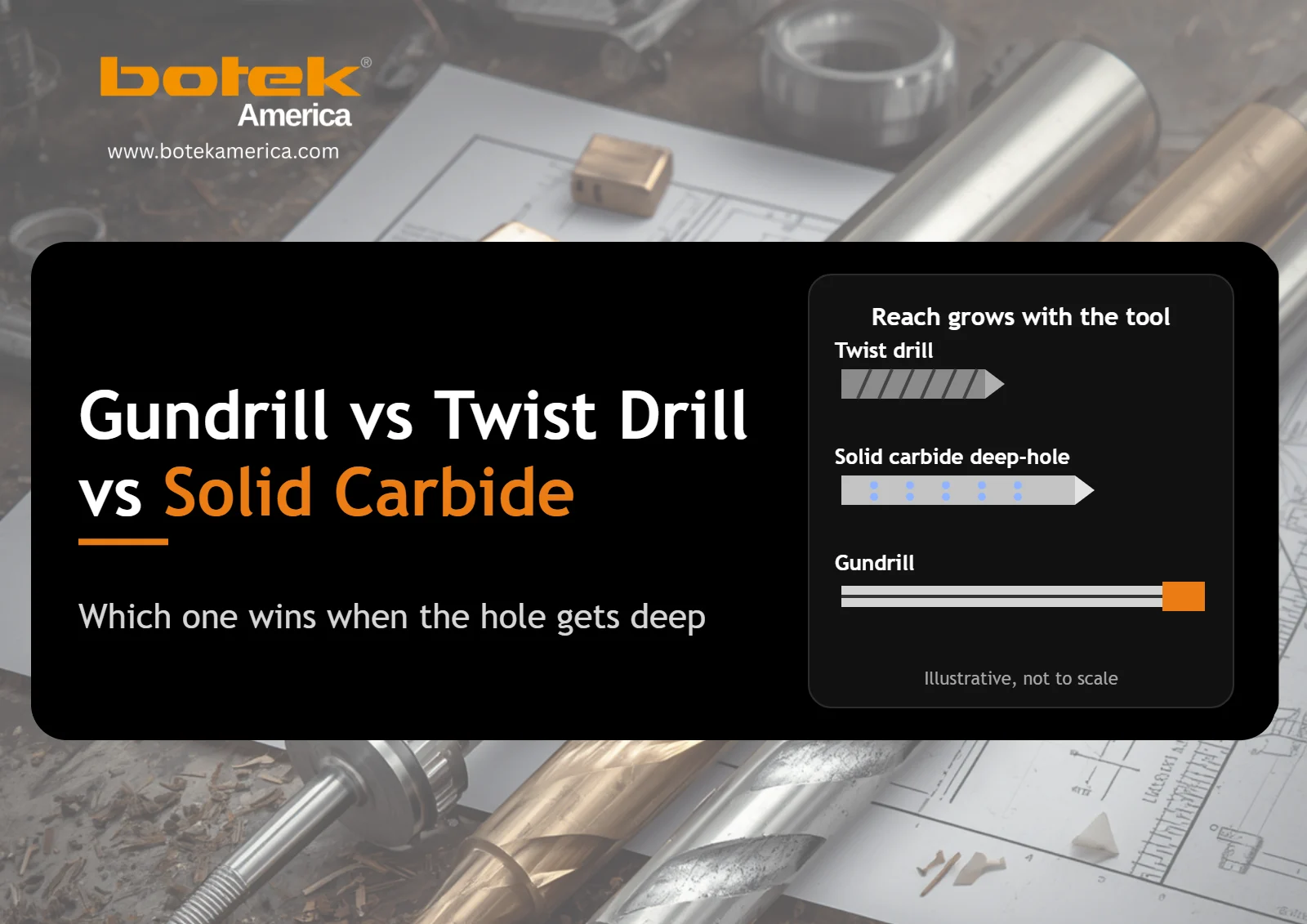
The most common mix-up is buying from a contract shop when you need tools, or the reverse. A contract shop sells drilled parts. A tool supplier sells tools and the know-how to run them. If you are still deciding whether gundrilling is the right process, read our comparison of gundrilling, BTA and ejector drilling first.
What should you send a gundrill supplier before asking for a quote?
A supplier can only recommend a tool for the hole it knows about. Send the same details to every supplier, so the answers can be compared.
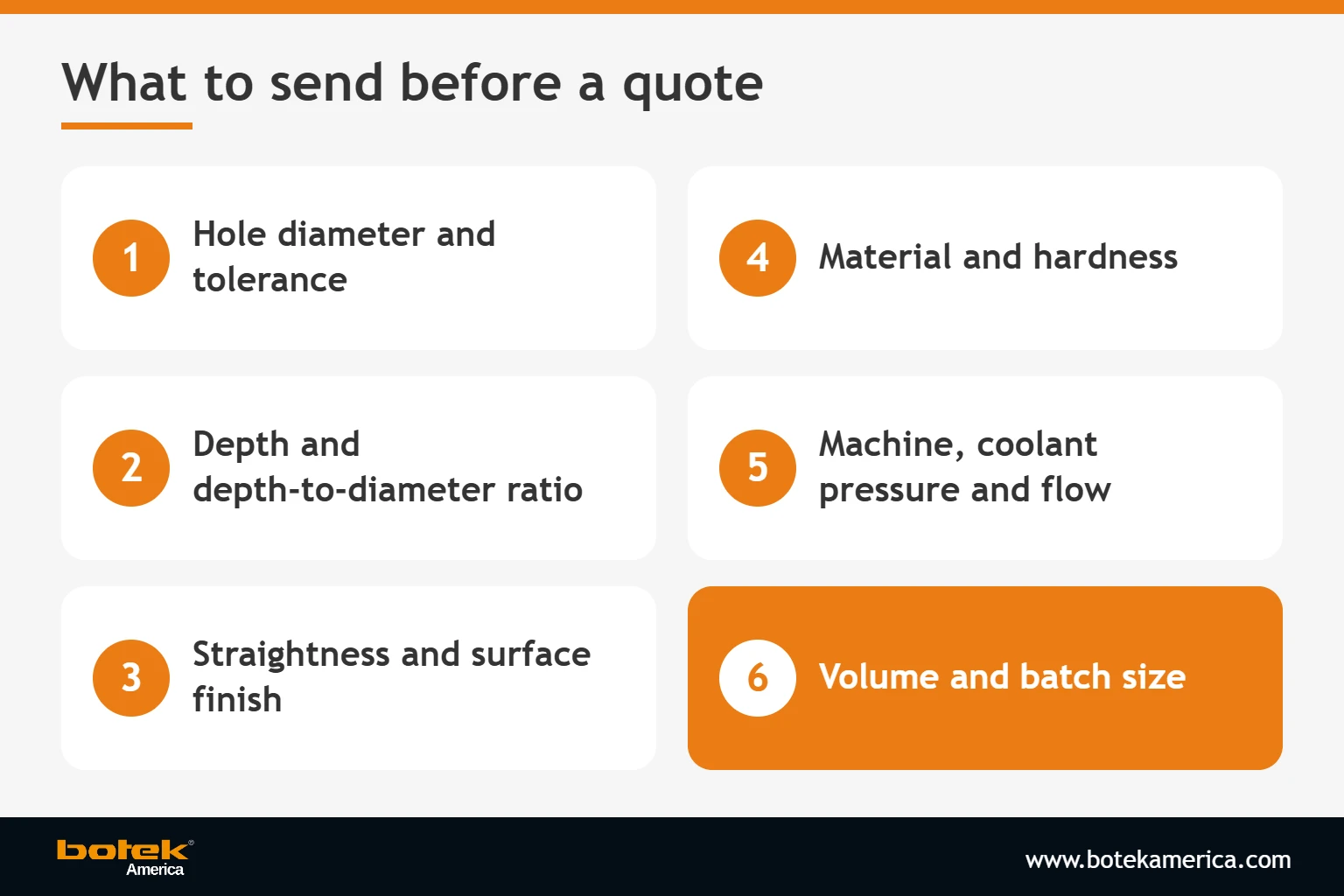
- Hole diameter and tolerance.
- Hole depth, and the depth-to-diameter ratio.
- Required straightness and surface finish.
- Workpiece material and hardness.
- Machine type (machining center, lathe or dedicated deep-hole machine), plus coolant pressure and flow.
- Annual volume and batch size.
- Entry and exit conditions, such as a flat entry surface or a cross hole.
Depth ratio is the first screening question. Cutting Tool Engineering reported in 2016 that straightness, chip packing and tool failure become concerns beyond roughly 10 to 20 diameters of depth, and that shops begin to consider a dedicated deep-hole machine somewhere between 20:1 and 40:1. A supplier that ignores your depth ratio is guessing.
The 10 criteria for choosing a Gundrill supplier
Work through the criteria in order. The first three screen out suppliers that cannot make the tool. The rest decide how well it is supported once it arrives.
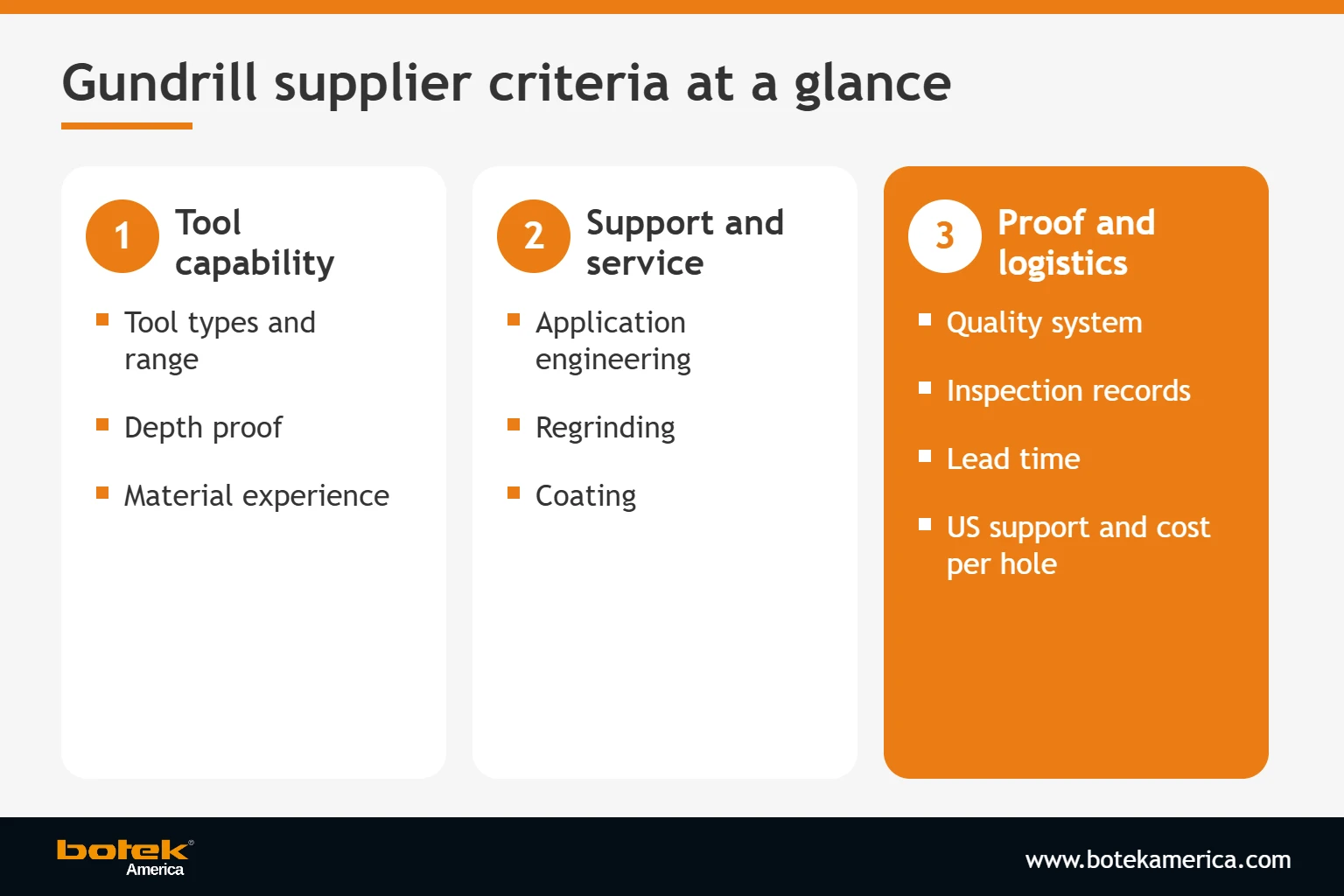
Tool capability: range, depth, and materials
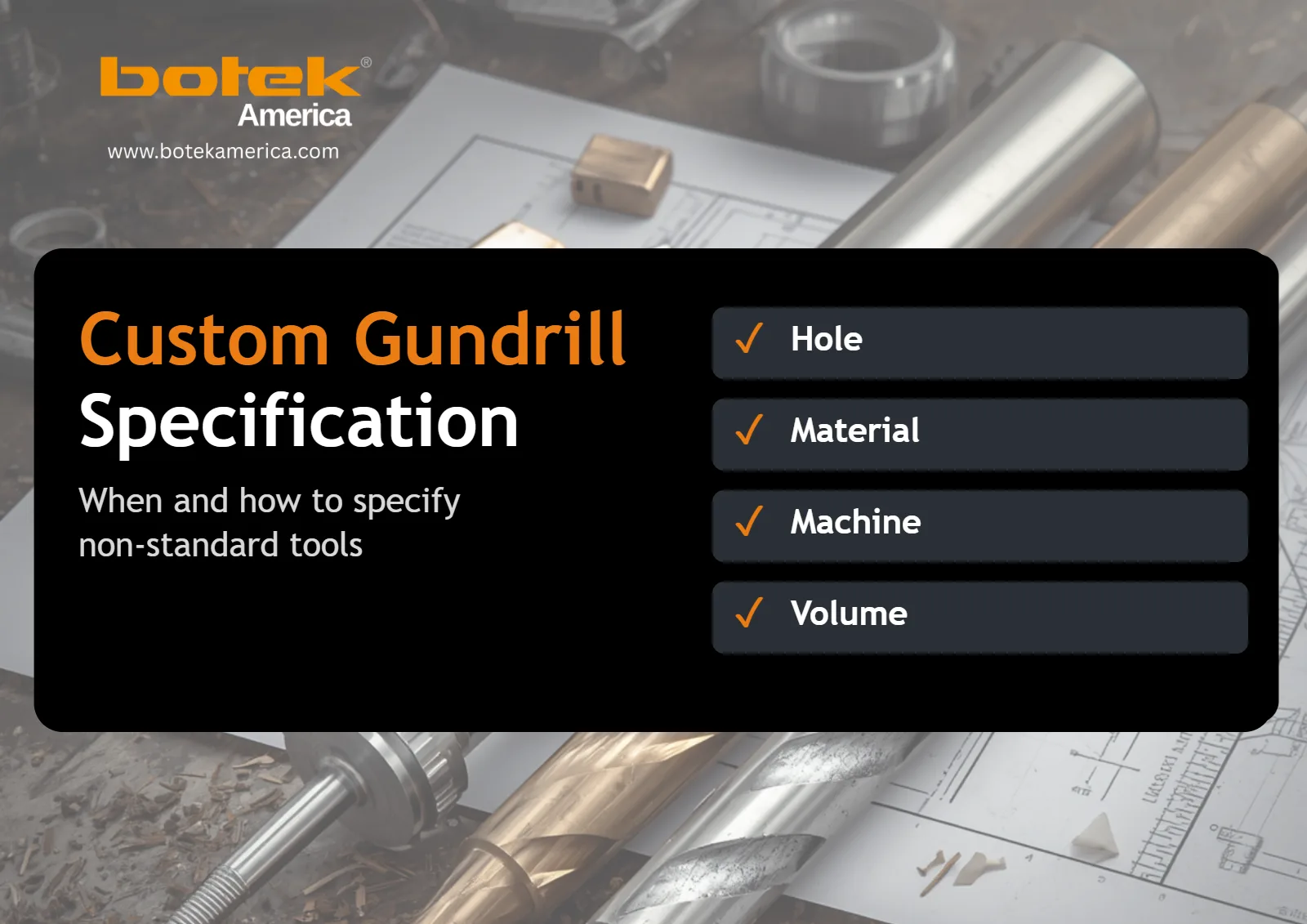
1. Tool types and diameter range. Ask which single-flute, twin-fluted, solid carbide and indexable styles the supplier offers, and the diameter range for each in millimeters and inches. Match the answer to your hole, including any step or counterbore. A catalog range may not hold for a special tool, so ask about special tools separately. Our guide on how to choose a gundrill and our page on custom gundrill specification cover what to define first.
2. Depth proof. Ask for the greatest depth-to-diameter ratio the supplier has run in a hole like yours, and on what kind of machine. A ratio reached on a dedicated deep-hole machine is a different claim from the same ratio on a machining center. Get the figure in writing, with the machine type and coolant pressure beside it.
3. Material experience. Stainless steel, titanium and nickel alloys call for different geometry and cutting values than ordinary steel. Ask what the supplier recommends for your alloy and why. A supplier that answers with a general claim of experience, and no tool or setting, has not answered.
Support and service: engineering, regrinding and coating
4. Application engineering. Ask who reviews your drawing, machine and coolant before the tool ships, and whether that person will set starting cutting values and support a trial. A named role is a better answer than a general promise of support.
5. Regrinding. Ask whether regrinding is done in house or sent out, which tool types and diameters it covers, and whether the supplier regrinds tools from other makers. A regrinder usually needs the exact nose grind of a tool it did not make, so ask what data to send. A tool that is out for regrinding is not in your machine, so ask for turnaround in writing.
6. Coating. Ask whether coating is offered, whether it can be applied to reground tools or only to new ones, and when the coating has to be specified. If coating is only available on new tools, it must be chosen at the time of order.
Proof and logistics: quality, lead time, US support and cost
7. Quality system. Ask for the certificate. ISO 9001:2015 is a requirements standard for quality management systems and applies to any organization. IAQG 9100, the standard behind AS9100, adds requirements for aviation, space and defense on top of an ISO 9001 system. Check that the certificate covers the site that makes or regrinds your tool, and when it expires. A certificate shows a system exists, not that your tool was inspected.
8. Tool and hole inspection. Ask how the supplier checks tool diameter, runout and geometry before shipping, and what it measures on trial holes: diameter, straightness and finish. Ask for a sample inspection report from a job like yours.
9. Lead time and availability. Ask for separate lead times for a standard tool, a custom tool, a regrind, a recoat and an emergency replacement. Ask which of them are firm and what happens when a date slips. Put the answers in the purchase order, not only in an email.
10. US support and cost per hole. For a U.S. shop, ask who answers in your time zone, where the regrind center is, and whether tools and documents use inches as well as millimeters. Then compare suppliers by cost per good hole, not by tool price: tool price, regrind cost, holes per tool, scrap and machine downtime all count.
Gundrill supplier scorecard
Use one row per criterion and one column per supplier. Score each cell 0 for no evidence, 1 for a verbal claim and 2 for written evidence, then weight the rows that matter most to your part. The scale is a suggestion, not a standard.
| Criterion | Evidence to request | Red flag |
|---|---|---|
| 1. Range | Range by tool type, in mm and inches | Only a catalog headline |
| 2. Depth | Ratio, machine type and coolant pressure in writing | A ratio with no machine named |
| 3. Material | Tool and settings for your alloy | “We drill everything.” |
| 4. Engineering | Named reviewer and trial support | Sales contact only |
| 5. Regrinding | Scope, tool data needed, turnaround | No stated process |
| 6. Coating | New or reground tools, when to specify | Coating promised, terms unclear |
| 7. Quality | Certificate with scope and expiry | Logo with no certificate |
| 8. Inspection | Sample inspection report | No measurement method |
| 9. Lead time | Separate dates by service, in writing | One “standard” lead time |
| 10. Cost and support | Cost per good hole, local contact | Price per tool only |
For a broader checklist that covers all deep-hole processes, see our 10-point deep hole drilling tool supplier checklist.
How do you test a Gundrill supplier before you commit?
A written answer is a promise. A trial is evidence. Agree on the test before the tool is made, so nobody argues about the result afterward.
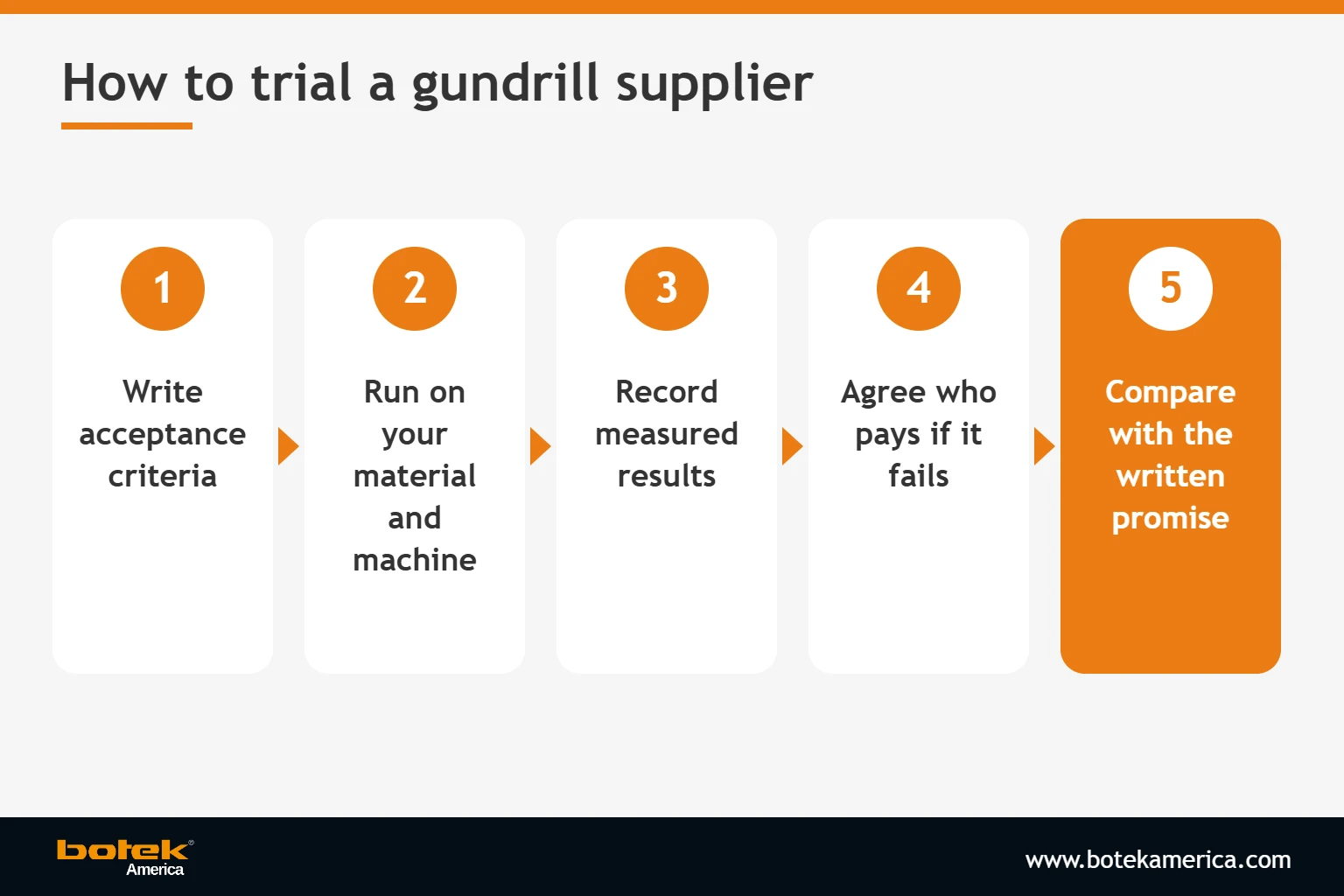
First, write the acceptance criteria: holes drilled per tool, hole diameter, straightness, surface finish and cycle time. Second, run the tool on your own material and machine, at the coolant settings the supplier specifies. Third, record measured results, not impressions. Fourth, agree in advance who pays if the trial fails. Finally, compare the numbers with what the supplier promised in writing.
Ask the supplier to state the guidance requirements for your setup. On a CNC machine without a guide bushing, the same Cutting Tool Engineering article describes a pilot hole 1 to 2 diameters deep and 0.0005 to 0.0010 in. (0.013 to 0.025 mm) larger than the drill. A supplier that knows gundrilling will have a view on this before you ask.
Want a second opinion on your shortlist? Talk to a botek® America specialist.
How does botek® America compare with this checklist?
botek® America publishes this guide, so read this section as a supplier describing itself. Everything below comes from botek® America’s own web pages. Confirm each point in writing, as you would with any supplier.
Range. botek® America’s single-flute gundrill and twin-flute gundrill pages list diameter ranges by tool type, so check the range for your tool type and confirm it in writing. The gundrilling page gives no diameter range for solid carbide drills, so ask for it.
Engineering and trials. The process optimization page says application engineers analyze and improve your process in your facility. The customer testing page describes tool development tailored to an application, and the gundrilling page says process validation is available at the Roselle, Illinois facility before production.
Regrinding and coating. Regrinding is done in house in Roselle, and the regrinding page says third-party tools with the same specifications can be reground when you provide the exact nose grind information. Coating is available on new tools only and has to be specified when the tool is ordered. The pages give no regrind turnaround beyond “short delivery times”.
Not stated on these pages: quality certifications, regrind turnaround in days, and U.S. stock levels. Ask botek® America for each of them, as you would ask any supplier.
Frequently Asked Questions
Can a supplier regrind gundrills made by another maker?
Sometimes. It depends on the tool type, the diameter and the data the regrinder has. A regrinder needs the exact nose grind of a tool it did not make, so ask what to send before you ship anything. botek® America’s regrinding page says it regrinds third-party tools with the same specifications when that information is provided.
Do I need AS9100 from a gundrill supplier?
Only if your customer or contract requires it. ISO 9001:2015 is a general quality management system standard. AS9100, based on IAQG 9100, adds requirements for aviation, space and defense on top of ISO 9001. Check the flow-down terms on your purchase order.
What is the difference between a gundrill, a gun drill and gundrilling?
Gundrill and gun drill are two spellings of the same tool, a drill that carries coolant to the cutting edge through the tool and is used for deep, straight holes. Gundrilling, or gun drilling, is the process. Suppliers use both spellings, so search for both.
Next step
Pick your ten criteria, send the same hole details to each supplier, and score what comes back. If botek® America is on your shortlist, upload your drawing and ask for advice on your application.
Searching for a gundrill supplier in the U.S.? See botek® America’s single-flute gundrills and twin-flute gundrills, or read how the gundrilling process works.