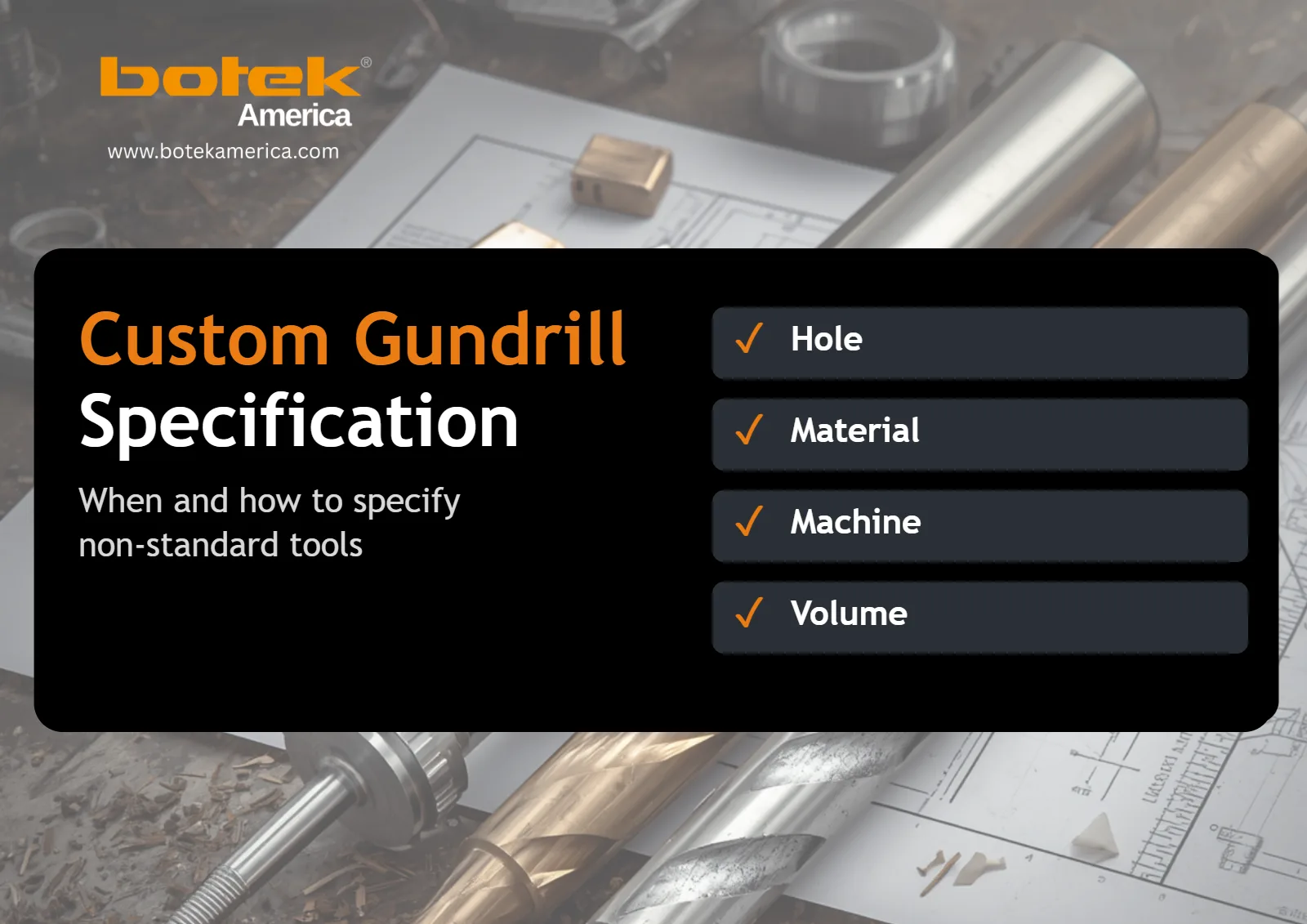
A custom gundrill specification is the set of facts a tool maker needs to design a tool for your hole instead of picking one from a catalog. Standard tools fit many jobs. They stop fitting when the hole, the material or the machine falls outside normal limits. This guide shows when a non-standard tool makes sense, what to put in the specification, and how to compare what you get back. If you already have a part in mind, ask botek America about special solutions.
When Should You Specify a Custom Gundrill?
Start with a standard tool from the standard gundrill range and move to a custom one only when a standard tool cannot meet a clear requirement. A custom tool costs engineering time, so the reason should be specific.
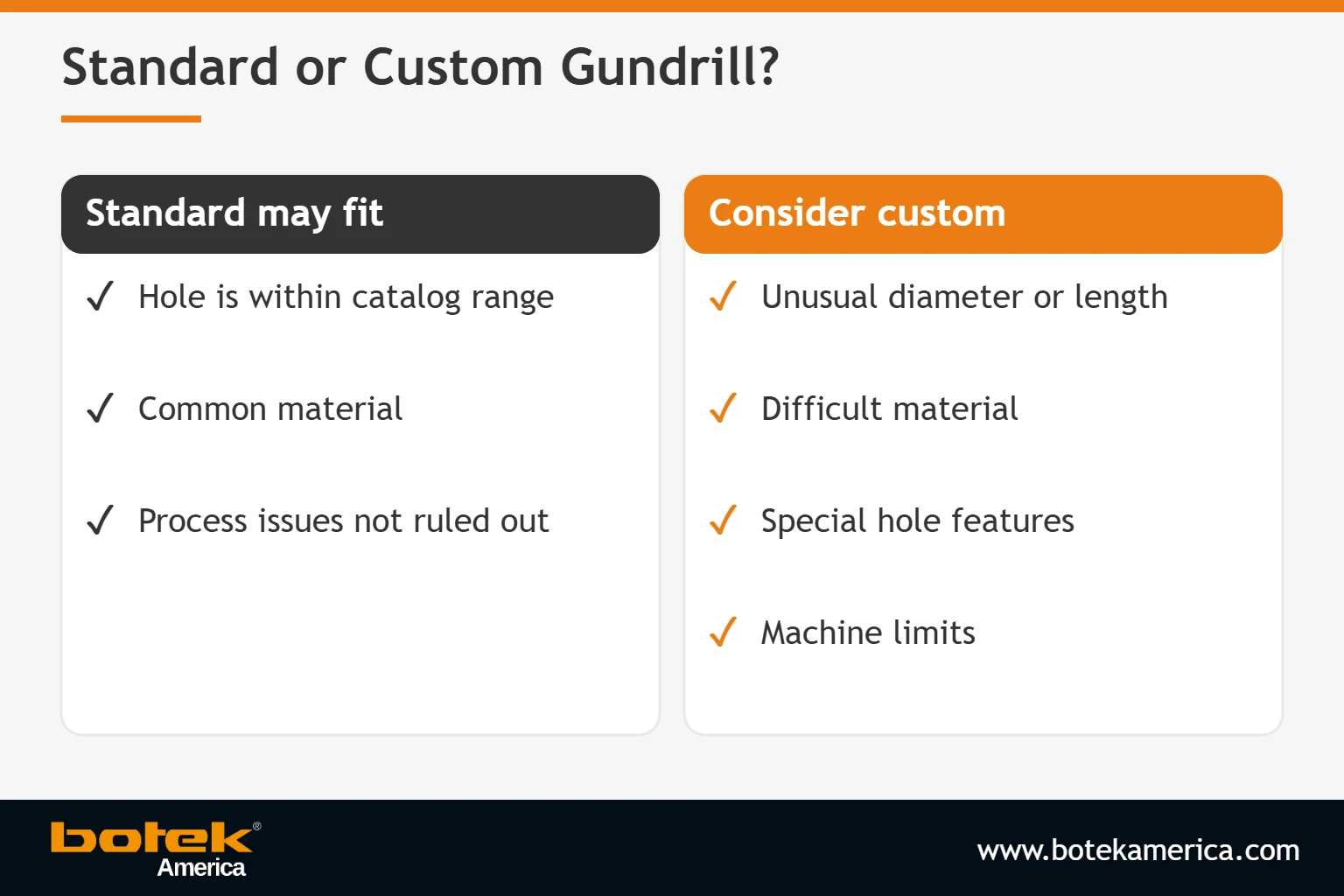
Signs a Standard Tool Is Not Enough
- Unusual diameter or length. The hole falls outside the catalog range.
- Difficult material. Standard geometry keeps chipping, sticking or wearing early.
- Special hole features. The hole needs a specific bottom shape, a step, or a cross-hole breakthrough.
- Machine limits. Your coolant pressure or spindle setup cannot run the standard tool well.
- Production targets. You need predictable tool life across a large run, not a good first hole.
Signs You Should Not Go Custom Yet
If a standard tool fails because of low coolant pressure, a worn bushing or a poor pilot hole, a custom tool will fail the same way. Fix the process first. Our posts on gundrill tool breakage and hole drift help you rule these out.
What Counts as a Non-Standard Gundrill?
A non-standard gundrill changes at least one thing a catalog tool fixes in advance: geometry, tool material, coating, length or head design.
What Can Be Changed
botek America lists single-flute gundrills, twin-fluted drills and solid carbide drills, and offers special solutions for applications outside the standard range. The main levers are point geometry, carbide grade, coating, overall length and shank design. Which of these can change for your tool is a question for application engineering.
Custom Tool or Custom Process?
Sometimes the answer is not a new tool but a new process. A BTA or ejector setup may suit a larger hole better than any gundrill. Read gundrilling vs BTA vs ejector drilling before you commit to a gundrill design, and see types of deep hole drilling tools for the tool families.
What Goes Into a Custom Gundrill Specification?
A good specification answers the questions a tool designer would otherwise have to ask. The more complete your custom gundrill specification is, the fewer rounds of back-and-forth you need.
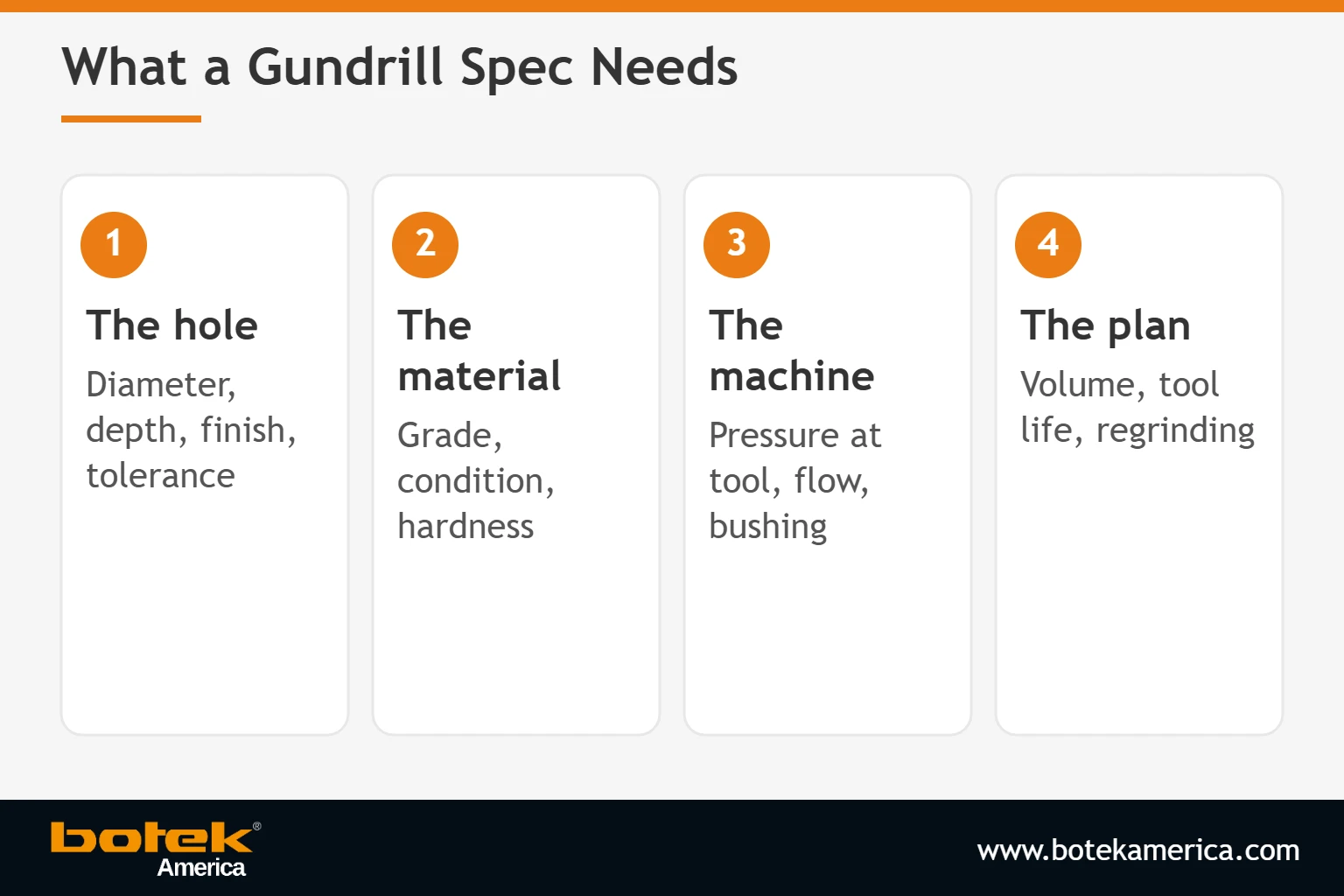
The Hole in Your Custom Gundrill Specification
- Diameter and diameter tolerance.
- Depth, and whether the hole is blind or through.
- Hole bottom shape for blind holes.
- Straightness, roundness and surface finish requirements. State finish as an Ra value, with the measuring method.
- Cross-holes, steps or interrupted surfaces.
Write tolerances the way your drawing does. ASME Y14.5 defines the symbols and rules for stating tolerances on engineering drawings, so a shared standard avoids misreading.
The Material
- Alloy or grade, and condition such as annealed or hardened.
- Hardness range and any known inclusions.
- Whether the material is a forging, casting or bar.
The Machine and Coolant
- Machine type and spindle or workpiece rotation.
- Coolant type, pressure at the tool and flow rate. Measure these instead of reading the pump label.
- Drill bushing or pilot hole setup.
The Production Plan
- Parts per year and batch size.
- Target cycle time and tool life.
- Regrinding plan. Ask about regrinding early, because tool design affects how many times a tool can be reground.
You can send these details through the application form, or upload your drawing if you have one ready.
How Does a Custom Gundrill Specification Move Through the Process?
The steps below are a sensible sequence, not a promise of timing. Ask any supplier to confirm each stage and its lead time in writing.
From Request to Release
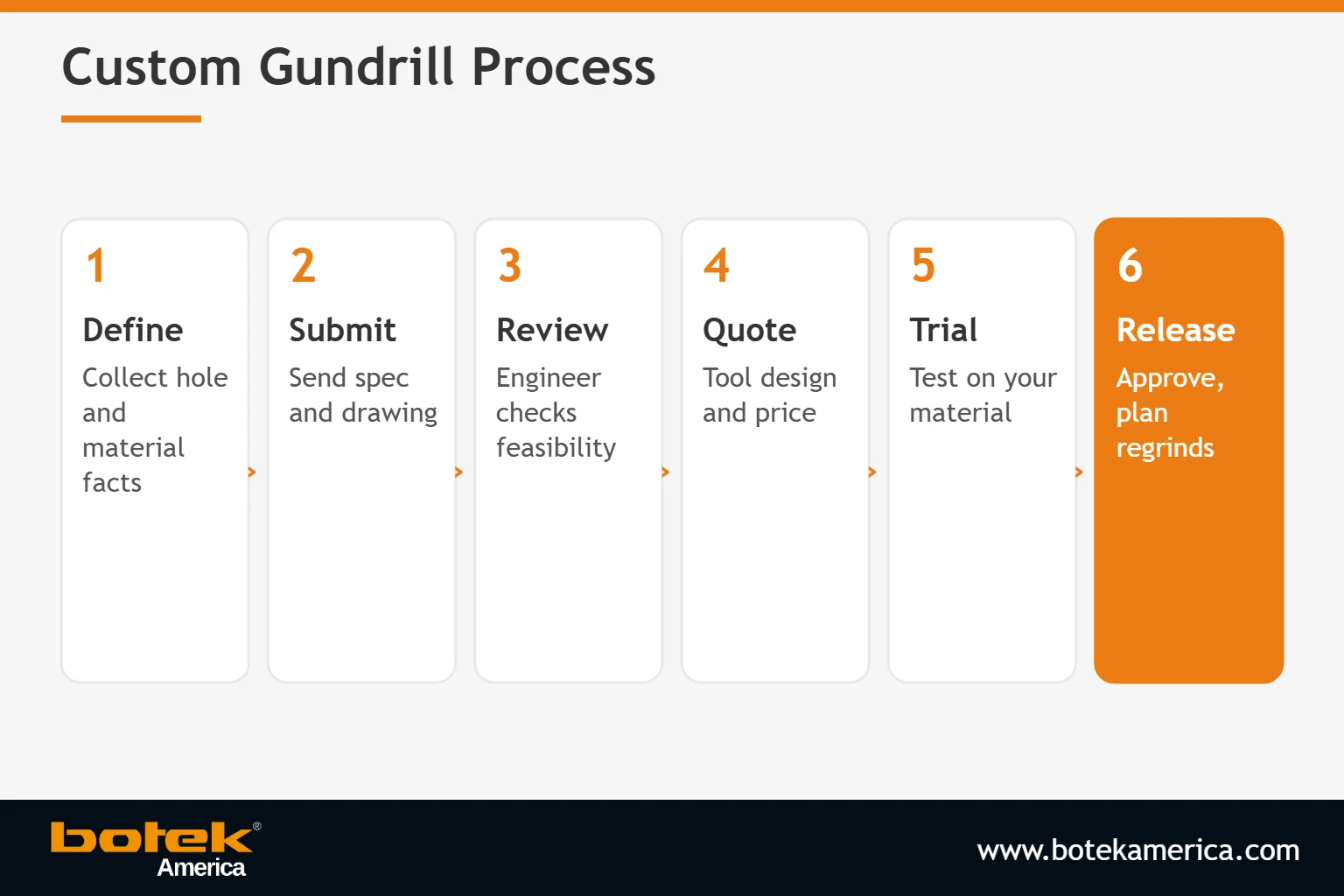
- Define. Collect hole, material, machine and volume details.
- Submit. Send the specification with your drawing.
- Review. An application engineer checks feasibility and asks follow-up questions.
- Quote and design. You receive a proposed tool and a price.
- Trial. Test the tool on your material before production.
- Release. Approve the tool and set a regrinding plan.
Why a Trial Pays Off
A trial exposes mistakes while they are still cheap. botek America offers customer testing and in-house trials at its Roselle, Illinois facility, and an express production line for time-sensitive needs. Confirm current availability and scope on those pages or with the team.
What Drives the Cost of a Custom Gundrill?
No honest article can quote a price for a tool it has not seen. It can show what moves the price, so you can ask better questions.
Cost Drivers You Can Control
- Design effort. A new geometry takes engineering time. A small change to a proven design takes less.
- Tool material and coating. Both change the unit price and, often, the tool life.
- Length and diameter. Longer, smaller tools are harder to make and to straighten.
- Quantity. Setup cost spreads over more tools in a larger order.
- Trial scope. A trial adds cost now and removes risk later.
Judge a Custom Gundrill Specification by Cost per Hole
Divide total tool spend by the holes produced. Here is illustrative arithmetic, not a quote or a forecast. If a standard tool costs 100 units and drills 500 holes before it fails, it costs 0.20 units per hole. If a custom tool costs 250 units and drills 2,000 holes, it costs 0.125 units per hole. The custom tool wins even at a higher price, but only if the holes are real and the tool life is proven. This is why a trial matters. Our post on deep hole drilling process optimization covers how to track the numbers.
Hidden Costs of Staying Standard
Scrapped parts, machine downtime after a tool breaks and extra inspection rarely appear on the tool invoice. Add them to the comparison before you decide that a standard tool is cheaper.
How Do You Compare Custom Tool Proposals?
Price per tool is only one number. A cheaper tool that fails sooner costs more per hole. Compare proposals on the same terms.
Questions to Ask Every Supplier
- What problem does each design change solve, and how will you know it worked?
- What tool life, hole quality and straightness is the proposal based on, and what data supports it?
- Can the tool be reground, and by whom?
- Is a trial included, and what happens if the trial misses its targets?
- Who supports the process after delivery?
For a wider checklist, use how to choose a deep hole drilling tool supplier. The botek group also publishes its product line catalog, which helps you see which tool families already exist before you ask for something new.
Frequently Asked Questions
How long does a custom gundrill take to make?
It depends on design complexity, material and shop load, so no honest answer is universal. Ask for a written lead time as part of the quote, and ask whether an express option applies to your case.
Do I need a drawing to start?
A drawing helps, but you can start with hole size, depth, material and machine details. Send what you have through the application form and an engineer will list what is missing.
Can a custom gundrill be reground?
Usually, but the number of regrinds depends on the tool design and wear. Raise it during design so the tool is made with regrinding in mind.
Ready to Discuss Your Application?
If a catalog tool does not fit your hole, start with the facts above and talk to a specialist. Submit your drilling application, contact botek America or call (630) 893-5300. A short review often shows whether you need a custom tool or just a process change.