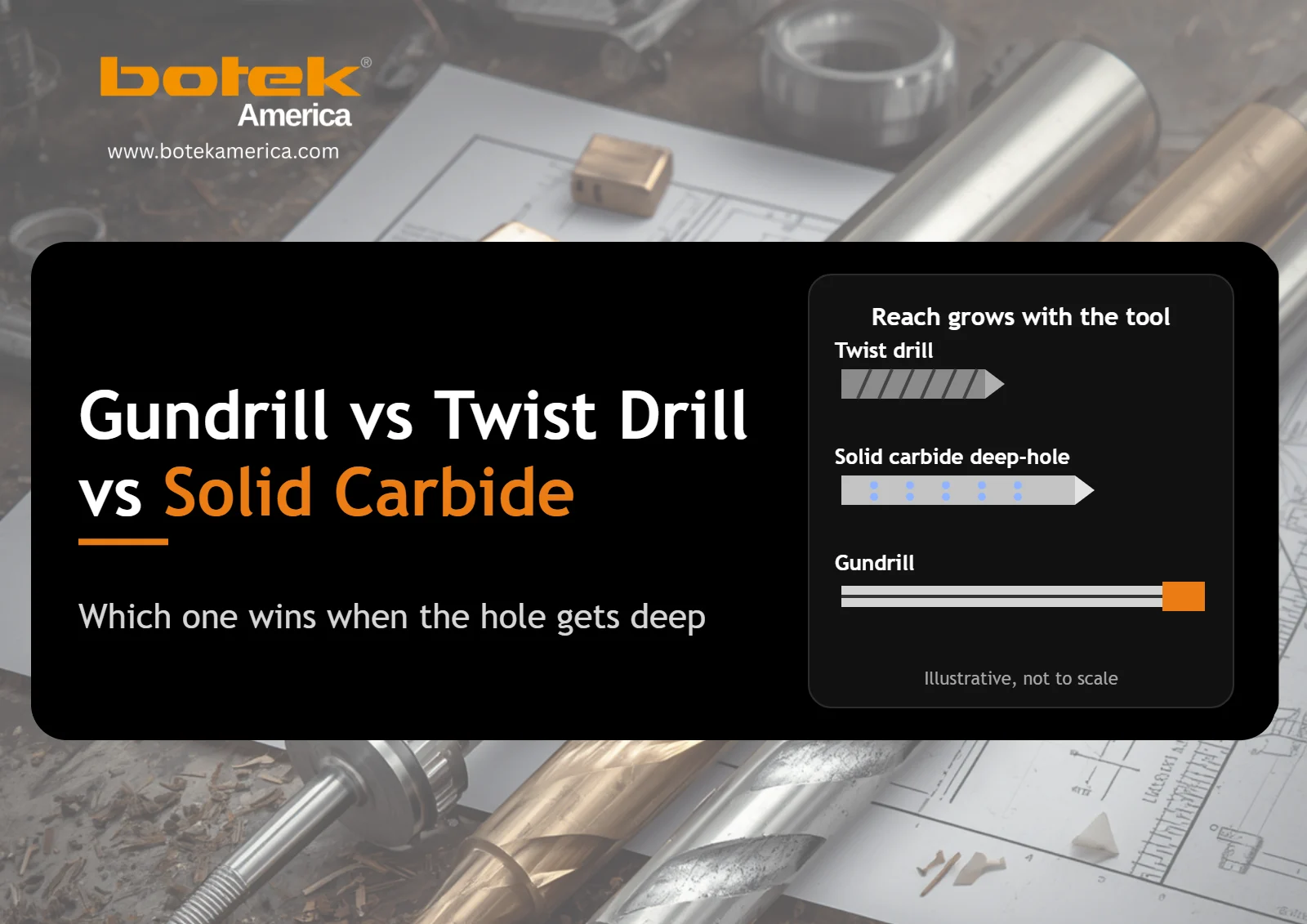
Gundrill vs twist drill is the question you meet when a twist drill can start a deep hole but cannot finish it straight, clean and in tolerance.
Use a twist drill for shallow holes, a solid carbide deep-hole drill for moderate depth on a CNC machine with through-spindle coolant, and a gundrill when depth, straightness and finish matter most and the machine can deliver coolant at pressure.
Past a few diameters of depth, an ordinary drill struggles to clear chips, holds heat at the tip and wanders off line. The result is a drifted hole, a jammed tool, a broken drill or a scrapped part with hours of machining in it. Choosing between a gundrill, a twist drill and a solid carbide deep-hole drill comes down to depth, finish, straightness, machine and coolant.
This guide compares gundrill vs twist drill vs solid carbide on those points, so you can pick before the first hole. Send your hole size, depth and material to a botek® America application engineer and get a second opinion on the choice.
Gundrill vs Twist Drill: Why Deep Holes Defeat Ordinary Drills
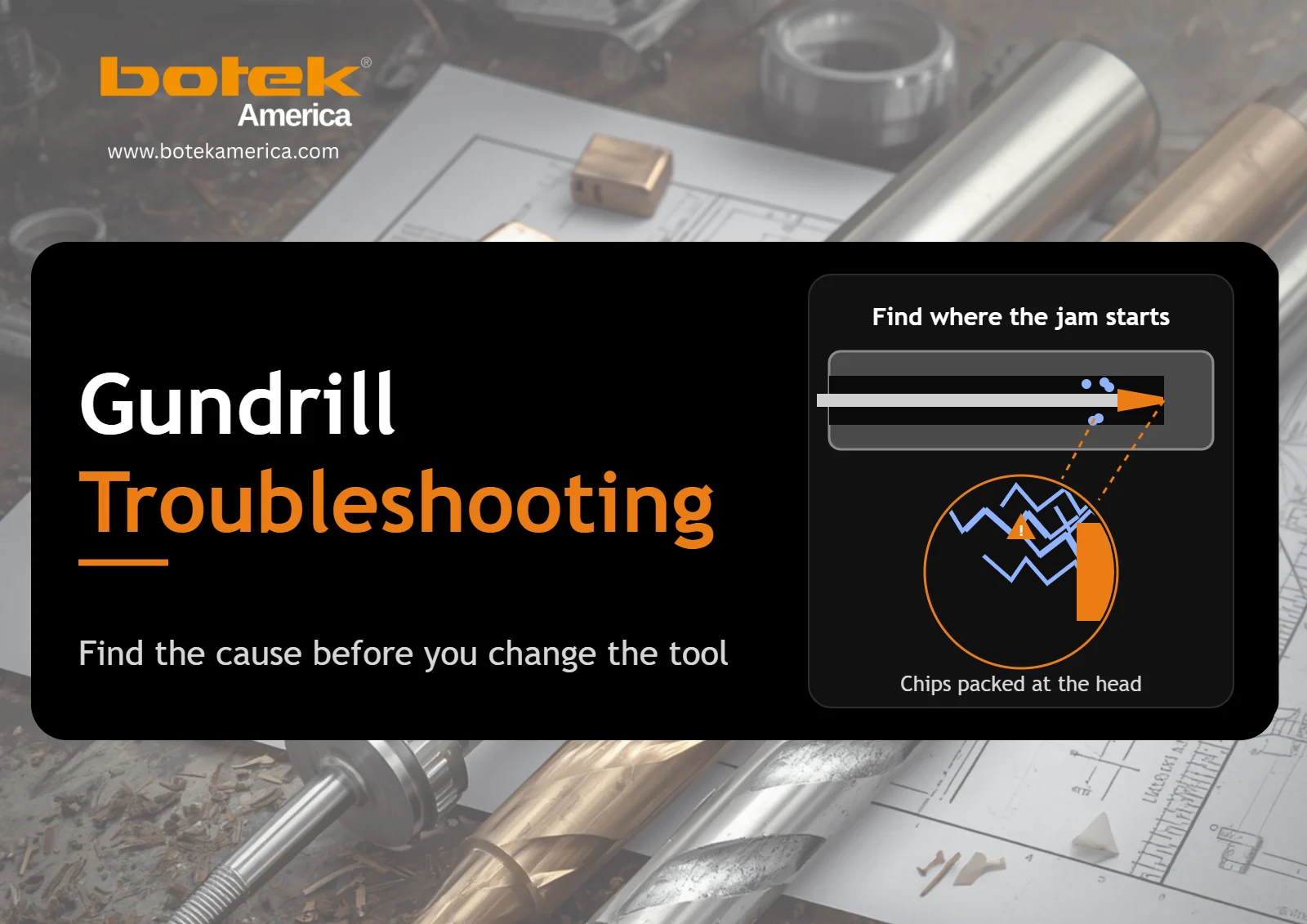
Chips Have Nowhere to Go
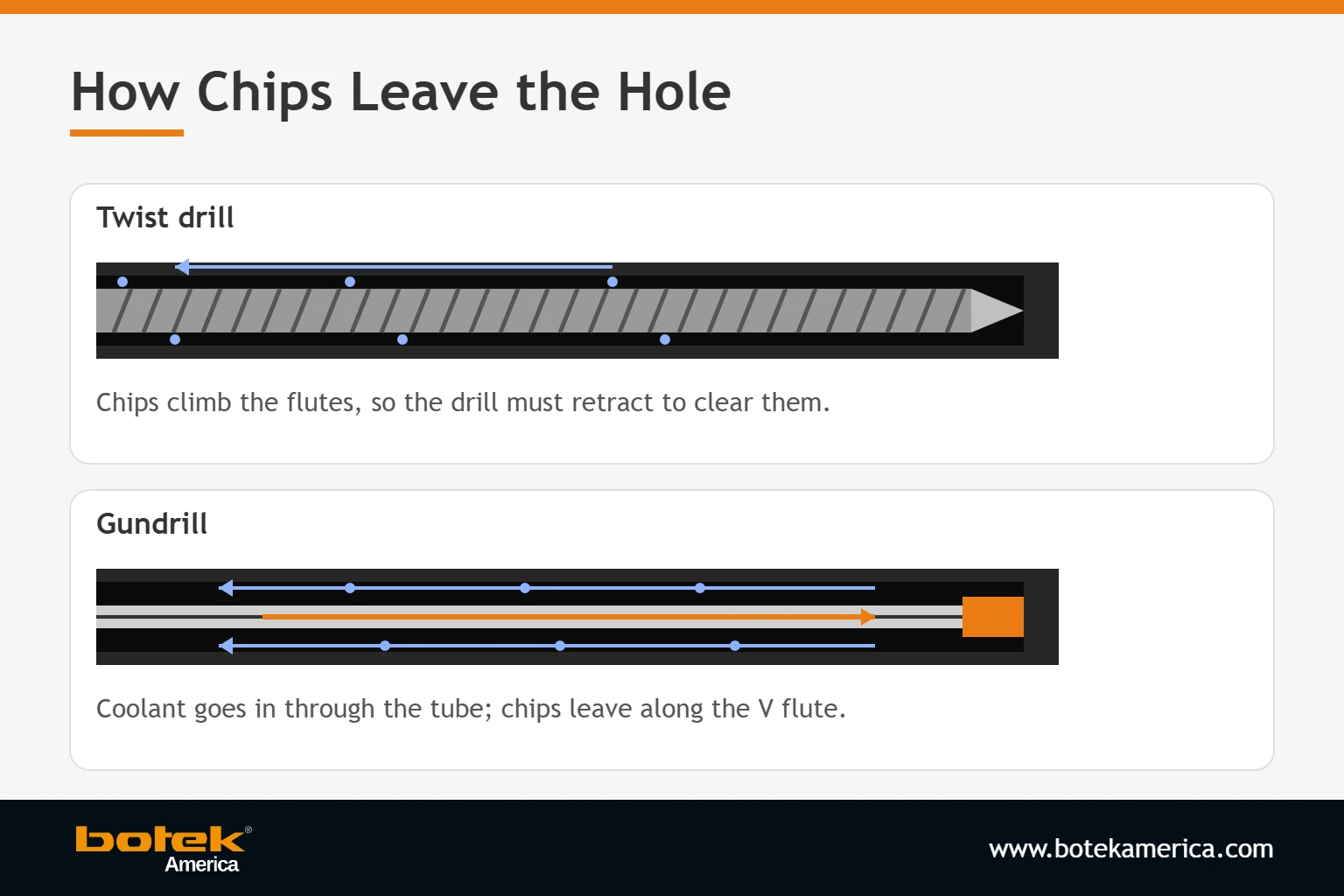
A twist drill has two flutes that carry chips back up the tool. As the hole deepens, chips travel further, and they can pack in the flutes and recut the wall. The usual remedy is to retract and clear, which costs cycle time and can chip the edge on re-entry.
Heat and Guidance Work Against Straightness
Without support along the bore, a long, slender tool can deflect, and a hole can leave the line it started on. That drift shows up as a straightness or positional error at the exit, often where the part is most valuable. Our guide to gundrill hole drift covers the causes.
Gundrill vs Twist Drill: How the Tools Differ
How a Twist Drill Works
A twist drill cuts with two edges and clears chips through two helical flutes. It runs on almost any drill press, mill or lathe. In a gundrill vs twist drill comparison, simplicity is its strength while the hole stays shallow.
How a Gundrill Works
A gundrill has a single cutting edge on a carbide head, two guide pads and a hollow tube with one V-shaped flute. Coolant goes in through the tube to the head and returns along the flute, pushing chips out. The guide pads burnish and support the bore. Our guide to how gundrilling works explains each part.
Where the Solid Carbide Deep-Hole Drill Fits
A solid carbide deep-hole drill is a twist-style tool made from carbide, with internal coolant holes. It extends what a twist-style drill can do and usually runs on a CNC machine with through-spindle coolant. It is still a twist-style tool, so its depth limit is lower than a gundrill’s, and the exact limit depends on the tool, material and coolant pressure. Ask the tool maker for the figure at your diameter.
Gundrill vs Twist Drill vs Solid Carbide: Side by Side
The gundrill vs twist drill differences are mostly qualitative, so the table keeps them side by side. botek® America’s gundrilling guide states that a conventional twist drill is limited to roughly 5:1 to 8:1 depth to diameter, and that a CNC machining center can run a gundrill to roughly 20 to 40:1. Treat these as botek® America’s published guidance, not universal limits.
| Factor | Twist drill | Solid carbide deep-hole drill | Gundrill |
|---|---|---|---|
| Chip removal | Two flutes, frequent retracts | Two flutes with internal coolant | Single V flute with coolant under pressure |
| Depth capability | Shallow holes | Moderate depth | Deepest of the three |
| Hole straightness | Drifts as depth grows | Better than a standard twist drill | Guide pads support the tool |
| Machine needs | Any drill or mill | CNC with coolant through the spindle | Dedicated machine or CNC with high coolant pressure |
| Tool cost and upkeep | Lowest | Mid range, usually replaced when worn | Higher, but can be reground |
Gundrill vs Twist Drill: How to Decide
Start With Depth and Diameter
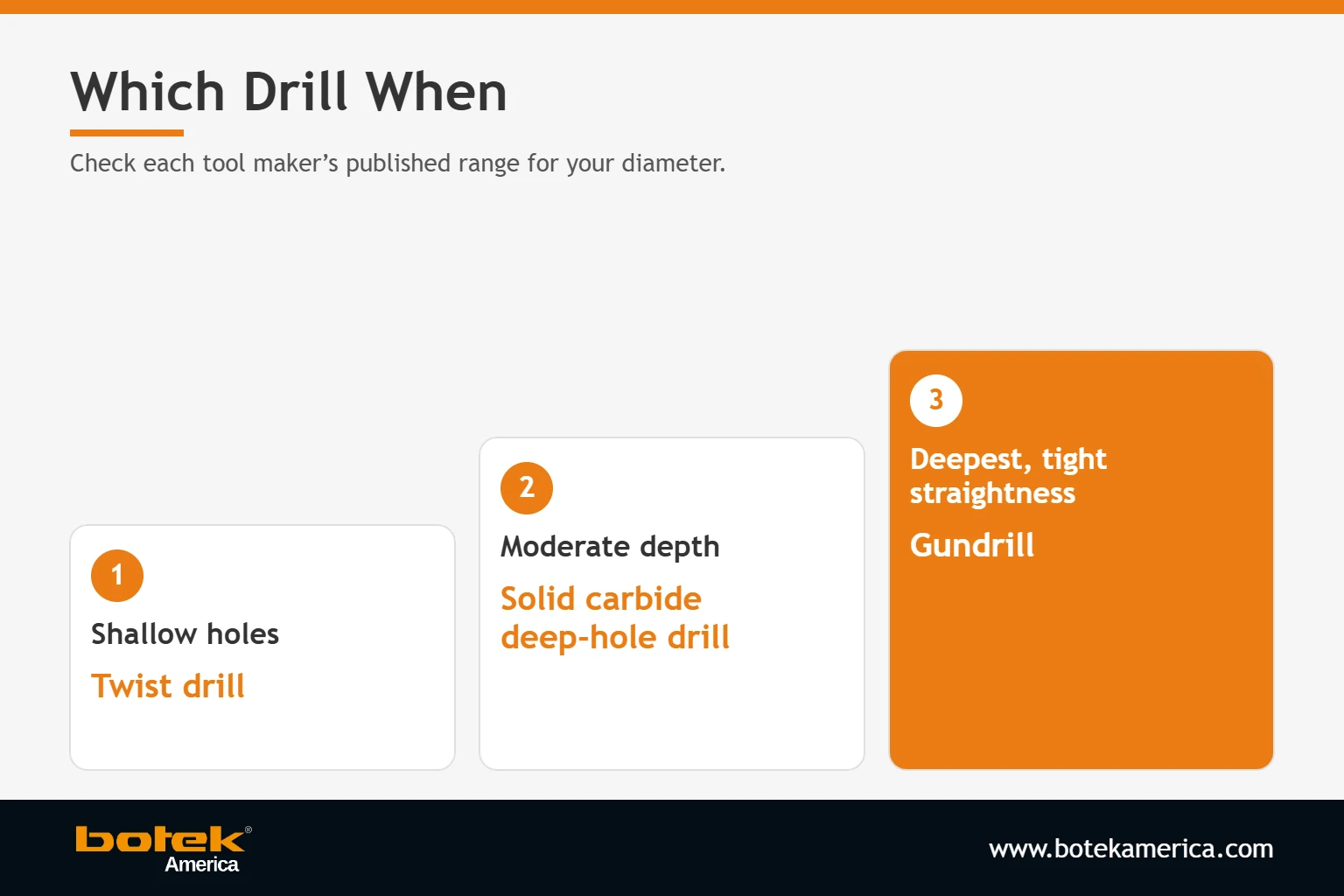
Kip Hanson, writing in Cutting Tool Engineering, reports that depth concerns begin around 10 to 20 diameters and that a dedicated machine is worth considering past 20:1 to 40:1. If depth is only a few diameters, a twist drill is simplest. As the L/D ratio grows, move to a solid carbide deep-hole drill, and for the deepest holes use a gundrill. Because limits vary with diameter and coolant, check each tool maker’s published range.
Check Finish and Straightness
botek® America’s guide says gundrilling achieves a finer finish (Ra) and tighter straightness than twist drilling under optimized conditions. If the drawing calls for a finish a twist drill cannot hold, a gundrill may save a finishing operation.
Check the Machine and the Coolant
A gundrill needs coolant delivered at pressure, measured at the tool. If your machine cannot do that, a solid carbide deep-hole drill may be the practical choice. See why a CNC machine differs from a dedicated machine for deep holes.
Gundrill vs Twist Drill Cost: Count the Whole Process
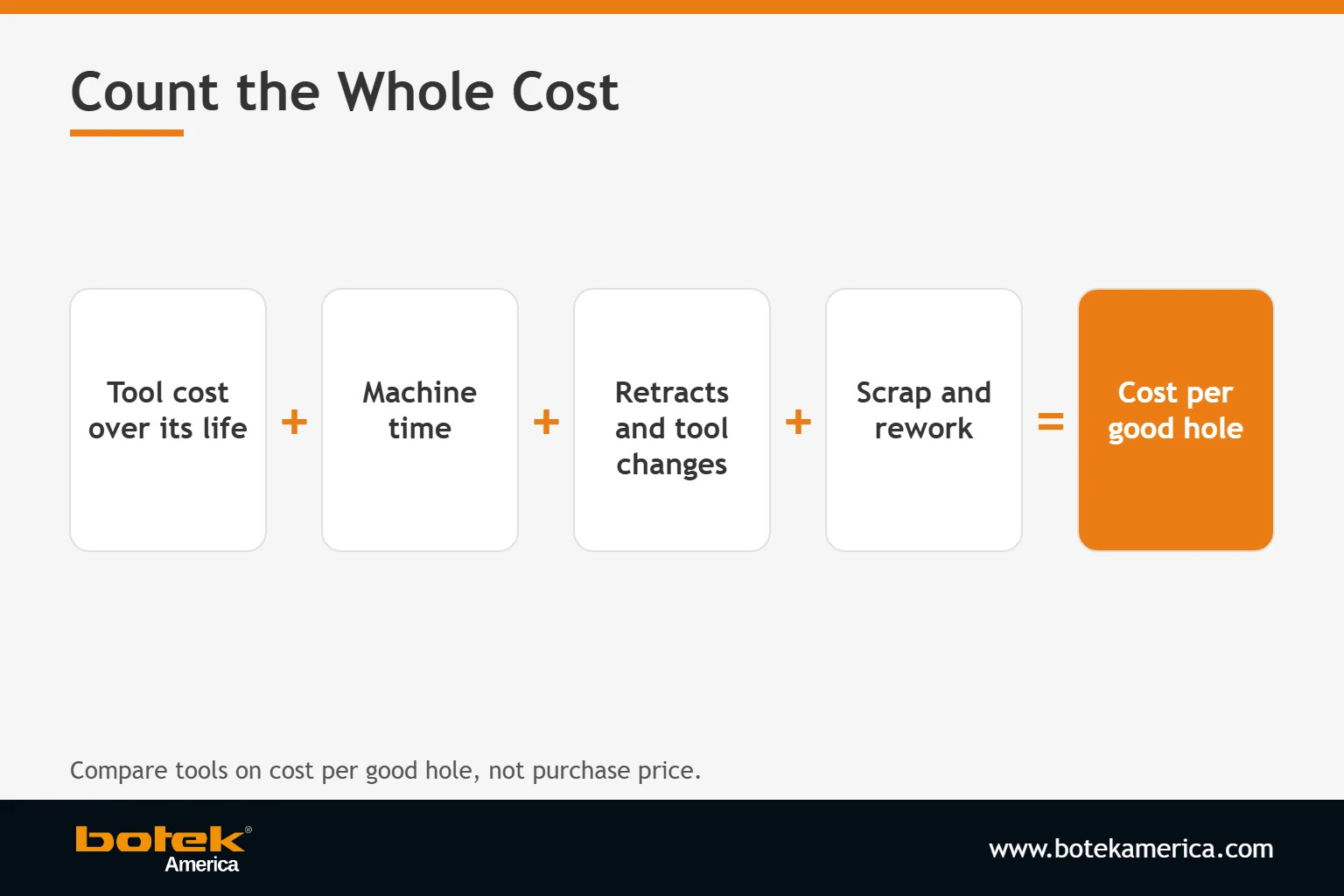
A twist drill costs less to buy, but a deep hole drilled with one can cost more once retracts, scrap and rework are counted. Compare tools on cost per good hole, using your own tool life, machine time and scrap rate. Our guide to regrinding versus buying new tools shows how regrinding changes the tool cost line.
Common Gundrill vs Twist Drill Mistakes
Pecking a Twist Drill and Hoping
Repeated retracts clear chips but lengthen the cycle and do not fix drift. If you are pecking more than you are drilling, the process is telling you the hole is too deep for the tool.
Treating Solid Carbide as a Gundrill Substitute
A solid carbide deep-hole drill extends a twist-style process. It does not replace the guide pads and chip loop of a gundrill when the hole is deep and straightness is tight.
Ignoring Coolant Capability
Both deep-hole options depend on coolant reaching the cutting edge. Check pressure at the tool before you blame the drill.
Comparing on Tool Price Only
Machine time, scrap and tool life decide real cost. Use cost per good hole for the comparison.
When Another Process Beats All Three
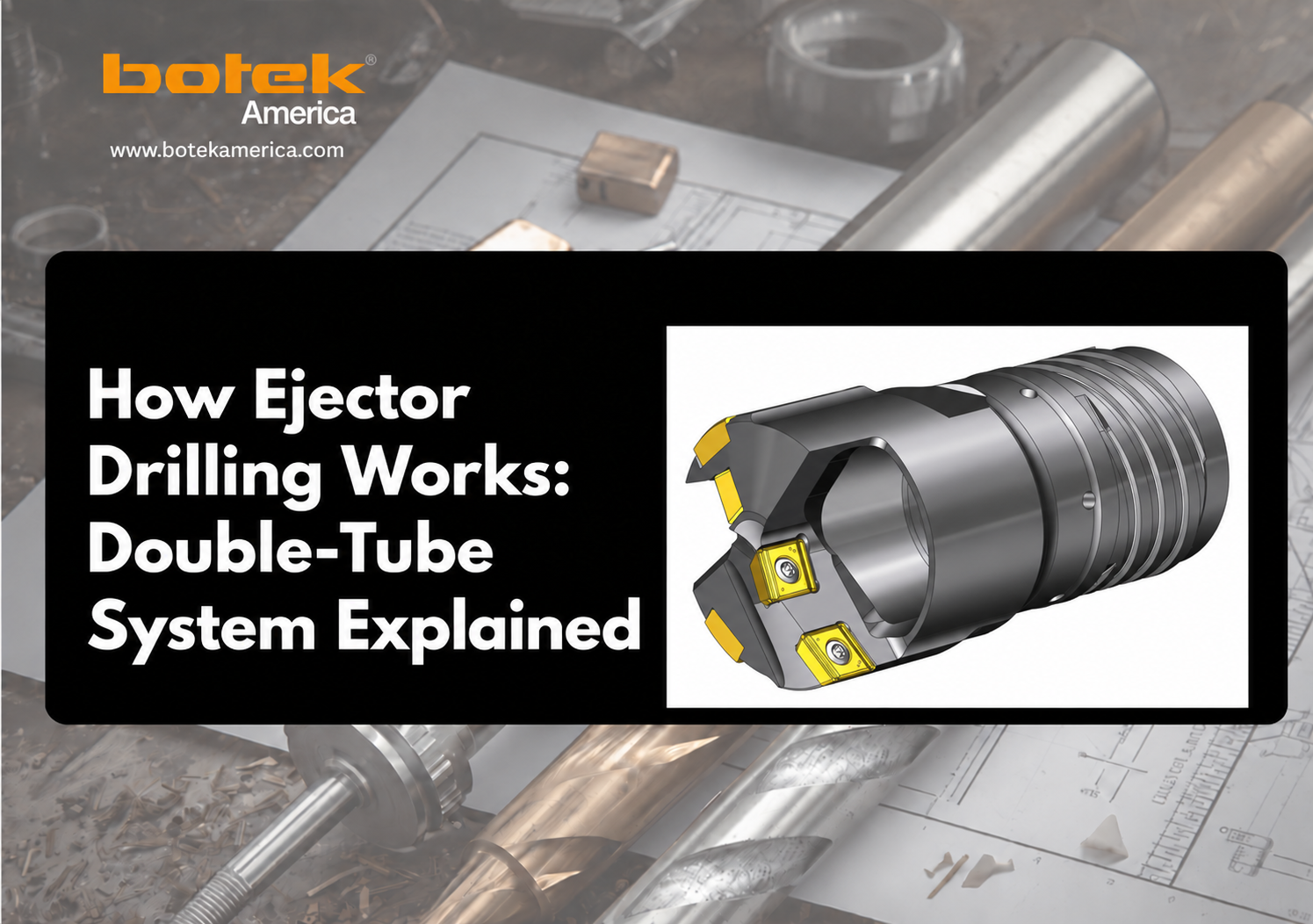
Very large or very deep holes may call for BTA (Boring and Trepanning Association) drilling, which carries chips back through the hollow tube, or for ejector drilling, which uses a double-tube system. Our comparison of gundrilling, BTA and ejector drilling covers that choice.
Gundrill vs Twist Drill: Questions to Ask Before You Switch
- Depth: What is my L/D ratio, and what does the tool maker publish for this diameter?
- Coolant: What pressure and flow reach the tool on my machine?
- Finish: What straightness and Ra does the drawing require?
- Volume: How many holes, and does regrinding change the cost?
- Proof: Can a trial confirm the choice before I commit to a batch?
Frequently Asked Questions
Can a twist drill replace a gundrill for deep holes?
For shallow holes, yes. For deep holes, chip clearing and straightness usually push the job toward a deep-hole tool, because a twist drill has to retract often and can drift.
Is a solid carbide deep-hole drill the same as a gundrill?
No. A solid carbide deep-hole drill is a twist-style tool with internal coolant holes. A gundrill has one cutting edge, guide pads and a single flute, and works on a different principle.
Which drill needs the most coolant pressure?
Gundrills usually need the most, because coolant has to push chips along the flute. Check the pressure measured at the tool against the tool maker’s data.
What botek® America Brings to the Decision
botek® America supplies gundrills and solid carbide drills and supports the choice with application engineering.
- Application review: compare options for your hole through the drilling application form.
- Customer testing: a trial in the research and development department, tailored to your application, through customer testing.
- Product range: see the tool types in the full gundrill range.
- Regrinding: in-houseregrinding in Roselle, Illinois.
Unsure about gundrill vs twist drill for your hole? Contact botek® America with your hole size, depth and material, and an application engineer can help you compare the options.