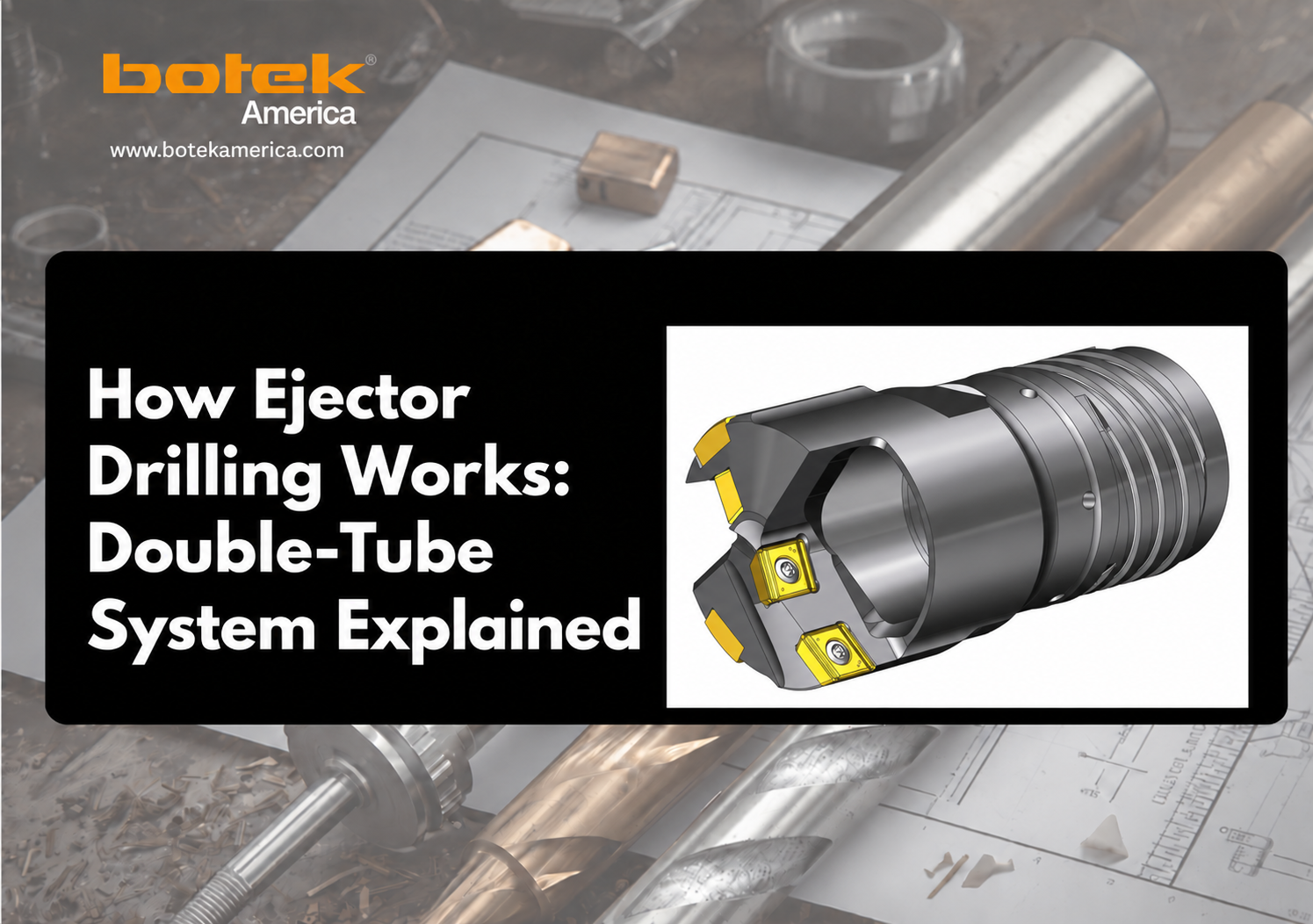
Ejector drilling is a deep hole drilling process that pumps coolant between two concentric tubes and pulls chips back through the inner tube with an ejector (Venturi-type) suction effect, so it needs no pressure-head seal against the workpiece. That is why shops use it to add deep hole capability to a CNC lathe or machining center without buying a dedicated machine. If your part cannot be sealed, or a dedicated machine is out of budget, it is usually the first process to evaluate. This guide explains how ejector drilling works step by step, how it compares with BTA and gundrilling, and where it fits.
Need a deep-hole drilling manufacturer and a proven deep-hole drilling system for ejector work? Request an ejector drilling quote from botek® America.
What Is Ejector Drilling, and Why Is It Called a Double-Tube System?
Ejector deep hole drilling is a variation of BTA drilling built on a double tube system (DTS): an outer tube and an inner tube joined to one drill head. Sandvik developed it in the 1960s, and the VDI 3210 deep hole drilling guideline documents it. botek’s ejector drilling systems for conventional machines cover 18.40 to 200 mm, with depths over 100xD.
Is Ejector Drilling the Same as DTS or Drilling Ejector Pin Holes?
Ejector drilling and DTS are the same process. It has nothing to do with drilling ejector pin holes in mold plates or fitting a pistol ejector. The name comes from the suction effect, not from ejector pins.
How Does Ejector Drilling Work, Step by Step?
Five things happen in sequence, all inside the tool.
Step 1: What Does the Dual-Tube Structure Look Like?
Two concentric tubes connect to a coolant connector (rotary connector) at one end and to the drill head through a fast-lead, four-start thread at the other. The ejector drill head carries indexable inserts and guide pads. The botek type 62 is a 30 mm example used in TU Dortmund research. The larger tube diameter also gives more torsional strength than BTA tubes.
Step 2: How Does Coolant Reach and Cool the Cutting Edge?
Pressurized metalworking fluid (MWF) enters the connector and flows down the annular space between the tubes. At the drill head it leaves through outlet bores, cooling and lubricating the cutting edges and guide pads and flushing the cutting zone.
Step 3: How Does the Ejector (Venturi) Effect Create Suction?
A small share of the coolant is diverted through ejector slots (nozzles) in the inner tube near the connector end. These jets point toward the outlet, creating low pressure and a partial vacuum inside the inner tube. This Venturi effect, also called the ejector effect or aspirator effect, pulls chips and fluid away from the drill head.
Step 4: How Do Chips Leave Through the Inner Tube?
Chips and coolant enter the chip mouth in the drill head, travel through the inner tube, and exit at the chip exhaust port. Chips never touch the bore wall, which protects surface finish. Guide pads give the tool a self-guiding effect that supports straightness and roundness.
Step 5: Why Doesn’t Ejector Drilling Need a Workpiece Seal?
Coolant stays inside the tool, so no BTA pressure head has to seal against the part. You still need a drill bushing (guide bush) or a pilot hole to start the head straight. That is why ejector drilling works on interrupted or oblique entry surfaces where a seal would leak.
Ejector Drilling vs BTA vs Gundrilling: Which Deep Hole Process Fits?
Ejector vs BTA drilling comes down to sealing and machine type. Choose an ejector for mid-size deep holes on an existing machine. Choose BTA drilling for large, high-volume bores such as oil and gas downhole tools, and gundrilling for small, precise holes.
| Factor | Ejector | BTA | Gundrilling |
| Coolant path | Between outer and inner tube | Between tube and bore wall | Through the tool body |
| Chip path | Inner tube, suction-assisted | Inside the drill tube | External V-flute |
| Seal needed | No, guide bush only | Yes, pressure head | No, bushing or pilot hole |
| Diameter (botek) | 18.40 to 200 mm | 7.76 to 700 mm | 1 to 50 mm |
| Machine | Lathe, turning center, machining center, horizontal boring mill | Dedicated machine | Dedicated machine or capable CNC |
For a full decision matrix, see how to choose between gundrilling, BTA, and ejector drilling.
What Types of Ejector Drilling Setups Exist?
Sources do not define formal types, so think in three setup choices.
Dedicated Deep Hole Machine or Conventional Lathe and Machining Center?
Ejector systems run on a dedicated deep hole drilling machine with a drill bushing or on a CNC lathe, turning center, horizontal boring mill, or machining center fitted with a coolant connector. The second route is the ejector drilling retrofit.
Rotating Tool, Rotating Workpiece, or Counter-Rotation?
Rotating the workpiece or counter-rotating the tool and part holds straightness better. Published deep hole figures show about 0.012 in per foot (0.001 in per inch) for a rotating tool in a stationary part, versus 0.003 to 0.005 in per foot for a rotating workpiece.
Through, Interrupted, or Oblique Entry Holes?
Through holes are standard. Interrupted cross-drilled bores and oblique entry surfaces suit ejector drilling because no seal is needed, but you still need a guide bush or pilot hole.
Where Does Ejector Drilling Work Best?
It works best for mid-diameter deep holes on equipment you already own or when part shape defeats a BTA seal.
| Application | Why ejector fits |
| Crankshafts | Interrupted, cross-drilled bores |
| Track shoes | Interrupted holes in heavy parts |
| Hydraulic cylinders | Long, straight mid-diameter bores |
| Gear shafts and valve guides | Deep holes on machining centers |
| Landing gear | Deep bores without a dedicated machine |
| Mold and die cooling channels | Deep channels on existing machines |
Browse the 7 types of deep-hole drilling tools and when to use each to confirm the fit.
What Are the Limits of Ejector Drilling, and How Do You Prevent Chip Clogging?
The main limit is chip evacuation. Inlet pressure is lower than in BTA, so a jam can form fast. Prevent it with enough volume flow rate, filtration, controlled chip form, and a stiff, aligned setup.
- Small sizes: Precihole notes the chip discharge area is smaller than BTA, so evacuation is less efficient in small diameters.
- Efficiency: UNISIG calls ejector drilling a limited alternative to BTA for efficiency, depth, and chip removal.
- Retrofit hardware: You need a high-horsepower spindle, a high-pressure coolant pump station, and rigidity.
- Chip form: Long, stringy chips cause chip clogging. Adjust feed rate to shorten them.
A 2026 study in Production Engineering by researchers including TU Dortmund’s machining technology team quantified the risk. A chip jam formed within 7 tool rotations, and feed force above 6 kN signaled blockage versus 2.5 to 4 kN normally. A vortex near the outer cutting edge trapped chips. An optimized head cut the minimum coolant flow for stable drilling by 16% at 60 m/min and 42% at 80 m/min (51.5 to 29.5 L/min). Track feed force as a KPI; see KPIs for deep hole drilling process optimization.
What Do Machinists Ask Most About Ejector Drilling?
What Diameter and Depth Can Ejector Drilling Reach?
botek covers 18.40 to 200 mm with depths over 100xD. ISCAR lists 18.4 to 184 mm, and Sunnen lists 19.99 to 183.9 mm.
Can I Run Ejector Drilling on My CNC Lathe or Machining Center?
Yes, if the machine has enough spindle power, rigidity, and a filtered high-pressure coolant pump station. A quick-change toolholder helps on machining centers.
Do I Need a Drill Bushing or Pilot Hole?
Yes, one of them. Start the drill head through a guide bush, or drill a pilot hole first, so the tool begins straight.
Is Ejector Drilling Faster Than Gundrilling?
Often, because the multi-edge head and larger tubes allow higher feed rates, but published multipliers range from a few times to about 20x. Book in-house drilling trials instead of trusting a headline number.
How Much Coolant Pressure and Flow Do I Need It?
Inlet pressure is lower than BTA, but volume flow matters more. The study’s 30 mm head ran at 55 L/min. Ask your tool maker for flow and DIN/ISO 286 tolerance guidance at your diameter and L/D ratio.
Ready to Set Up Ejector Drilling on Your Machine?
botek® America is a deep hole drilling manufacturer with U.S. application engineering and in-house drilling trials in Roselle, Illinois. Explore the full deep hole drilling system range, then send your material, diameter, L/D ratio, and machine type for a tooling recommendation.
Request an Ejector Drilling System Quote | Book In-House Drilling Trials | Request a Deep Hole Drilling Process Review
T: (630) 893-5300 | E: info@botekamerica.com