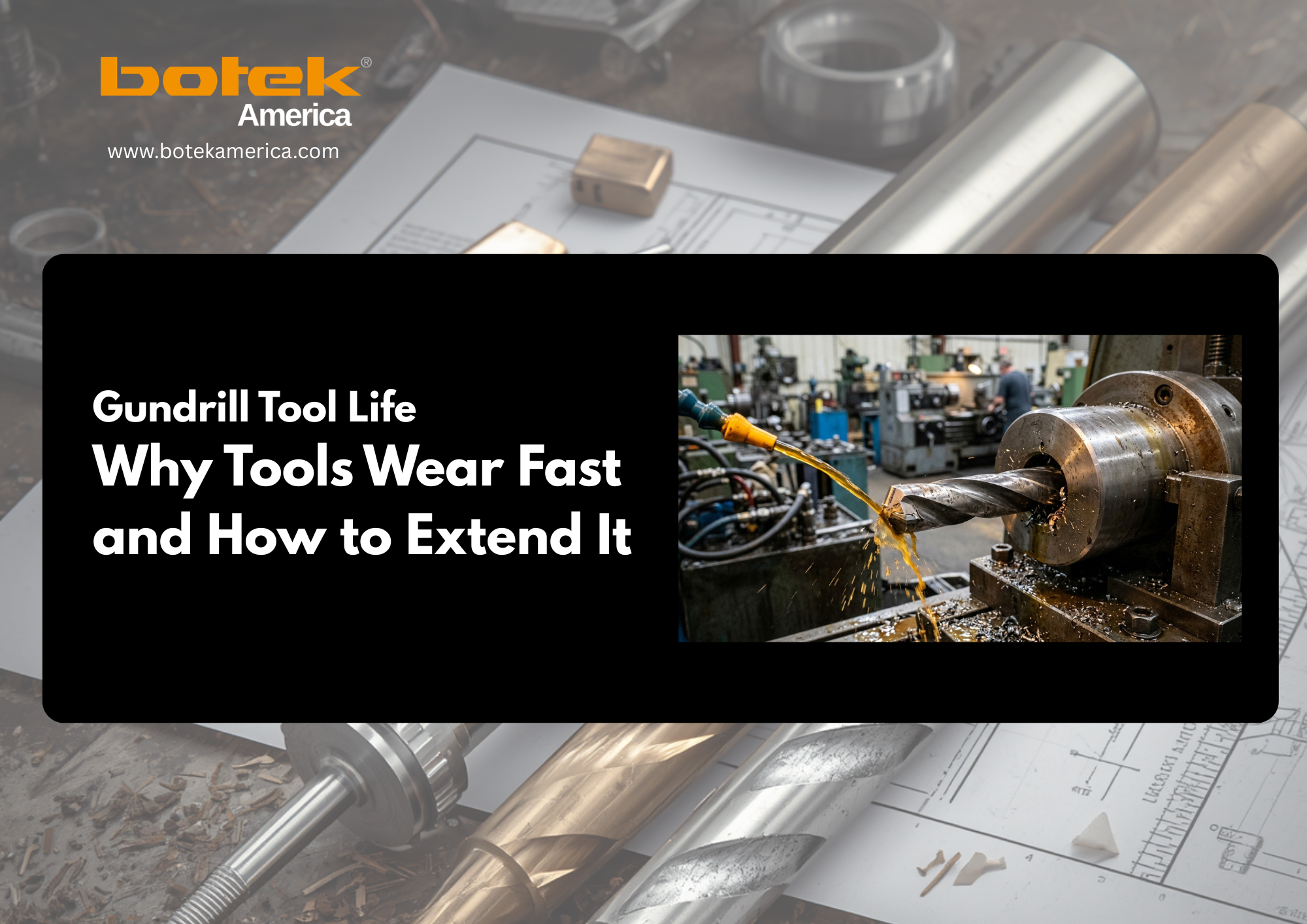
Gundrills are not cheap. When a solid carbide gundrill wears out at 500 inches instead of 1,000, that is not a tool defect. That is a process problem. And it shows up in your cost per hole, your scrap rate, and your production downtime.
This guide covers the three wear zones to know, the early warning signals, and the specific steps that extend gundrill tool life without slowing your operation.
Explore botek® America’s deep hole drilling systems built for consistent tool life and lower cost per hole.
What Is Normal Gundrill Tool Life?
A well-applied single-flute solid carbide gundrill in mild steel should last around 1,000 inches of drilling before resharpening.
In aluminum and softer materials, you can push beyond that. In harder materials like manganese steel, Inconel, or tool steel with high depth-to-diameter ratios, expect 30 to 50 percent less.
If your gundrill is dying at 400 to 600 inches, here are the most common causes:
- Spindle RPM is too high or feed rate is too low for your workpiece material
- Coolant pressure falls below the required range for proper chip evacuation
- Soluble oil is being used where straight oil is needed for high depth-to-diameter applications
- Setup misalignment is destroying guide pads and wear pads within the first few inches
- Tool is running past its optimal regrinding interval, compounding abrasive wear
Fix the process first. Then evaluate the tool.
The 3 Gundrill Wear Zones Every Machinist Needs to Know
Gundrills wear in three distinct areas. Each wear zone signals a different root cause in your machining process. Fix the wrong one and nothing changes.
Point Wear: Wrong Geometry for Your Material
When 50 to 66 percent of the cutting edge is worn, regrind immediately. If that threshold hits too early, the problem is the nose grind angle. It is not matched to your workpiece material hardness.
Outer Diameter Wear: Cutting Speed Too High
Corner rounding on the OD almost always means your cutting speed is too high. Or there is an alignment problem between tool and workpiece. The carbide wear pads that burnish the hole wall take the direct impact here.
Face Wear and Built-Up Edge: A Coolant Problem in Disguise
Built-up edge (BUE) and crater wear on the tool face look like a feed rate problem. They are usually a coolant lubricity problem. Feeds that are too low cause material to stick to the cutting edge instead of shearing cleanly. That is adhesion wear.
4 Warning Signs Your Gundrill Is About to Fail
Catching wear before failure saves the part and the tool. A broken carbide tip inside a deep hole is far worse than an early tool change.
| Warning Signal | What It Means | Action |
| Coolant pressure spikes | Chip packing: edge is breaking down | Stop and inspect immediately |
| Discolored or irregular chips | Chip formation is degrading | Pull tool for inspection |
| Rising thrust and torque | Tool forcing through, not cutting | Change the tool now |
| Hole drift or rough surface | Wear pads gone; OD compromised | Regrind or retire the tool |
What Premature Tool Wear Is Actually Costing You Per Hole
More than your tooling budget shows. Scrapped parts and unplanned downtime rarely land in the tooling line item.
Here is the cost-per-hole math most shops skip running. A $300 solid carbide gundrill lasting 1,000 inches across ten 100-inch holes equals $0.03 per hole in tool amortization. Cut that tool life to 600 inches, and the same tool costs $0.05 per hole. That is a 67 percent increase in tooling cost per hole before counting machine time or consumables.
At 500 parts per month, that adds up to $100 or more in excess tooling spend. Before scrapped parts.
According to a survey of Society of Manufacturing Engineers data, sharpening and recoating a premium carbide drill priced above $400 can cost as little as $29. That is over 90 percent savings versus replacement. A disciplined gundrill regrinding program is one of the highest-ROI decisions in any perishable tooling program. (Source: gwstoolgroup.com/drill-regrinding)
4 Proven Ways to Extend Gundrill Tool Life
1. Optimize Cutting Speed and Feed Rate Together
Do not adjust just one. High cutting speed causes OD wear and corner rounding. Low feed rates cause BUE and face wear. Both extremes hurt tool life. Find the right speed-to-feed ratio for your specific workpiece material and carbide grade. Change one machining parameter at a time and document the result. That is the only reliable way to isolate the problem.
2. Fix Your Coolant Pressure and Type
Coolant is the only chip-evacuation system in deep-hole drilling. There is no secondary mechanism at depth. Low coolant pressure means chip recutting against the brazed carbide tip. That destroys tool life from the inside.
Required pressure by gundrill diameter:
- Under 0.5 inch (12.7mm): 500 to 1,000 psi (35 to 70 bar), 1 to 2 gpm flow rate
- Above 0.5 inch: 300 to 500 psi (20 to 35 bar), 2 to 5+ gpm flow rate
Straight oil gives better lubricity and better tool life. Soluble oil saves on coolant cost but increases tool replacement frequency. Model the full tooling cost before choosing.
3. Choose the Right PVD Coating for Your Material
Gundrill coatings extend tool life even after resharpening because the coating on the wear pads stays intact after tip face regrinding. That is where burnishing happens and where coating delivers the most value.
| Coating | Tool Life Gain | Best For |
| TiN | 2 to 4x | General steel, standard conditions |
| TiCN | 4 to 5x | Higher cutting speeds, harder steel |
| TiAlN | 4 to 10x | Exotic alloys, hardened steel, high-temp |
| AlCrN | 4 to 10x+ | Abrasive materials, superior oxidation resistance |
TiAlN delivers the fastest payback for most steel applications. For hard-to-machine alloys like Inconel, titanium, or manganese steel, AlCrN gives better abrasive wear resistance and thermal stability.
4. Build a Gundrill Regrinding Program
A solid carbide gundrill can be resharpened 8 to 10 times. Each regrind costs a fraction of a new tool. Pull tools before major chipping happens. Early regrinding removes less carbide and extends total regrinding cycles. Track resharpen count per tool. Use a dedicated gundrill grinder for consistent facet grinding results across your operation.
Regrind or Replace? How to Decide Fast
Regrind when:
- 50 to 66 percent of the cutting edge is worn and geometry is recoverable
- Wear pads and head length are still intact
- The tool has not fractured under load
Retire and replace when:
- The gundrill fractured. Carbide micro-cracks are invisible. They will cause another failure inside a deep hole.
- Head length is too short. Guide pads can no longer support the tool, and hole straightness will fail.
- Back taper from repeated regrinding has taken the OD outside your hole diameter tolerance.
Frequently Asked Questions
Why are my guide pads wearing out after just a few inches?
Almost always an alignment issue. The tool is entering off-axis, and the wear pads are absorbing lateral load. Check your bushing support and starting approach before changing anything else.
How many times can I regrind a gun drill?
8 to 10 times under proper facet grinding conditions. Retire the tool when head length or diameter change from back taper affects your hole tolerance.
Does regrinding remove the gundrill coating?
Only from the tip of the face. The PVD coating on the wear pads stays intact. That is where it matters for burnishing and hole wall quality. Performance after regrinding is comparable to a new coated tool for most applications.
Ready to Stop Losing Money on Premature Gundrill Wear?
Gundrill tool life is not something you accept. It is something you engineer. The right point geometry for your workpiece material. The right coolant pressure and type. The right PVD coating. And a regrinding program that keeps your tooling investment working longer.
Small process adjustments add up to real savings per hole. And real savings per hole add up to a lower total cost of ownership across your entire deep-hole drilling operation.
botek® America engineers precision gundrills, in-house regrinding, and PVD coating services built to lower your cost per hole. German engineering. U.S.-based support. Application-specific solutions from a team that specializes in deep hole drilling.
Stop accepting premature tool wear as a cost of doing business. Explore botek® America Deep Hole Drilling Systems by contacting our gundrilling experts.