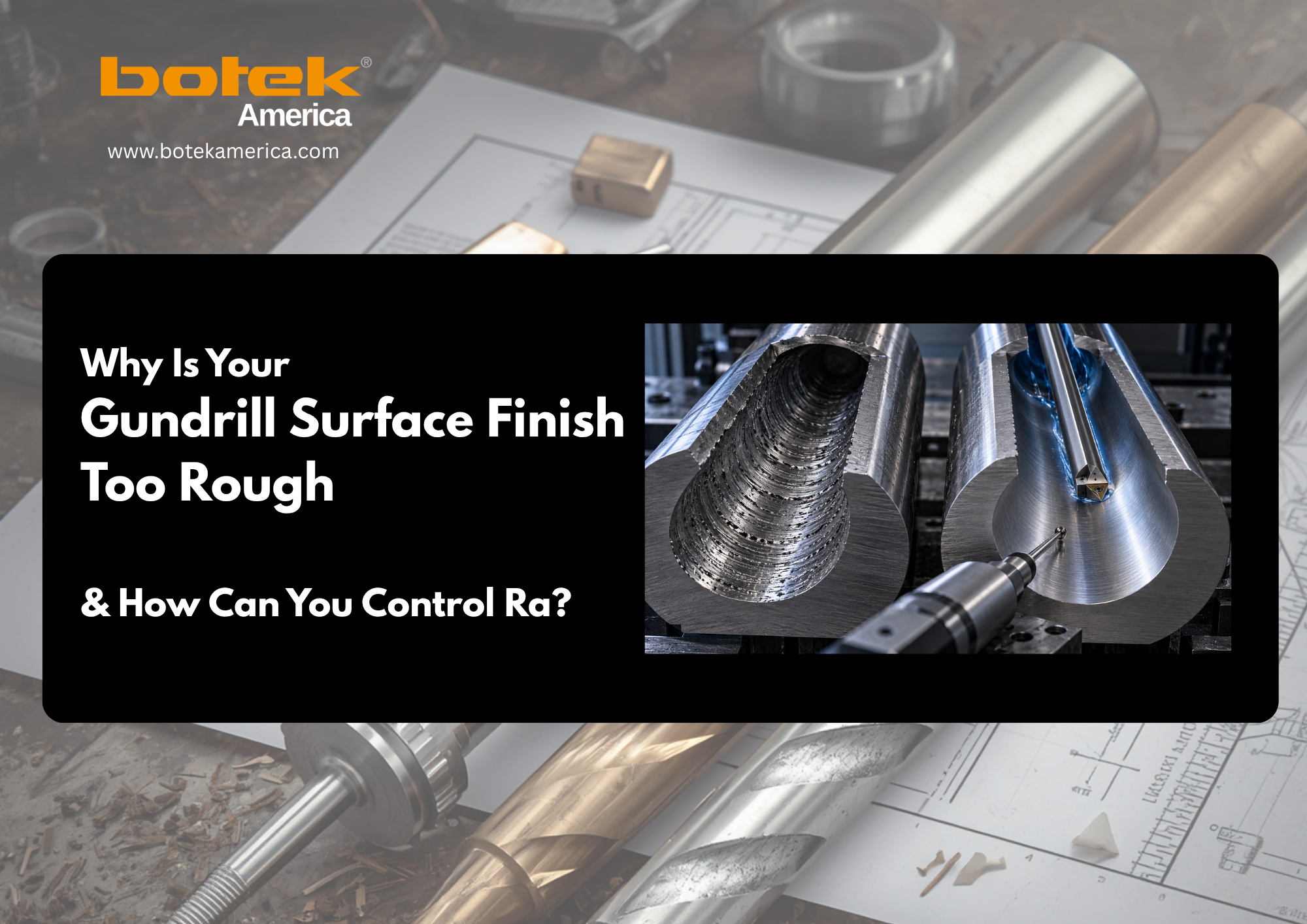
A poor gundrill surface finish can cause leakage, seal wear, rejected components, and extra finishing. If it finishes deteriorating with depth or across parts, inspect the bore, tool, chips, coolant, and setup in a controlled order.
Control the complete process: the cutting edge creates the surface, guide pads burnish it, coolant lubricates it, and stable chip evacuation prevents scratching. See how a gundrill cuts, guides, and evacuates chips for the full mechanism.
| Need application-specific support? Consult botek® America, an experienced Deep Hole Drilling Manufacturer, and talk to an application engineer before changing several process variables at once. |
What Does an Unacceptable Gundrill Surface Finish Look Like?
An unacceptable gundrill surface finish may exceed the specified Ra or show axial scratches, spiral marks, chatter, torn material, discoloration, or rough bands. These defects matter even when hole diameter remains within tolerance because they can impair sealing, lubrication, fatigue life, or component fit.
- Axial scratches indicate chips or contamination dragged along the bore.
- Spiral marks suggest runout, misalignment, or unstable guide pads.
- Chatter marks point to vibration, weak support, or poor rigidity.
- Torn or smeared material suggests built-up edge or weak lubricity.
- Rough or discolored bands suggest heat, declining coolant flow, recutting, or tool wear.
What Does the Ra Value Actually Tell You About Hole Finish?
Ra reports the average absolute deviation of the measured surface profile from its mean line. It is useful for monitoring roughness, but it does not fully describe deep scratches, isolated peaks, surface lay, or waviness. Evaluate Ra together with the visible bore condition and the surface’s functional requirement.
How are Ra and Rz different?
Ra is a roughness average; Rz is more sensitive to peak-to-valley height. Similar Ra values can conceal isolated scoring that affects sealing or fatigue. Confirm which parameter the drawing controls.
How should Ra be measured inside a deep hole?
- Use a suitable stylus profilometer or approved bore-measurement method.
- Measure in the specified direction relative to the surface lay.
- Record bore depth and circumferential position.
- Keep sampling length, evaluation length, cutoff settings, and test locations consistent.
Two Ra readings from the same hole can differ because of measurement direction, stylus access, cutoff length, debris, localized scoring, or waviness. For standardized guidance on surface roughness, waviness, and lay, refer to the ASME B46.1 surface texture standard
Is Cutting-Edge Wear Causing the Rough Surface?
Yes, cutting-edge wear can cause a rough gundrill surface. Suspect wear when Ra rises gradually across successive parts, spindle load increases, chip shape changes, or material begins tearing instead of shearing. Inspect the carbide cutting edge and guide pads before the condition progresses to breakage. See why gundrill tool breakage happens and how to prevent it.
How does a dull or chipped cutting edge change the bore wall?
Flank wear, edge chipping, or a rounded edge increases heat and thrust. The tool may tear material, form irregular chips or built-up edge, and increase Ra or spindle load.
How do worn guide pads affect burnishing?
Guide pads support the drill head and burnish the bore. Worn, chipped, or material-loaded pads cannot smooth it consistently and may cause friction, spiral marks, or scoring. Uneven pad contact can also cause hole drift; see why gundrill hole drift happens and how to fix it.
When should the gundrill be reground?
Regrind at the proven wear limit. Track parts per edge, Ra, spindle load, chips, diameter, and pad condition. Regrinding must restore the specified cutting-edge, chip-former, clearance, and guide-pad geometry; sharpness alone may not restore quality. See why gundrills wear fast and how to extend tool life for wear limits, or request in-house gundrill regrinding from botek® America.
Are Coolant and Chips Damaging the Hole Finish?
Yes, inadequate coolant delivery and uncontrolled chips can damage the hole finish. To determine whether they are responsible, verify actual coolant flow and observe chip discharge. Indicated pressure alone does not prove that sufficient clean fluid is reaching the cutting zone.
Can inadequate coolant flow create a rough bore?
Yes. Coolant starvation reduces lubricity, raises temperature, encourages material pickup, and accelerates wear. Check pump capacity, actual flow and pressure, coolant condition, seals, passages, and filtration.
Can evacuated chips scratch a finished bore?
Yes. Chip packing or a restricted V-flute can force chips against the new surface. Poor gundrill chip evacuation causes recutting, axial scratches, scoring, rising torque, and an unstable deep-hole finish. See why gundrill chip evacuation fails and how to fix it.
- Inspect the filter and coolant cleanliness.
- Confirm a steady chip-and-coolant return.
- Check the coolant hole and V-flute for blockage.
- Examine chips for long, nested, or welded pieces.
Are Feed and Cutting Speed Producing the Wrong Surface Texture?
Yes, unsuitable feed or cutting speed can produce excessive Ra, tearing, built-up edge, heat damage, or an unstable surface pattern. Compare the current settings with the tool’s material-specific cutting data, then change only one parameter at a time so the effect can be measured. Need to verify them? Get help confirming gundrill cutting values for your material.
Can excessive feed increase Ra roughness?
Yes. Excessive feed per revolution raises chip thickness, cutting force, pad loading, and the amplitude of the generated texture. However, reducing feed too far can prevent the chip former from creating manageable chips, causing stringy chips, recutting, and a worse bore surface.
Can cutting speed be too high or too low?
Yes. Excessive speed may generate heat and accelerate flank wear, while unsuitable low speed can promote built-up edge. Adjust within botek’s process window while monitoring Ra, chips, spindle load, diameter, and wear.
Are Runout, Misalignment, or Vibration Creating Chatter Marks?
Yes. Runout, misalignment, and vibration can produce repeating chatter bands, spiral marks, uneven guide-pad contact, and inconsistent Ra. Measure alignment and runout, then inspect tool support and workholding. Cutting-parameter changes cannot compensate for an unstable mechanical setup.
Which setup conditions should be inspected?
- Tool-to-spindle and workpiece alignment
- Pilot-hole diameter, depth, straightness, and finish
- Guide-bushing position and wear
- Toolholder, driver, and workholding rigidity
- Unsupported tool length, spindle condition, vibration, and runout
An inaccurate pilot hole can load one side of the drill head and guide pads, creating deflection, chatter, spiral marks, uneven burnishing, or gundrill hole drift.
Can counter-rotation improve surface quality?
Yes, in suitable deep-hole drilling systems. Counter-rotating the tool and workpiece can improve process symmetry and straightness. It will not correct cutting-edge wear, damaged guide pads, chip blockage, or inadequate coolant delivery.
Why Does the Material Change the Gundrill Surface Finish?
Workpiece material changes surface finish because hardness, ductility, abrasiveness, microstructure, and work-hardening behavior alter chip formation, cutting temperature, built-up edge, and tool wear. Match carbide grade, coating, geometry, coolant, feed, and cutting speed to the specific material; one setup will not produce the same Ra in every alloy.
Ductile materials can smear or form built-up edge. Work-hardening alloys generate heat, while abrasive materials accelerate tool wear. Microstructure and heat treatment can also change results. A suitable coating can reduce built-up edge; explore coating options for your gundrills.
What Is the Fastest Way to Diagnose Poor Surface Quality?
The fastest reliable method is to identify the physical bore defect, match it to the most probable process cause, and verify that condition before changing cutting data. This prevents several variables from being changed at once and preserves evidence of the actual failure mechanism.
| Surface symptom | Probable cause | First check |
| Axial scratches | Chips dragged along bore | Evacuation and filtration |
| Spiral marks | Runout or guide-pad issue | Alignment and pad condition |
| Torn or smeared surface | Built-up edge or weak lubricity | Cutting edge and coolant |
| Chatter pattern | Vibration or inadequate support | Toolholding and guide bushing |
| Finish worsens with depth | Recutting, heat, or reduced flow | Coolant return and V-flute |
| Ra rises across parts | Progressive tool wear | Edge and guide pads |
Which troubleshooting sequence should operators follow?
- Confirm the Ra requirement and measurement method.
- Identify the bore pattern and where it begins.
- Inspect the cutting edge, guide pads, chips, and flute.
- Verify coolant flow, condition, and filtration.
- Measure pilot accuracy, alignment, runout, support, and vibration.
- Confirm material-specific data; change one variable and document the result.
Can Gundrilling Eliminate Reaming or Honing?
Yes. Gundrilling can eliminate reaming or honing when it consistently produces the specified diameter, straightness, roundness, and surface texture in one pass. Confirm this with process-capability data across production parts rather than relying on one acceptable hole.
Reaming, honing, skiving, or roller burnishing may remain necessary for tight geometry, sealing, bearing-area, or functional texture requirements. The lowest Ra is not always best.
When Should You Ask a Gundrill Application Engineer for Help?
Ask a botek® America application engineer for help when finish remains unstable after confirming measurement, tool condition, coolant, chip control, alignment, and cutting data, or when the required Ra approaches the demonstrated process limit.
Provide the required Ra/Rz, hole dimensions, material, tool and regrind history, cutting data, coolant information, runout, load trend, bore photographs, and readings by depth. When evaluating deep hole drill suppliers, assess testing, regrinding, coatings, and process expertise, not price alone. This 10-point checklist for choosing a deep hole drilling tool supplier shows what to ask, and botek® America offers in-house testing before production.
How Can You Maintain Consistent Gundrill Surface Finish?
Maintain consistent gundrill surface finish by standardizing Ra measurement, replacing or regrinding tools at a proven wear limit, maintaining clean coolant flow, preventing chip recutting, and controlling alignment and vibration.
Trend Ra, spindle load, tool life, chips, and coolant condition together. These signals reveal process drift earlier than final inspection alone. See KPIs and benchmarks for deep hole drilling process optimization for a tracking framework.
| Resolve recurring Ra problems. Request a gundrill quote from botek® America for tooling and process support from a specialized Deep Hole Drilling Manufacturer. |