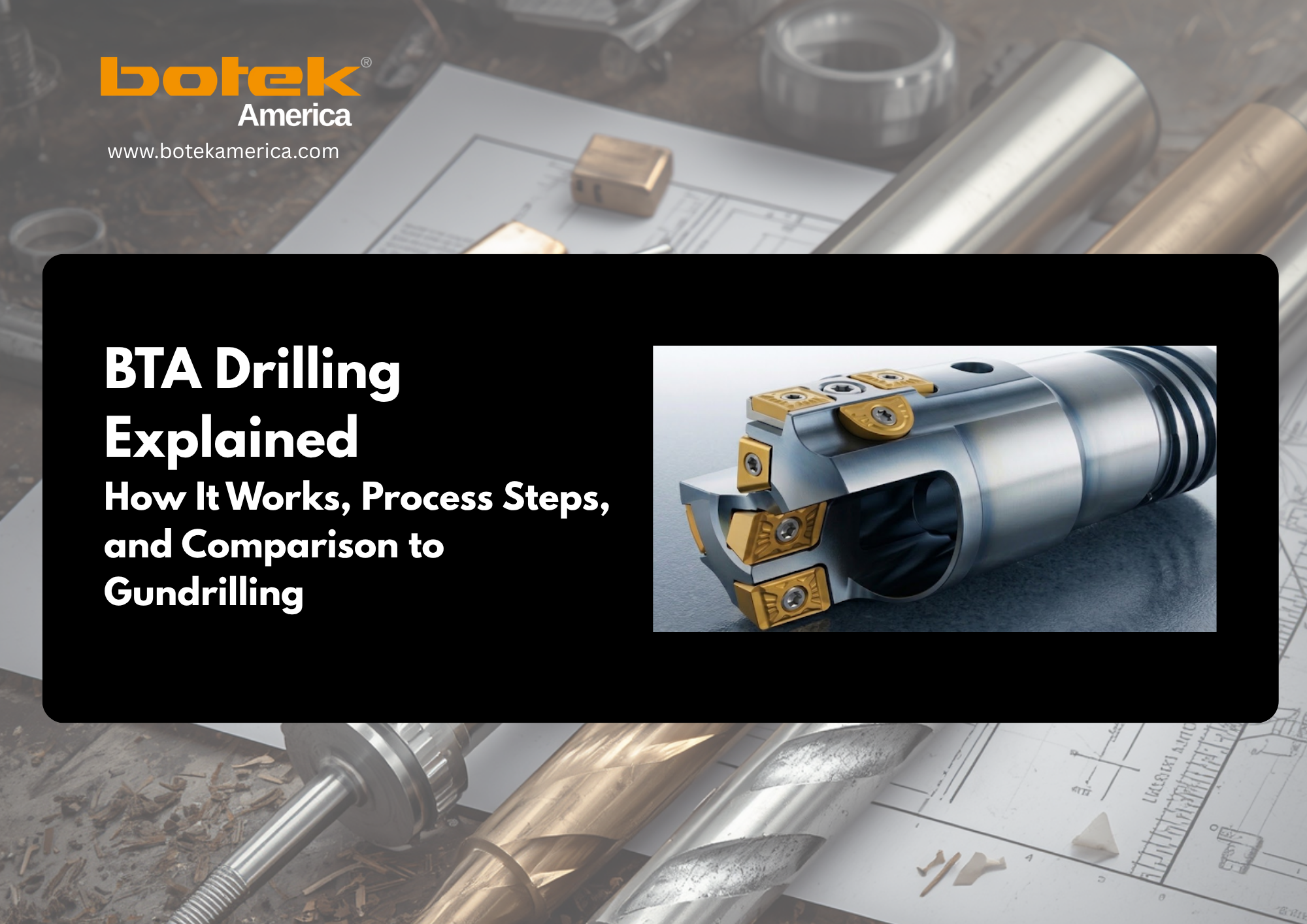
What Is the BTA Drilling Process?
BTA drilling (Boring and Trepanning Association) is a deep hole drilling process that delivers high-pressure coolant externally through an annular space around the drill tube while evacuating chips internally through the tube bore. It handles larger diameters than gundrilling, typically from 20 mm (0.79″) upward, with depth-to-diameter ratios up to 400:1 and higher material removal rates for demanding production applications.
BTA drilling is the standard process for large-diameter, high-output deep hole drilling. Where single-flute gundrilling for small-to-medium diameter holes leaves off, BTA handles what comes next: bores starting around 20 mm and scaling well beyond 100 mm in materials from steel and Inconel to stainless steel and nickel alloys.
This page covers how the BTA process works, what the tooling looks like, what parameters it achieves, and how to decide between BTA and gundrilling for a given application.
What Does BTA Stand For?
BTA stands for Boring and Trepanning Association, the industry body that standardized the process and its tooling interfaces. The name has stayed; the technology has moved on considerably.
The process is also called STS drilling (Single Tube System), describing the same principle: external coolant supply, internal chip removal, one drill tube. BTA is the more common term in North American manufacturing.
How BTA Drilling Works: The Core Principle
BTA drilling reverses the coolant and chip flow direction compared to gundrilling. That reversal is why BTA handles larger diameters and higher feed rates.
Coolant delivery (external):
High-pressure metalworking fluid is pumped into the space between the drill tube and the bore wall. This annular space is sealed at the workpiece face by a pressure head, which keeps the coolant contained and pressurized as the drill advances.
Chip evacuation (internal):
Coolant reaches the cutting head, picks up chips, and carries them back through the hollow center of the drill tube, through the spindle, and out into a chip collection system at the machine end. The chips never return through an external flute; they have a full-diameter tube as their exit route.
This means chip evacuation capacity scales with tube diameter. Larger tubes move more chips per unit time, which is why BTA is the right process once diameters increase and production output matters.
BTA System Components
A BTA drilling system is an assembly, and every component has to be matched to diameter, depth, feed rate, and coolant pressure.
| Component | Function |
| BTA drilling head | Carries cutting inserts or brazed carbide. Multiple cutting edges allow higher feed rates than a single-flute gundrill. |
| Drill tube | Hollow tube carrying chips internally back to the machine. Its stiffness and straightness directly affect hole straightness. |
| Pressure head | Seals the coolant circuit at the workpiece face; coolant enters here and is directed into the annular space around the tube. |
| Boring bar / adapter | Connects the drill tube to the machine spindle; determines rotational and axial rigidity. |
| Guide pads | Mounted on the drilling head, contact the bore wall to guide the tool and prevent deflection. |
| Counterboring tools | Enlarge or finish the bore after the initial drilling pass. |
| Trepanning tools | Remove a core rather than drilling solid material, used for large diameters or core recovery. |
Botek BTA tooling covers bore diameters from 7.76 mm to 700 mm, with depths exceeding 100 x D. See the full BTA drilling head, tube, and pressure head specifications for sizing by application.
BTA Drilling Process, Step by Step
- Pressure head sealing. The pressure head is clamped against the workpiece face before drilling begins. An incomplete seal drops coolant pressure, degrades chip evacuation, and destabilizes the whole process.
- Coolant pressurization. Fluid is pumped into the annular space between tube and bore wall. Larger diameters need lower pressure but higher flow volume to sustain chip transport through longer tubes.
- Drilling head advance. The drill advances at a controlled feed rate; multiple cutting edges remove material simultaneously, which is why feed rates and removal rates run well above gundrilling at equivalent diameters.
- Internal chip evacuation. Chips flush continuously through the tube bore. Chip form matters here: long, stringy chips can bridge inside the tube, so cutting data must produce manageable shapes for the material.
- Breakthrough and retraction. Feed rate drops near breakthrough to control exit quality. The pressure head releases, coolant stops, the drill retracts, and chip collection systems capture the debris.
Parameters and Achievable Tolerances
| Parameter | Typical Range |
| Bore diameter | 7.76 mm to 700 mm (0.31″–27.6″) with Botek tooling |
| Depth-to-diameter ratio | Up to 400:1 and beyond, depending on tube stiffness and coolant system |
| Surface finish | Ra 0.4–3.2 µm (application-dependent) |
| Hole straightness | Comparable to gundrilling within the BTA diameter range |
| Material removal rate | Higher than gundrilling at equivalent diameters |
| Feed rate | Significantly higher than gundrilling for larger bores |
These values depend on cutting speed, feed rate, coolant pressure, fluid type, guide pad condition, and tube stiffness. Setting the correct process parameters before production starts prevents most BTA drilling problems; for a structured way to baseline and track these variables, see botek® America’s KPI and benchmarking framework for deep hole drilling process optimization.
BTA Drilling vs. Gundrilling: How to Choose
Both processes produce accurate deep holes. The primary decision factor is diameter; secondary factors are production volume, material, and depth-to-diameter ratio.
| Factor | Gundrilling | BTA Drilling |
| Diameter range | 0.5–51.2 mm (0.020″–2.016″) | Typically 20 mm+ (Botek from 7.76 mm) |
| Coolant delivery | Internal, through the tool body | External, through annular space |
| Chip removal | External, through V-flute | Internal, through drill tube bore |
| Cutting edges | Single | Multiple |
| Feed rate | Moderate | Higher for large diameters |
| Best application | Small-to-medium precision holes, tight tolerances | Large diameters, high-volume production, difficult materials at scale |
| Tooling setup | Drill bushing or pilot hole | Pressure head; full BTA system assembly |
Below 20 mm: gundrilling is almost always correct. Above 20 mm: both are technically possible; production volume, finish requirements, and machine capability drive the decision. Above 50 mm: BTA is typically the standard approach. Many manufacturers run both processes side by side, gundrilling for small precision holes and BTA for large-diameter, high-output work. See the gundrilling process breakdown for tool selection and setup at smaller diameters, or the ejector drilling overview for a double-tube option that works on conventional machines where sealing the coolant circuit is difficult.
BTA Machine Requirements
BTA drilling needs a machine that can deliver high-pressure coolant through the pressure head, hold the workpiece rigidly against the seal, and collect chips at the spindle end.
Dedicated deep hole drilling machines integrate the coolant pump, pressure head, chip collection, and tube support in one purpose-built system. Machining centers can be adapted, but setup complexity increases and depth-to-diameter capability is typically limited.
Coolant type matters too. Deep hole drilling oil gives superior lubrication for small diameters and difficult materials; water-miscible emulsion works for larger diameters and higher flow volumes, at a minimum 10–12% concentration with appropriate additives.
BTA Drilling Applications by Industry
BTA drilling shows up wherever large-diameter deep holes are needed at production scale: aerospace and defense (actuator cylinders, structural components, rocket launcher tubes, hydraulic manifolds in titanium, Inconel, and high-strength steel), automotive and powertrain (crankshaft and camshaft bores, transmission shafts, and large oil passages in high-volume production); energy technology (heat exchanger tube sheets, pressure vessel bores, and turbine component bores in nickel alloys and stainless steel); hydraulics and pneumatics (cylinder bores, large valve bodies, and manifold passages); and machine and plant engineering (large shafts, housings, and rotating components). Botek BTA tooling supports each sector with application-specific drilling heads, tube assemblies, guide pad selection, and process engineering. See deep hole drilling tooling recommendations by industry and material for more detail.
Common BTA Drilling Problems and Fixes
Chip jams inside the drill tube:
Cause: chip form too long for tube diameter or coolant flow volume insufficient to transport chips at depth.
Fix: adjust feed rate for shorter chip segments, verify flow volume at the pressure head (not just the pump), and check the tube bore for partial blockages at every inspection. The same root causes drive most tool failures in deep hole drilling generally; see botek® America’s early warning signs and root-cause checklist for gundrill tool breakage for the diagnostic approach, much of which carries over to BTA tooling.
Pressure head seal failure:
Cause: workpiece face not square, sealing element worn, or clamping force insufficient.
Fix: machine the workpiece face to the required squareness, replace sealing elements on a regular schedule, and verify clamping pressure meets specs.
Hole drift at depth:
Cause: guide pad wear, insufficient tube stiffness for the depth, or incorrect entry setup.
Fix: inspect guide pads before each run, match tube selection to hole depth and diameter, and confirm entry alignment before cycling.
Short cutting insert life:
Cause: incorrect cutting data for the material, coolant concentration below minimum, or poor guide pad contact.
Fix: review cutting speed and feed for the specific material, maintain 10–12% minimum emulsion concentration (or switch to drilling oil for difficult alloys), and verify guide pad fit.
BTA Drilling FAQ
What is the difference between BTA drilling and gundrilling?
Gundrilling delivers coolant internally through the tool and evacuates chips externally through a V-flute. BTA delivers coolant externally through the annular space around the tube and evacuates chips internally through the tube bore. BTA handles larger diameters and higher feed rates; gundrilling handles smaller diameters and tighter tolerances.
What diameter does BTA drilling start at?
The practical lower limit for standard BTA tooling is around 20 mm (0.79″). Botek BTA tooling starts at 7.76 mm. Below 20 mm, gundrilling is typically more practical and cost-effective.
What is the maximum depth-to-diameter ratio for BTA drilling?
Up to 400:1 and beyond with proper tube support, machine setup, and coolant system. Actual limits depend on tube stiffness, coolant pressure, and chip transport distance.
What is boring and trepanning in BTA drilling?
Boring means enlarging or finishing a previously drilled bore. Trepanning means producing a hole by removing a ring of material around a central core rather than drilling the full cross-section solid. Both can be performed with BTA-system tooling, including Botek counterboring tools and trepanning heads.
Can BTA drilling be done on a machining center?
With adaptation, yes. Dedicated deep-hole drilling machines remain the standard choice because they integrate the pressure head, coolant system, chip collection, and tube support in a single purpose-built setup. Machining center adaptations add complexity and may limit achievable depth-to-diameter ratios.
What coolant is used for BTA drilling?
Deep hole drilling oil for small diameters and difficult materials; water-miscible emulsion at a minimum 10–12% concentration for larger diameters and higher-flow applications. Coolant choice affects chip transport, surface finish, guide pad life, and insert life.
Get BTA Drilling Tools and Process Engineering Support
Choosing the wrong process, or the right process with the wrong tube stiffness, pressure head seal, or coolant strategy, shows up as scrapped bores, seal failures, and downtime, not a minor efficiency loss. Getting the diameter, material, and production volume matched to the correct tooling before the first cut is cheaper than fixing it after.
botek® America supplies BTA drilling heads, drill tubes, counterboring tools, trepanning tools, and full BTA system components for bore diameters from 7.76 mm to 700 mm, engineered in Germany and supported out of Roselle, Illinois. Whether you need a BTA tooling quote, help choosing between BTA drilling and gundrilling for a new large-diameter deep hole drilling application, or in-house trials before committing to production, our application engineers work with you directly on process layout, cutting data, and tool selection.
Request a BTA Tooling Quote | Talk to an Application Engineer | Submit Your Drilling Application