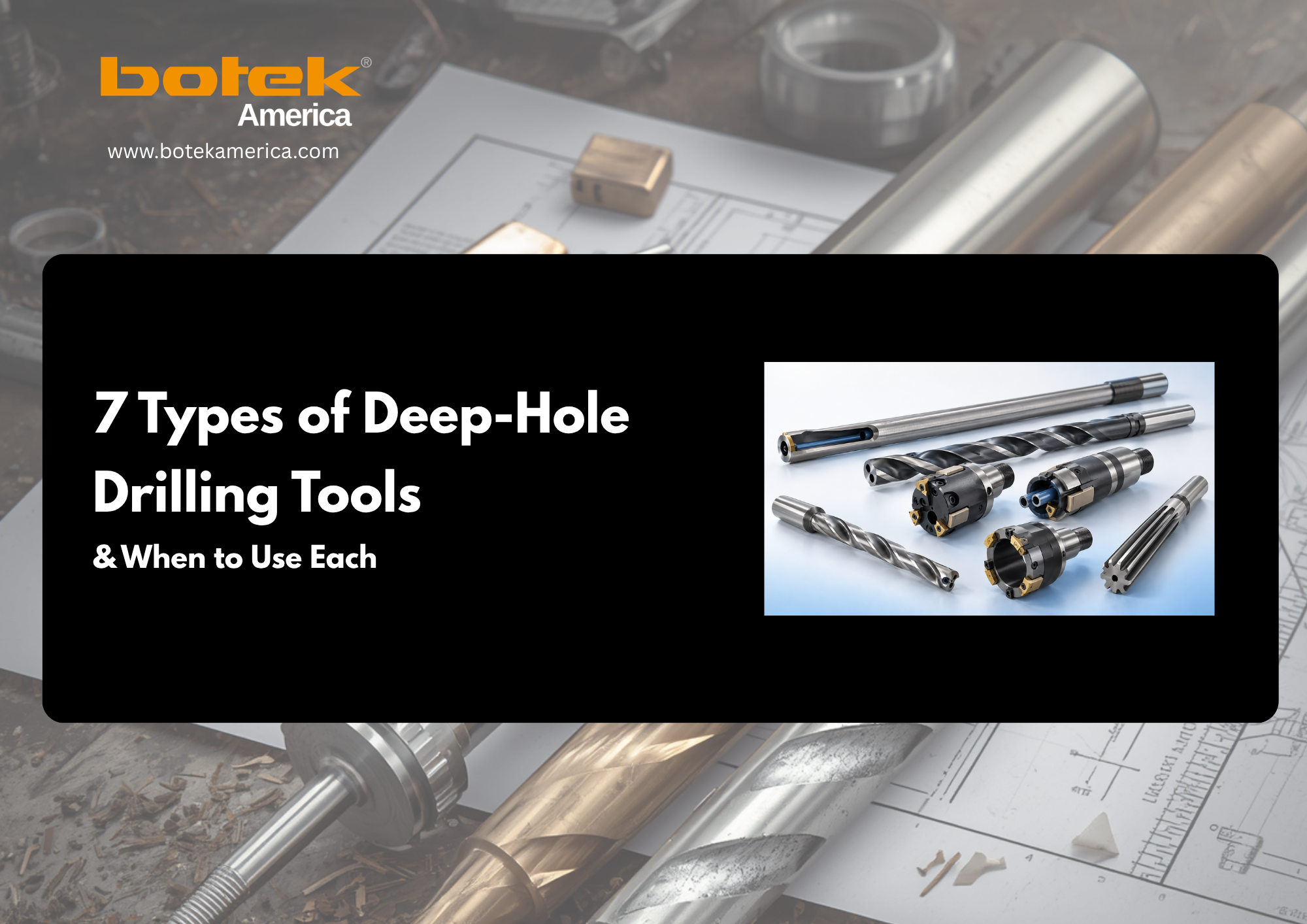
Any hole with a depth-to-diameter ratio above 10:1 is a deep hole. Standard twist drills fail well before that threshold. They cannot manage chip evacuation, coolant delivery, or tool guidance at depth. There are seven specialized tool types built to solve those problems. This guide covers all seven, with the key specs and the conditions where each one belongs.
Selecting the wrong deep-hole drilling tool is expensive. botek® America is a Deep Hole Drilling Manufacturer with tooling for every process on this list. Request a tooling recommendation or upload your drawing at botekamerica.com.
All 7 Deep-Hole Drilling Tool Types at a Glance
Quick reference before going deeper into each type. If you know your diameter and machine setup, the right tool type is usually clear from this table alone.
| Tool Type | Diameter Range | Max L/D | Coolant Direction | Machine Requirement |
| Gun Drill | 1 to 50 mm | 400:1 | Internal in / external out | High-pressure TSC recommended |
| BTA Drill | 16 to 200+ mm | 400:1 | External in / internal out | Dedicated machine required |
| Ejector Drill | 18 to 65 mm | 100:1 | Dual-tube / internal out | Standard machine compatible |
| Parabolic Drill | Varies | ~30:1 | External flood | Standard machine compatible |
| Trepanning Tool | 50 mm+ | Varies | External (BTA machine) | Dedicated machine required |
| Counterboring Tool | 16 mm+ | Varies | External (BTA machine) | Dedicated machine required |
| Bottle Boring Tool | Custom profile | N/A | External (BTA machine) | Dedicated machine required |
1. Gun Drills: Small-Diameter Precision at Extreme Depth
Gun drills produce holes from 1 mm to 50 mm in diameter at depth-to-diameter ratios up to 400:1. A single asymmetric cutting edge advances into the workpiece while high-pressure coolant travels internally to the tip. Chips exhaust back through a V-shaped external flute. Guide pads on the drill body burnish the bore wall and keep the tool running straight. This is how gun drills hold tolerances in the IT6 to IT7 range even at extreme depth.
Three gundrill configurations:
- Single-flute solid carbide (botek® type 110): guide pads correct unbalanced cutting forces; highest precision for small diameters
- Twin-flute (botek® type 120): balanced cutting forces, higher feed rate capability, improved roundness
- Indexable (botek® type 01): replaceable carbide inserts, approximately 2x the feed rate of carbide-tipped tools
Choose this tool when diameter is under 50 mm, hole straightness and surface finish (Ra 0.4 to 1.6 µm) are primary requirements, and L/D exceeds what a parabolic drill can reliably handle. See how gundrilling works for the full process breakdown.
2. BTA Drills: High-Feed Drilling for Large-Diameter Deep Holes
BTA stands for Boring and Trepanning Association. Also called STS (single tube system) drilling, BTA handles diameters from 16 mm to over 200 mm at depth-to-diameter ratios up to 400:1. The coolant direction is reversed from gundrilling: high-pressure fluid enters around the outside of the drill tube, forcing chips back through the hollow tube and out through the spindle. Multiple cutting edges on a single BTA head allow feed rates 5 to 7 times faster than gundrilling at the same diameter. BTA tooling is available in brazed and indexable carbide configurations.
Choose this tool when hole diameter exceeds 20 mm, the cycle time is a production constraint, and you are running a dedicated deep-hole drilling machine. The BTA drilling explained guide covers the full process, chip evacuation mechanism, and machine requirements.
3. Ejector Drills: Deep-Hole Performance on Standard Machines
Ejector drills use two concentric tubes. Coolant flows in through the annular space between the outer and inner tubes. A ring nozzle redirects some of that coolant back into the inner tube, creating an ejector (underpressure) effect that pulls chips through the inner tube without needing a sealed connection at the workpiece face. This is what makes ejector drilling possible on standard machining centers, CNC lathes, and retrofitted equipment that cannot accommodate a BTA seal. Diameter range: 18 to 65 mm. Maximum depth: approximately 100 times diameter.
Choose this tool when your machine cannot run BTA due to sealing constraints, you are drilling oblique or interrupted workpieces, or you need deep-hole capability on standard existing equipment without capital investment in a dedicated machine.
4. Parabolic Flute Drills: Moderate-Depth Drilling on Standard Equipment
Extra-long twist drills with parabolic flutes extend the reach of standard tooling to roughly 20 to 30 times the diameter. The modified flute geometry pulls chips upward more efficiently than standard flutes and reduces the peck cycles needed at moderate depths. They run on standard machines without dedicated high-pressure coolant systems. Their limits are real: chip packing, hole drift, and surface finish all degrade before reaching 30:1 in most materials. They are a starting point, not a substitute for dedicated deep-hole tooling at high L/D.
Choose this tool when L/D is below 30:1, workpiece material is aluminum or mild steel, production volume is low or prototype-stage, and you do not have access to a dedicated deep-hole machine.
5. Trepanning Tools: Large-Diameter Holes With a Reusable Core
Trepanning tools cut a groove around a solid core rather than removing all the material inside the hole diameter. For large-diameter holes above approximately 100 mm, this requires far less cutting power than solid drilling, generates less heat at the cutting zone, and produces a reusable core slug. Trepanning tools run on BTA-equipped deep-hole machines. The core that remains can be repurposed in other components, which matters when workpiece material is expensive.
Choose this tool when the hole diameter exceeds approximately 100 mm, the workpiece billet is high-value material (titanium, Inconel, or tool steel), or the solid core can be reclaimed and used in other parts.
6. Counterboring Tools: Enlarging and Finishing Existing Deep Bores
Counterboring tools remove stock from existing bores, enlarging them to a finished diameter. They run on BTA-equipped machines and feature multiple cutting edges for elevated feed rates. The tool guides off either the finished bore for hole straightness or the pre-bore for concentricity. That guidance choice directly affects the bore tolerance output. Constant wall thickness across a deep bore is the most common specification target for counterboring operations in hydraulic cylinders and pressure vessels.
Choose this tool when a primary bore already exists and needs to be enlarged to a finished diameter, or when constant wall thickness is the critical dimension across the full depth.
7. Bottle Boring Tools: Internal Profiles and Contours Inside a Deep Bore
Bottle boring tools use a cutting insert that extends and retracts inside the bore under CNC control on a BTA-equipped deep-hole machine. The insert can machine internal chambers, tapers, undercuts, and complex contours that no other deep-hole tool can reach. Available as individual custom tools designed for a specific profile or as modular systems with interchangeable components for multiple configurations.
Typical applications include hydraulic valve bodies, gun receivers, aerospace structural components, and injection mold cooling channels with non-cylindrical internal contours.
Choose this tool when the bore requires a non-cylindrical internal profile. If the inside of the hole needs to be anything other than a straight cylinder, bottle boring is the only tool that reaches it.
Selecting the Right Deep-Hole Drilling Tool for Your Application
Three variables drive the decision: hole diameter, depth-to-diameter ratio, and the machine you are running. Start with diameter. Then check L/D. Then check machine capability. The table below maps requirements to tools.
| Your Requirement | Recommended Tool |
| Diameter under 50 mm + tight tolerance | Gun Drill |
| Diameter over 16 mm + high volume + dedicated machine | BTA Drill |
| Standard machine only + ejector diameter fits | Ejector Drill |
| L/D below 30:1 + low volume + soft material | Parabolic/Extended Twist Drill |
| Diameter above 100 mm + core has reuse value | Trepanning Tool |
| Enlarging an existing deep bore | Counterboring Tool |
| Non-cylindrical internal profile required | Bottle Boring Tool |
For the full decision between gundrilling, BTA, and ejector on overlapping diameter ranges, the gundrilling vs BTA vs ejector drilling comparison covers every selection criterion in detail.
Frequently Asked Questions
Can gun drilling run on a standard machining center?
Yes, with through-spindle coolant at adequate pressure and a bushing plate or starter bushing setup. Ejector drilling is a better fit for shops that cannot supply high-pressure coolant or do not have bushing fixturing available.
What is the difference between BTA and ejector drilling?
BTA requires a sealed connection at the workpiece face and a dedicated machine to manage the sealed coolant circuit. Ejector does not need a seal and can run on retrofitted standard machines. BTA is more efficient, handles larger diameters, and reaches higher L/D ratios. For any application where both are technically possible, BTA is the stronger process.
Not Sure Which Deep-Hole Drilling Tool Fits Your Application?
Choosing the wrong tool type costs more than the tooling. Chip packing, hole drift, poor surface finish, and premature tool failure all trace back to a mismatch between the tool and the application.
botek® America manufactures and supplies gun drills, BTA tooling, ejector systems, and specialized boring tools for every process in this guide. German-engineered tooling. U.S.-based application engineering from Roselle, Illinois. In-house regrinding and PVD coating available.
Request a tooling recommendation based on your diameter, depth, and material. Or explore botek® America’s Deep Hole Drilling Systems to find the right process for your production requirements.