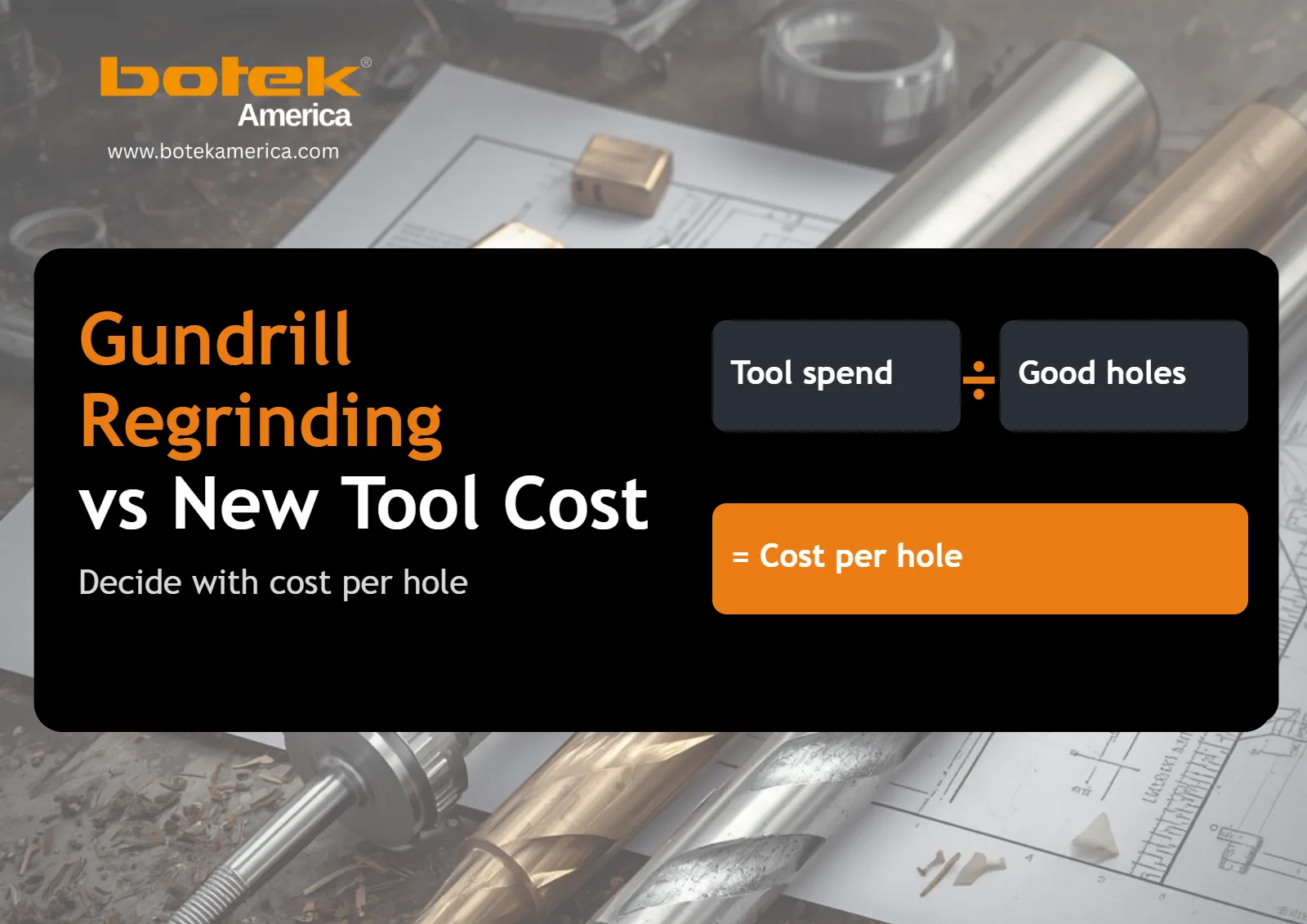
The gundrill regrinding vs new tool cost question comes down to one number: cost per hole. A reground tool costs less than a new one, but it only wins if it drills enough good holes. This guide shows how to compare the two, which costs to count, and when buying new is the better choice. To see how botek America handles resharpening, review the regrinding service. Every example below is illustrative arithmetic, not a quote or a promise of tool life.
How Do You Compare Gundrill Regrinding vs New Tool Cost?
Compare the total cost of each path over the same number of holes. Price per tool alone misleads, because a tool that costs less but fails sooner can cost more per hole.
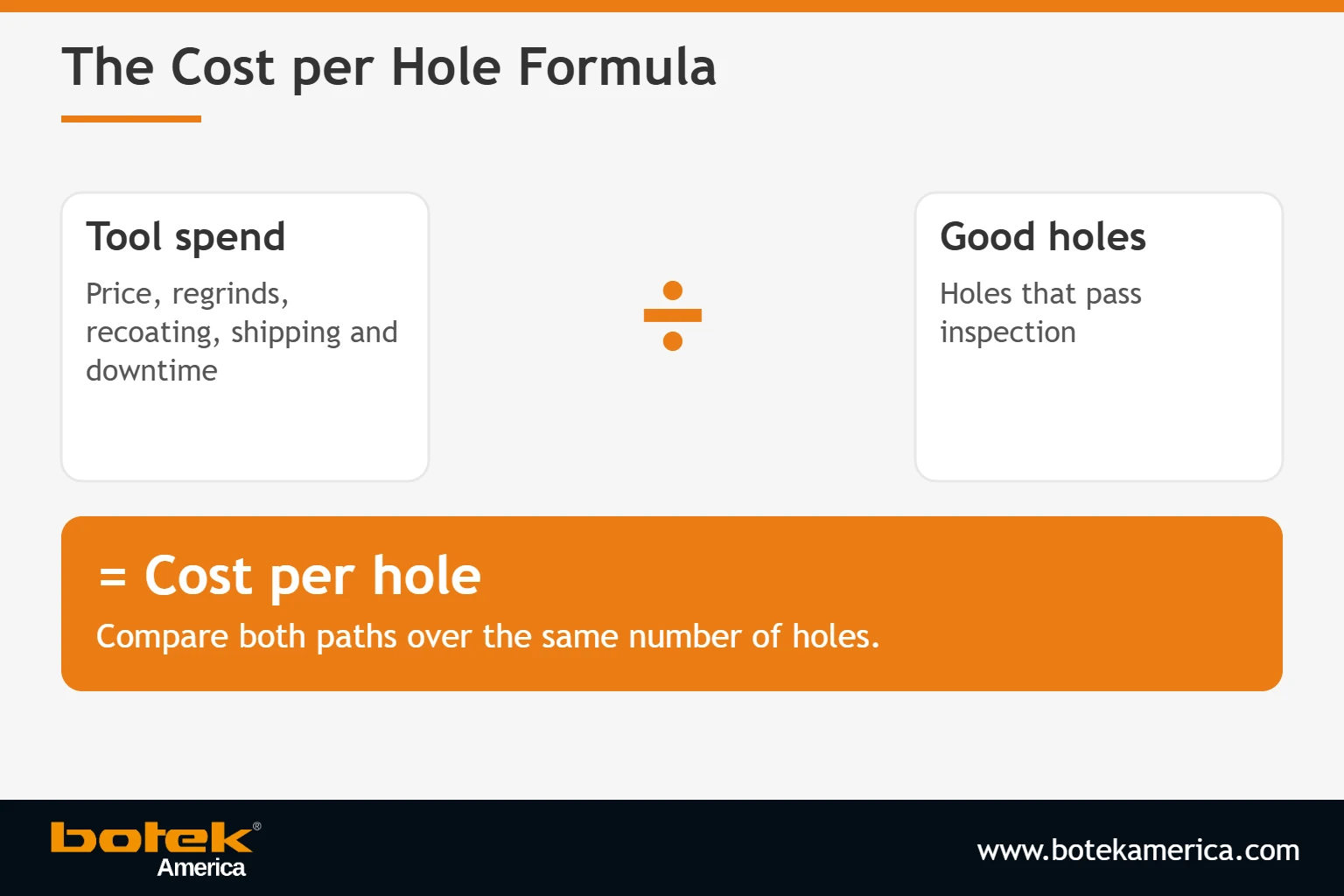
The Cost per Hole Formula
Cost per hole equals the total tool spend divided by the good holes produced. Total tool spend includes the purchase price, each regrind, any recoating, handling and shipping, and the cost of the downtime for tool changes.
An Illustrative Example
These numbers are made up to show the arithmetic. Say a new tool costs 100 units and drills 1,000 holes. A regrind costs 25 units and restores the tool to 800 holes. Over one new tool and two regrinds, spend is 150 units for 2,600 holes, or about 0.058 units per hole. Buying three new tools costs 300 units for 3,000 holes, or 0.100 units per hole. Real values vary by tool, material and hole. Replace the sample figures with your own data before you decide anything.
What Does Regrinding Cost Beyond the Invoice?
The regrind price is easy to see. The full picture also includes time, inventory and risk.
Costs That Belong in the Calculation
- Turnaround time. You need spare tools while one is out for regrinding.
- Tool pool size. More tools in circulation means more cash tied up.
- Recoating. A coated tool may need a new coating after regrinding. Ask what the coating service adds.
- Shipping and handling. Include both directions.
- Quality risk. A poorly sharpened tool can hurt size, finish and straightness, and shorten tool life.
What Evidence Exists on Regrinding Value
Public data on gundrills is thin, so treat any figure with care. One peer-reviewed study of solid carbide end mills in titanium found that regrinding recovered more than 60 percent of the original tool life at about 9 percent of the purchase price, with lower cost per volume machined than new tools (Conradie, Oosthuizen and Dimitrov, International Journal of Advanced Manufacturing Technology, 2017). It covers milling tools, not gundrills, so it shows the logic and not your result.
When Does Gundrill Regrinding vs New Tool Cost Favor Regrinding?
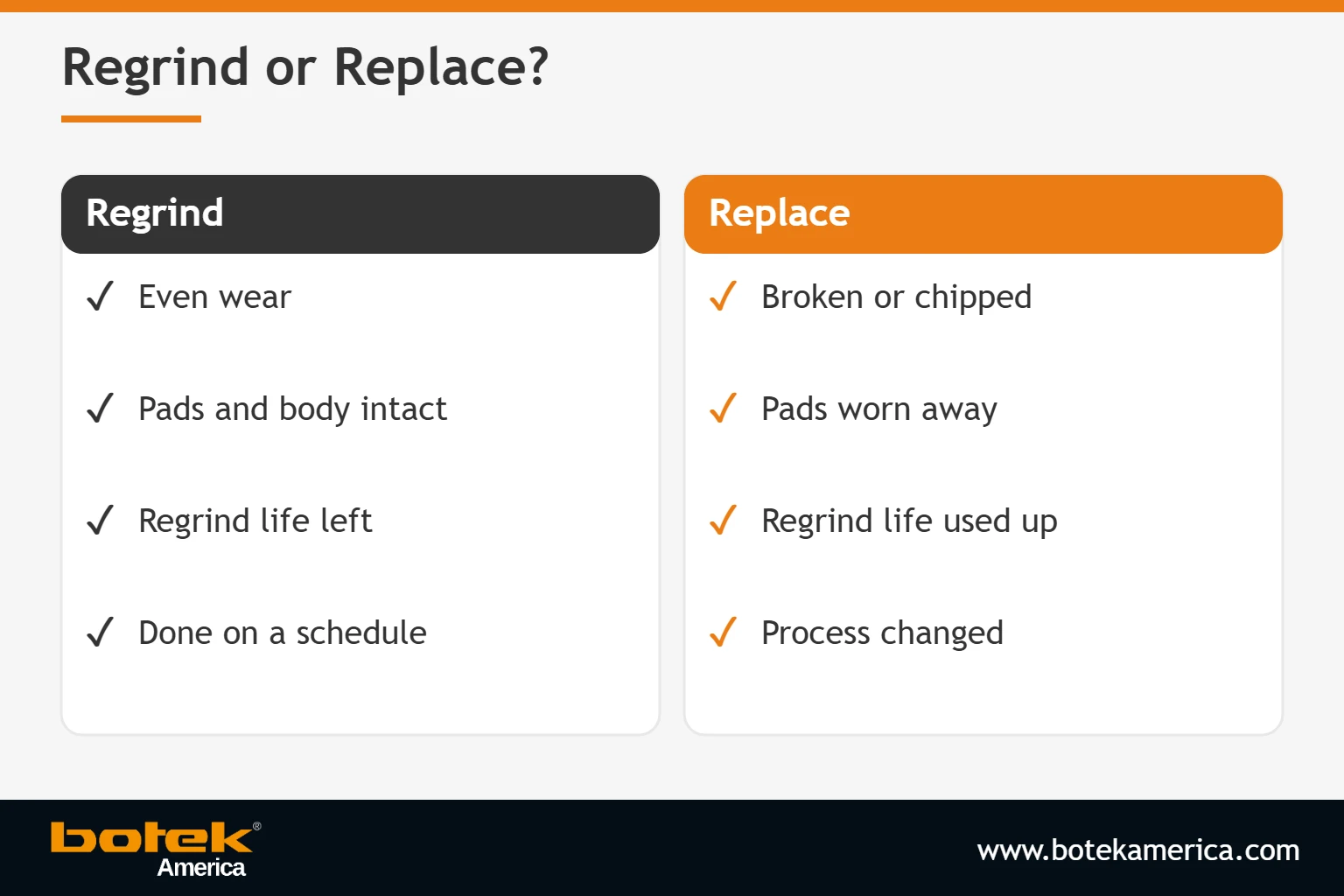
Regrinding tends to win when wear is normal and the tool still has usable length and body. It loses when damage goes past what a grind can fix.
Signs a Tool Is a Good Regrind Candidate
- Wear is even and within the range your supplier sets for regrinding.
- Guide pads and body are intact.
- The tool has regrind life left. Each grind removes length at the tip.
- You regrind on a schedule, before wear becomes damage.
Regrinding on a schedule beats regrinding after a failure. The posts on gundrill tool life and tool breakage explain how to read wear and catch it early.
When Does Gundrill Regrinding vs New Tool Cost Favor Buying New?
Buy new when the cost or risk of regrinding outweighs the saving.
Signs to Replace Instead
- The tool is broken, cracked or chipped beyond what a grind can remove.
- Guide pads are worn away or the body is bent or damaged.
- The tool has used up its regrind life.
- Your process changed and the old geometry no longer fits. Specify the new tool around the changed process.
- The hole is critical and you cannot accept any added variation.
Match the Tool Type to the Decision
Solid carbide, brazed and indexable tools handle wear differently. Read types of deep hole drilling tools before you set a regrinding policy.
What Data Do You Need Before You Decide?
You can start with rough numbers and improve them over time. Six inputs cover most of the decision.
The Six Inputs
- Price of a new tool, including freight.
- Price of a regrind, including freight both ways.
- Holes or length drilled per tool, new and after each regrind.
- Downtime per tool change and the machine cost per hour.
- Scrap rate on the part, and what a scrapped part costs.
- Number of spare tools you must hold.
Scale the Result to Your Year
Illustrative arithmetic again: if the difference is 0.04 units per hole and you drill 50,000 holes a year, the gap is 2,000 units a year. A small difference per hole becomes a large number at volume. It can also vanish if tool life drops after a regrind, so measure results from your own shop before you set a policy.
What a Good Result Looks Like
A good policy settles the gundrill regrinding vs new tool cost question with data. It lowers cost per hole without raising scrap. If scrap rises, the saving on tools is not real. Review cost per hole and scrap together every quarter.
How Do You Build a Regrinding Policy?
A written policy turns regrinding from a guess into a habit. It should be short enough that operators follow it.
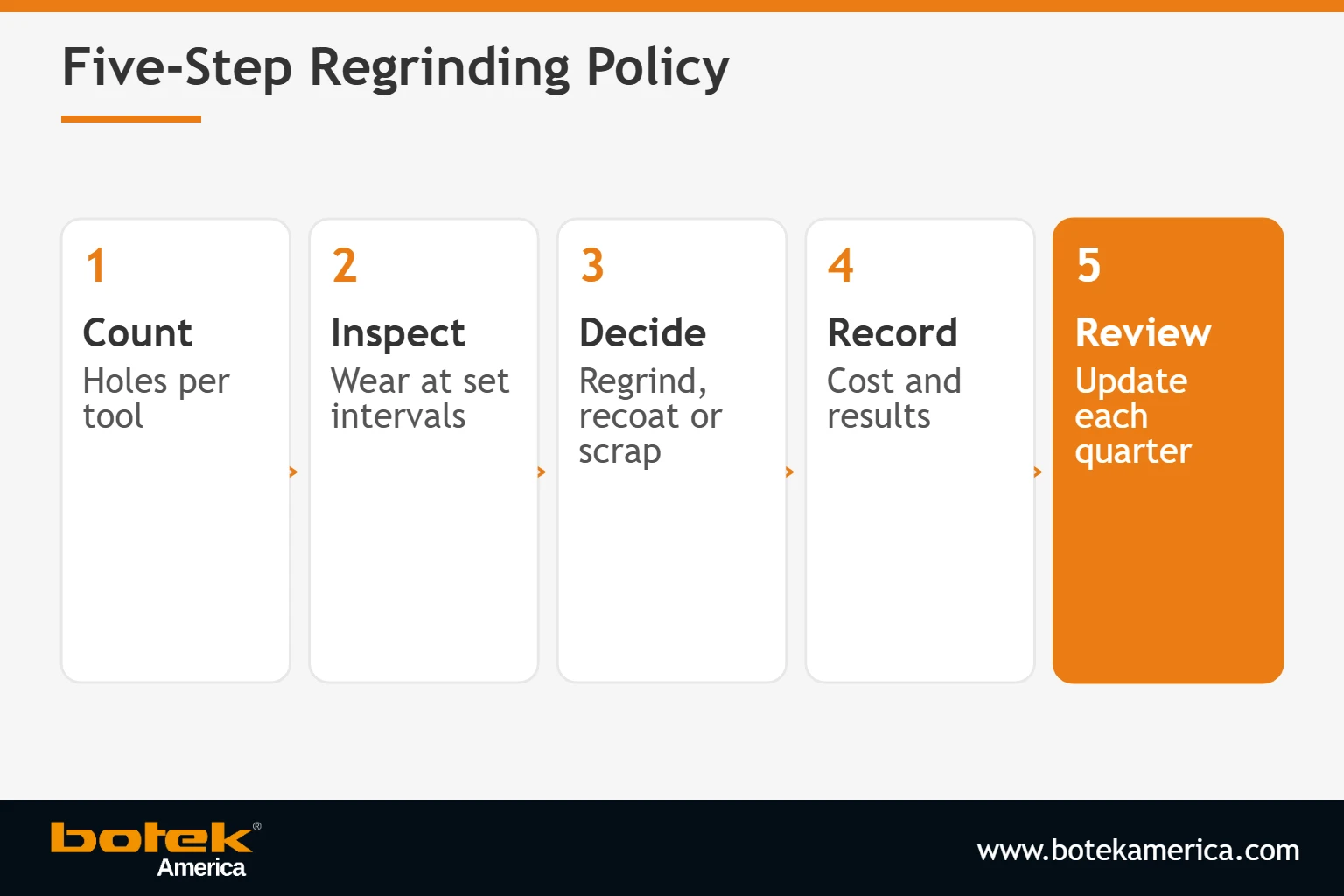
Five Steps to Settle Gundrill Regrinding vs New Tool Cost
- Count. Track holes or length drilled per tool.
- Inspect. Check wear at set intervals.
- Decide. Set rules for regrind, recoat or scrap.
- Record. Log cost and results of every regrind.
- Review. Update the rules every quarter with real numbers.
Where In-House Support Helps
botek America regrinds gundrills in-house at its Roselle, Illinois facility, so wear data stays close to the people who make the tools. Ask what turnaround and inspection you can expect for your tool type. Process data feeds back into better decisions, which our guide to process optimization covers in more depth. If you also run your own grinding, see the grinding machines and fixtures botek lists.
Frequently Asked Questions
How many times can a gundrill be reground?
It depends on the tool, the wear and the grind. Each regrind shortens the tool, so the count is limited. Ask your supplier for a limit for your tool type, and track results instead of assuming.
Does a reground gundrill perform like a new one?
It can, if the regrind is done well. Poor sharpening can hurt size control, finish and straightness. Quality of the grind matters as much as the decision to regrind.
Should I regrind in-house or send tools out?
Compare turnaround, quality control and the cost of a spare tool pool. A supplier that also builds the tool may regrind to its own geometry. Include shipping and downtime in the comparison.
Talk to a Specialist About Your Tool Costs
The best way to settle the regrinding question is with your own data: holes per tool, regrind cost and downtime. botek America can review it with you, and you can compare new gundrill options before you decide. Learn about regrinding, contact the team or call (630) 893-5300.