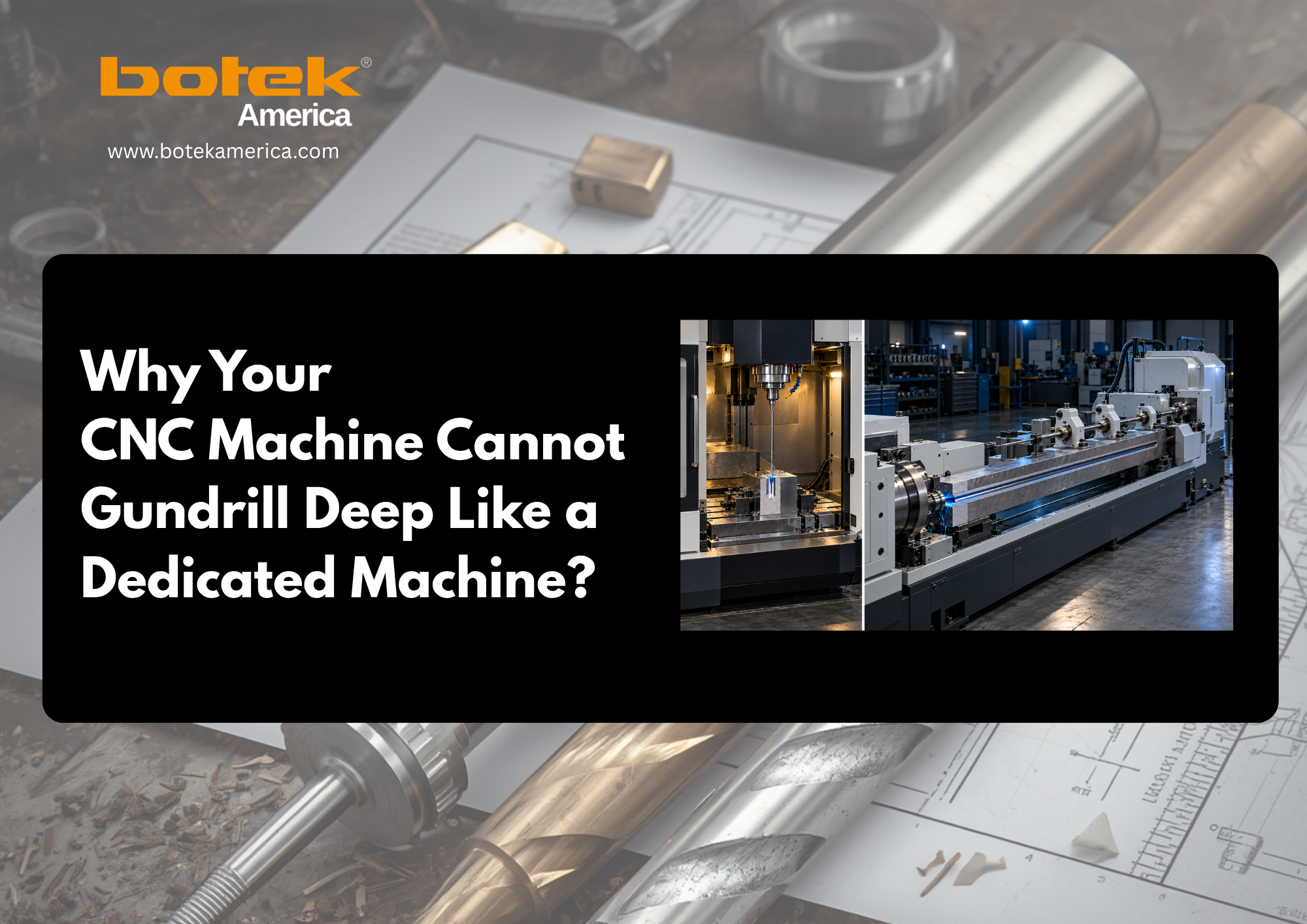
CNC gundrilling limitations show up the same way in most shops. The hole drifts at depth, chips pack, and a tool snaps with little warning. A machining center or CNC lathe can gundrill, but only inside a range. Past that range, the cause is machine design, not a setting you can tune. This guide shows where that range ends and what a dedicated deep hole drilling machine adds. If your parts already sit near that limit, send your drilling application to botek America for an engineering review.
What Is the Depth Limit Among CNC Gundrilling Limitations?
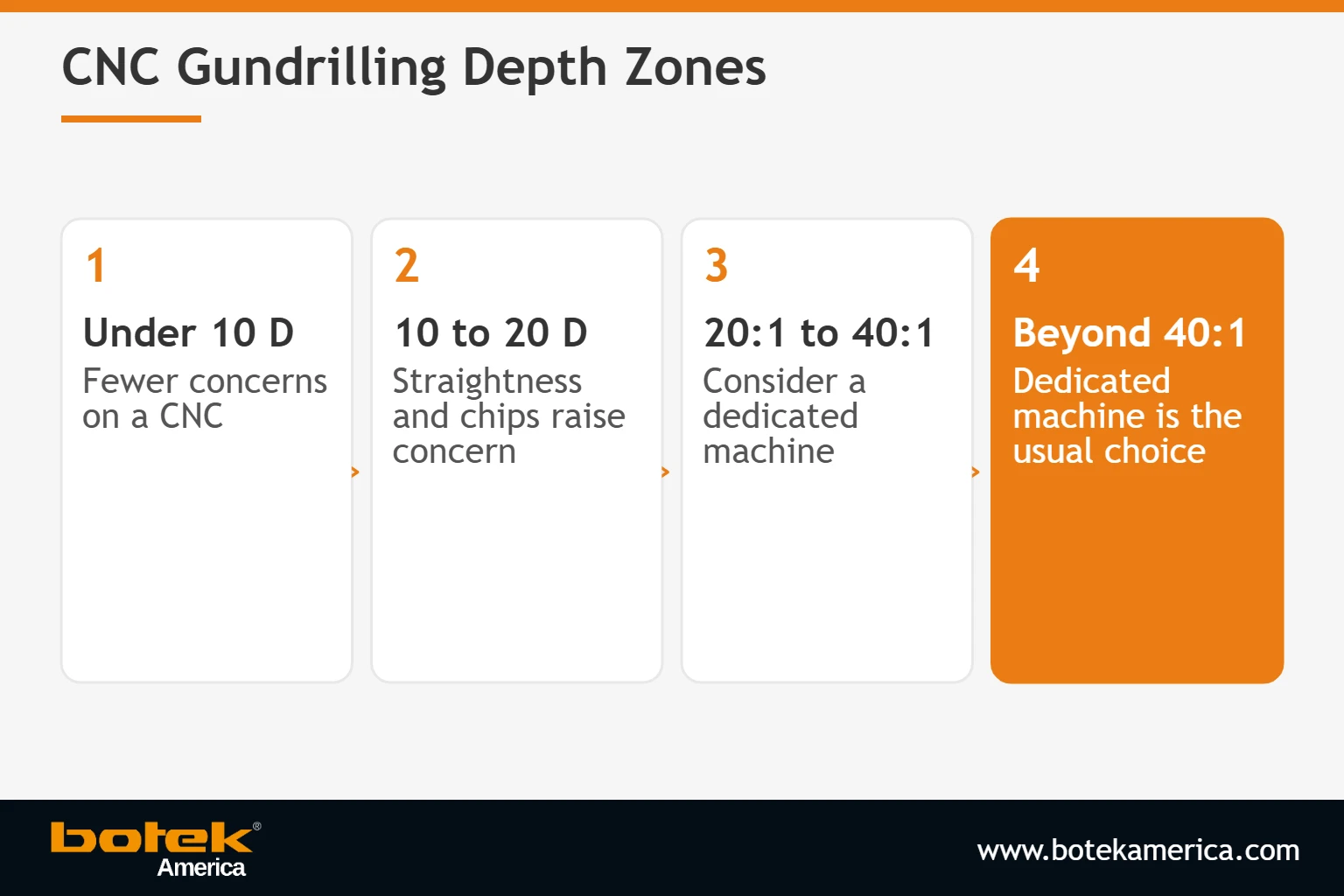
There is no single number, but most sources agree on the range. Holes deeper than about 10 to 20 diameters start to raise concerns about straightness, chip packing and early tool failure on a conventional machine. Past roughly 20:1 to 40:1, a dedicated machine is usually worth considering (Kip Hanson, CTE magazine, 2016).
How Depth-to-Diameter Ratio Works
The L/D ratio is hole depth divided by hole diameter. Here is illustrative arithmetic, not a recommended setup: a 10 mm hole drilled 300 mm deep is 30:1. The same hole at 500 mm deep is 50:1. Each step deeper adds more unsupported tool length, more coolant to push, and more chips to carry out.
Why the Limit Is a Range, Not a Line
Material, hole diameter, coolant pressure and straightness demands all move the limit. Aluminum at a loose tolerance can run deeper on a CNC than stainless steel at a tight one. Treat 20:1 to 40:1 as the zone where you should test before you commit to production. These CNC gundrilling limitations shift with every job, which is why testing beats guessing.
Why Is Coolant Pressure the Main CNC Gundrilling Limitation?
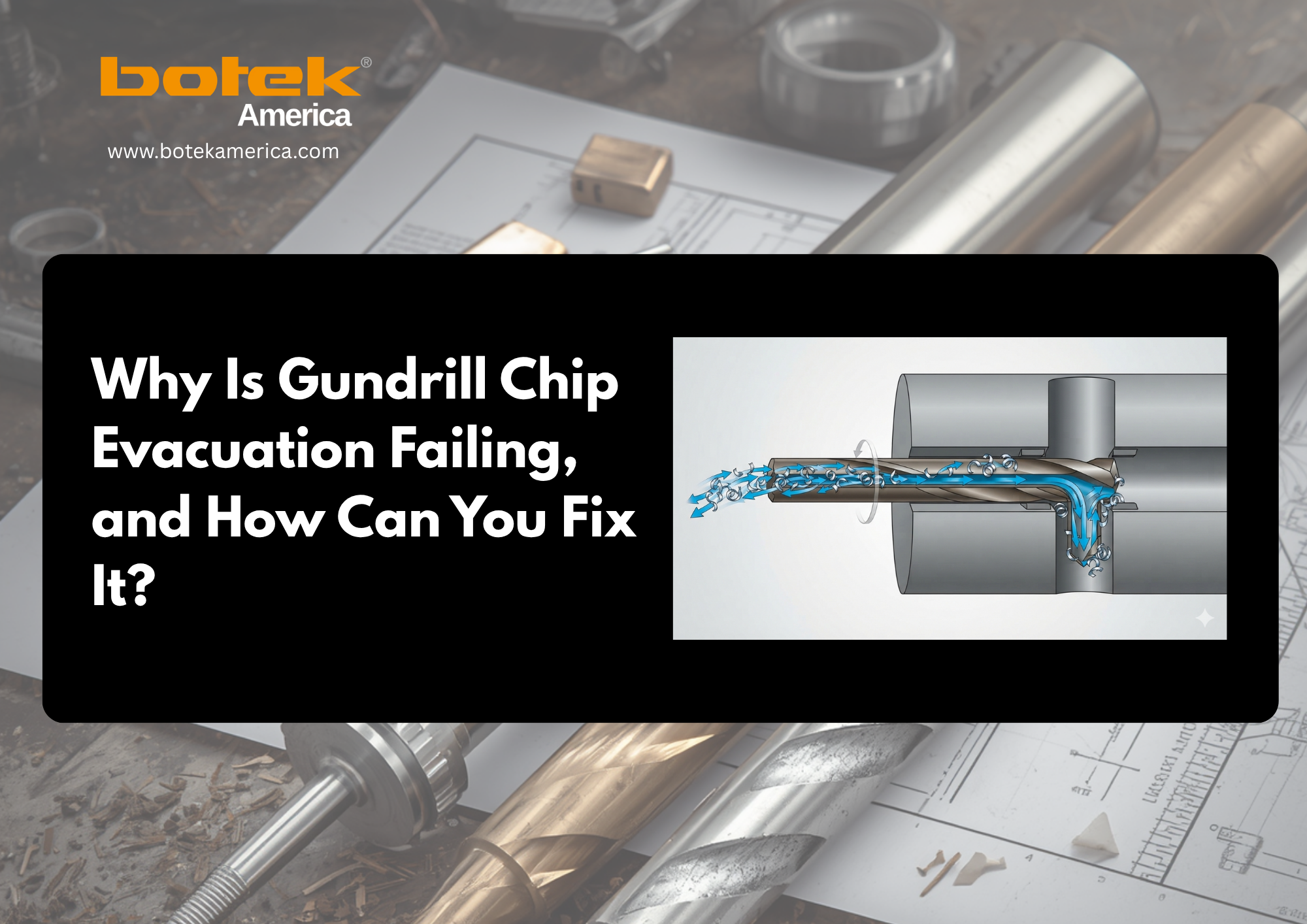
A gundrill clears chips with coolant that flows through the tool and back along the flute. If pressure or flow falls short, chips pack, heat rises and the tool breaks. Conventional machines often cannot supply enough pressure for the job.
What Pressure CNC Machines and Dedicated Machines Deliver
CTE reports that 200 to 400 psi (about 14 to 28 bar) may get you by on drills 2 inches in diameter or larger. Swiss-style lathes commonly offer around 1,000 psi (69 bar). Most dedicated gundrilling machines provide two to three times that figure. Treat these as industry reference points, since every machine and tool differs.
Why Small Holes Need More Pressure
Small flutes resist flow, so the pressure demand rises as diameter falls. The same CTE article notes that tiny medical-device holes can require 1,500 psi (about 103 bar) and higher. A standard through-spindle coolant system rarely reaches that.
How to Check Your Actual Pressure
The pump rating on the machine plate is not the pressure at the cutting edge. Measure it at the tool. botek lists a coolant pressure gauging kit for this purpose, and the botek group describes a measuring case that reads actual pressure at the spindle outlet or tool, up to 160 bar (botek.de). If your tool life is falling, read the guide to gundrill tool life and the notes on chip evacuation problems next.
Why Does a Gundrill Drift on a CNC Machine?
A CNC machine starts the hole with a pilot hole, while a dedicated machine uses a drill bushing. Any error in the pilot hole carries forward and grows with depth.
Pilot Hole Versus Drill Bushing
A dedicated machine holds the tool in a hardened bushing at the workpiece, which aligns the drill and supports it from the first moment of entry. A conventional machine needs a pilot hole about 1 to 2 diameters deep, 0.0005 to 0.0010 inch (0.013 to 0.025 mm) larger than the gundrill. You position the tool with the spindle stopped, turn the coolant on, then start drilling (CTE, 2016). Never rotate a gundrill outside the workpiece on a mill, because the unsupported tool can whip.
Missing Anti-Whip Support and Counter-Rotation
Dedicated machines also use anti-whip guides along the tool and can counter-rotate tool and workpiece, which supports straighter holes. A machining center usually has neither. A steady rest on a CNC lathe can help guide a long drill, but a machining center generally cannot offer one. For causes and fixes in detail, see our post on gundrill hole drift.
What Else Does a Dedicated Machine Handle Better?
Two more gaps matter: cross-holes and process monitoring. Operators often blame the tool for both.
Cross-Holes
When a gundrill breaks into an intersecting cavity, coolant escapes along the easiest path. Pressure falls, chips stop moving and the tool can break inside the bore. Plan cross-hole jobs with an application engineer before you run them.
Process Monitoring
Dedicated machines track pressure, flow, power and thrust, and stop the cycle automatically when a reading shifts (CTE, 2016). A CNC typically shows a spindle load meter. By the time load climbs enough to alarm, the tool may already be failing.
CNC Machine or Dedicated Machine: How Do You Decide?
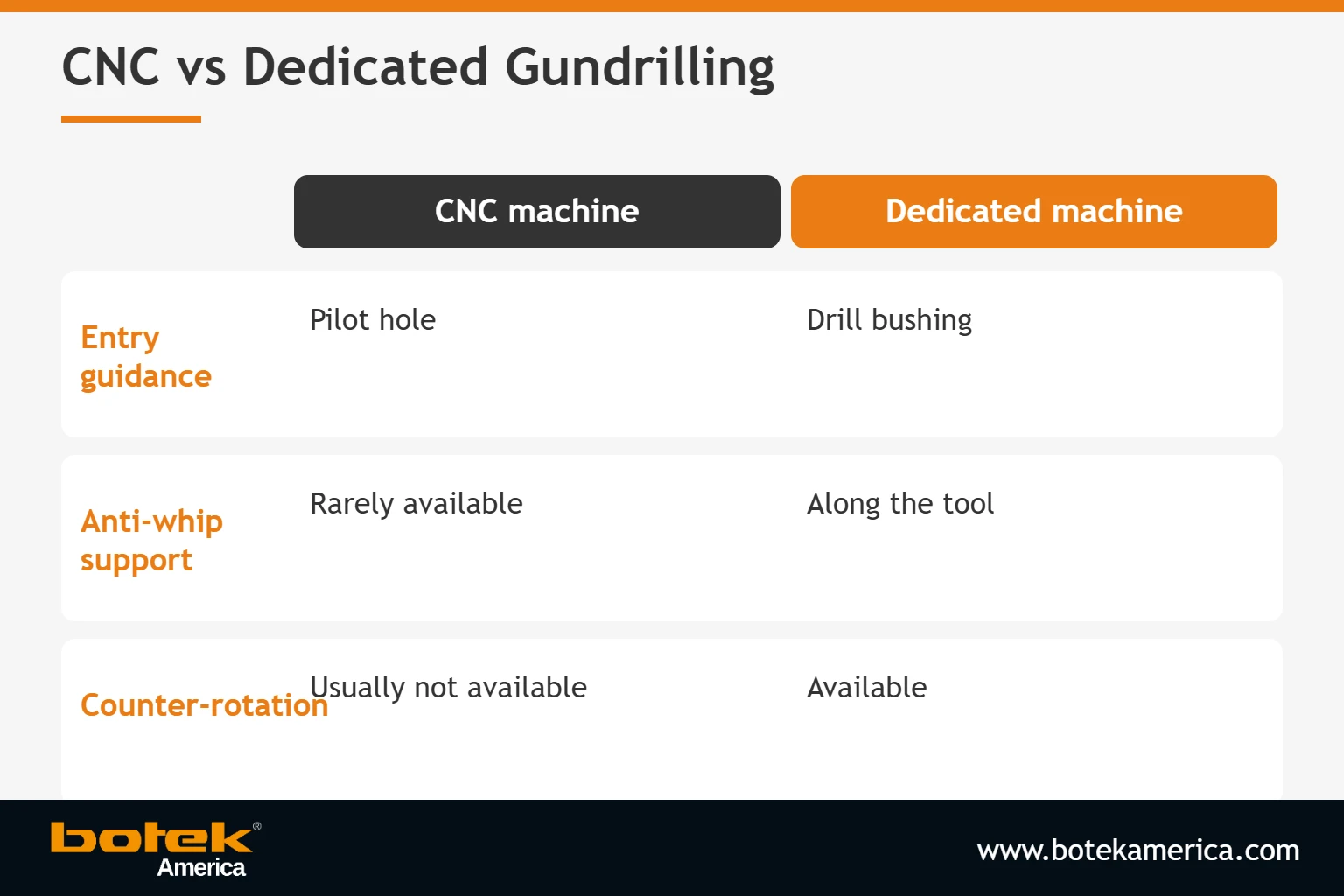
Match the machine to the hole. The table compares the two and shows where CNC gundrilling limitations appear in practice, using the sourced points above.
| Factor | CNC machine | Dedicated machine |
|---|---|---|
| Depth concerns begin | About 10 to 20 diameters | Considered past 20:1 to 40:1 |
| Coolant pressure | Often 200 to 400 psi (14 to 28 bar) on larger drills | Often 2 to 3 times Swiss-lathe levels |
| Entry guidance | Pilot hole | Drill bushing |
| Anti-whip support | Rarely available | Along the tool |
| Counter-rotation | Usually not available | Available |
| Monitoring | Spindle load | Pressure, flow, power, thrust |
When CNC Gundrilling Limitations Do Not Matter
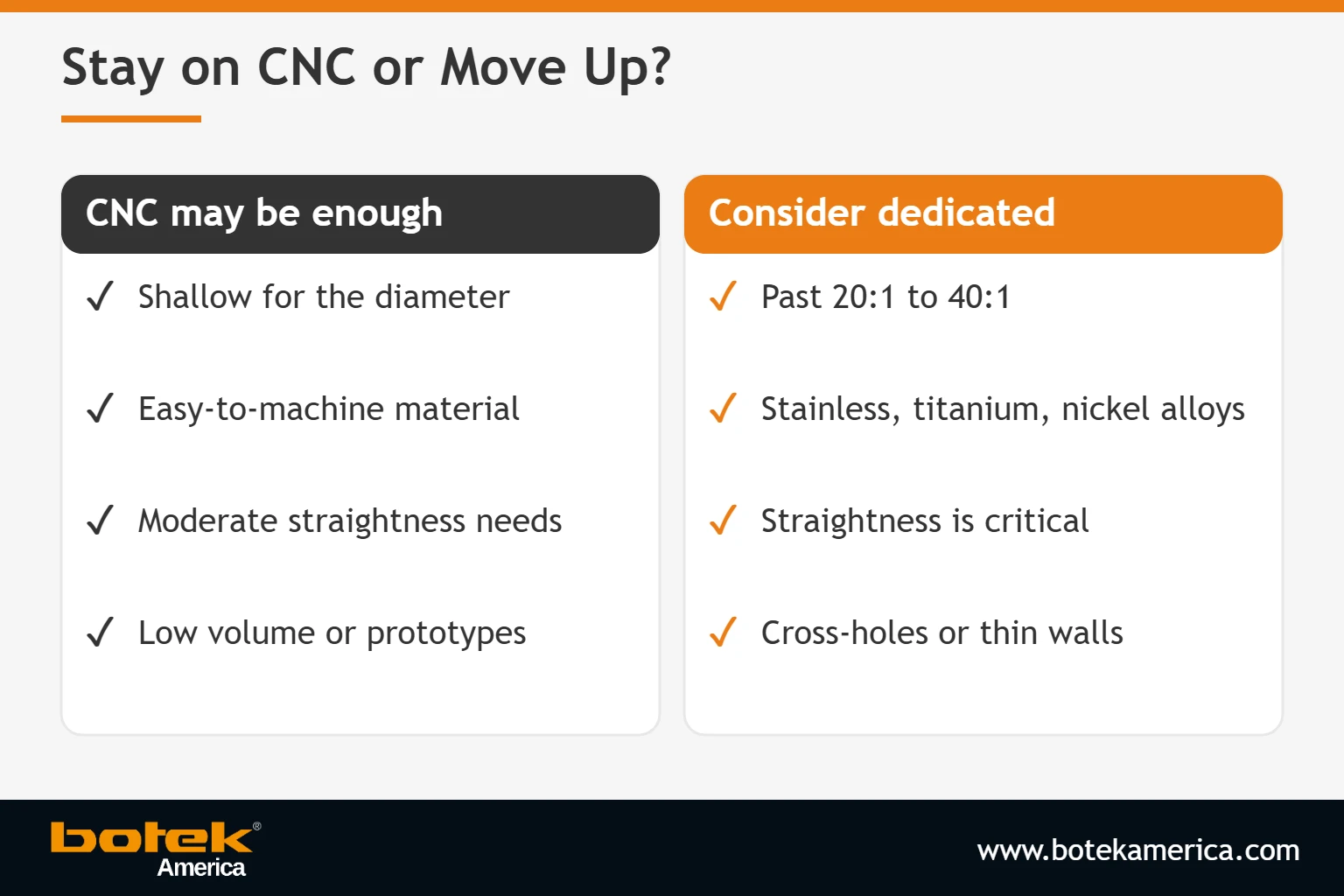
- The hole is shallow for its diameter and the material machines easily.
- Straightness and finish requirements are moderate.
- Volume is low, or you are making prototypes.
- You have measured enough coolant pressure at the tool.
When CNC Gundrilling Limitations Say Move On
- The L/D ratio is above the 20:1 to 40:1 zone.
- The material is stainless steel, titanium, a nickel alloy or hardened steel.
- Hole straightness affects how the part works, or volume is high.
- The part has cross-holes, thin walls or interrupted cuts.
For the basics behind these limits, read how gundrilling works and the gundrilling process overview. To compare gundrilling with other methods, see gundrilling vs BTA vs ejector drilling.
Which Applications Need a Dedicated Machine?
The answer depends on what the hole must do, not on the industry label. Aerospace and defense parts, medical technology components, powertrain oil galleries and mold cooling channels all share the same traits: a long hole, a hard or difficult material, and a straightness requirement that decides whether the part works. A scrapped part late in the process costs far more than the machine time saved, so test the process first. botek America offers customer testing at its Roselle, Illinois facility for exactly that.
Not sure your CNC setup can hold the depth? Send your hole size, material and machine to an application engineer, or compare gundrill types and ranges for your lathe or machining center.
Frequently Asked Questions
What coolant pressure does a CNC need to gundrill at 30:1?
It depends on diameter and material, so no single value is safe. CTE puts 200 to 400 psi in the workable range for drills 2 inches or larger, and small holes need far more. Measure pressure at the tool and compare it with the tool maker’s recommendation for your diameter.
Can a CNC lathe gundrill deeper than a machining center?
Often, yes. A steady rest on a lathe can guide a long drill, and the workpiece can rotate. A machining center usually has no equivalent support, so its practical depth is lower. Both still lack the bushing, anti-whip guides and monitoring of a dedicated machine.
Why does my gundrill drift after a few inches?
Check the pilot hole first. It should be concentric with the spindle and only 0.013 to 0.025 mm larger than the tool. Spindle runout at entry, a worn guide pad or low coolant pressure can also push the tool off line.
Ready to Stop Pushing Your CNC Past Its Limits?
Drifting holes, fast tool wear and scrap you cannot explain usually point to CNC gundrilling limitations, not the tool. If that sounds familiar, botek America application engineers can review your hole, material and machine. Call (630) 893-5300 or use the contact page.