Most shops blame the tool when a gundrill fails. In hard materials, the workpiece is often the real cause. Steel, stainless steel and Inconel each damage a gundrill in a different way, so one tool setup rarely works for all three. This guide explains why gundrill failure in hard materials happens, what each material does at the cutting edge, and what to check first. For a tool built around your material, explore botek America coating and tooling options.
Why Does Gundrill Failure in Hard Materials Start With the Material?
A gundrill has one cutting edge and little support along its length inside the bore. Any spike in resistance goes straight to the carbide tip and the guide pads. There is no second edge to share the load.
Why Gundrill Failure in Hard Materials Is Not Just About Hardness
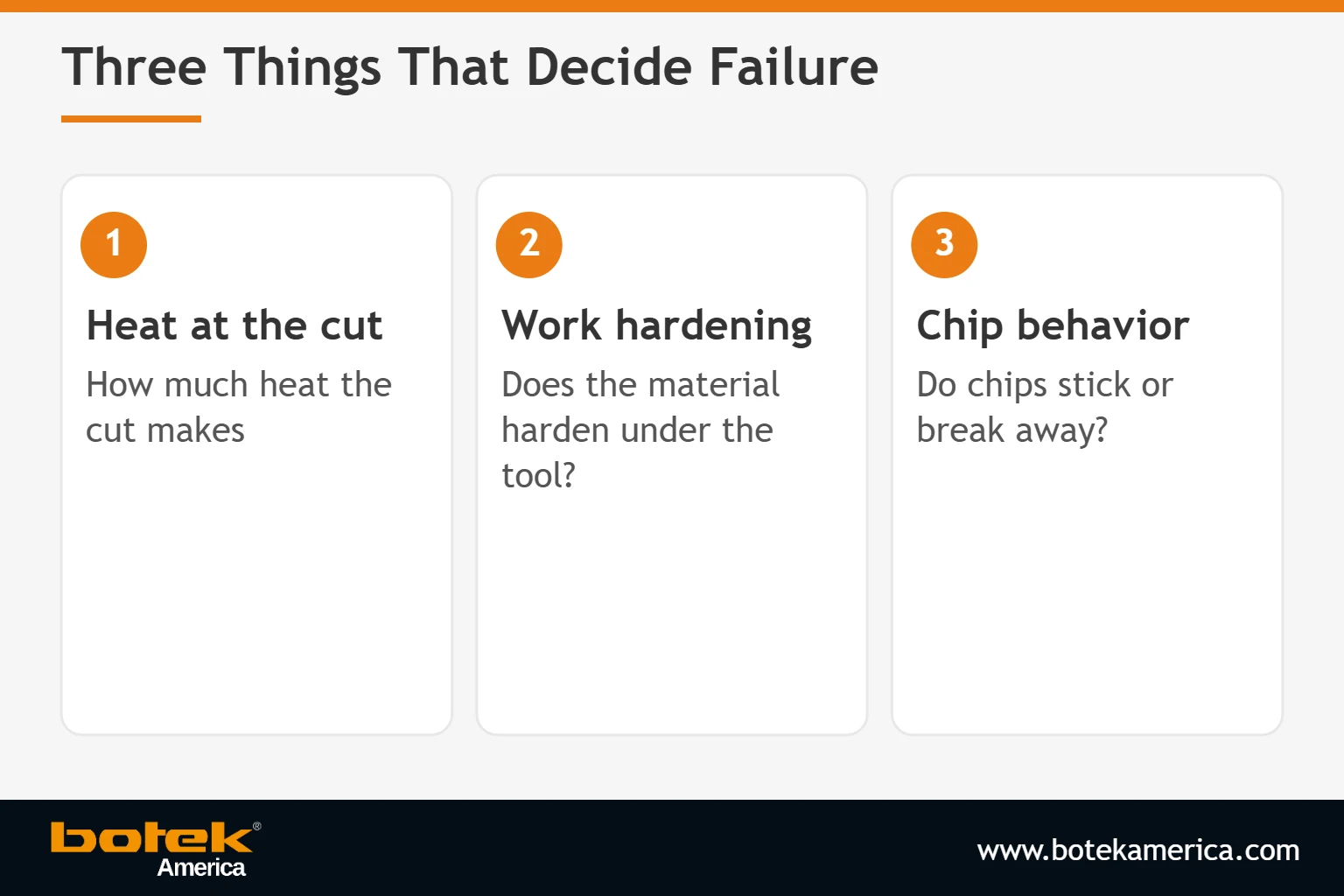
The Rockwell C scale gives a starting point, but the real question is how the material behaves at the cutting zone. Three things matter: how much heat the cut makes, whether the material hardens under the tool, and whether the chips stick or break. Those three decide which failure comes first. Gundrill failure in hard materials follows from them.
Steel: Why Does Gundrilling Still Fail Here?
Carbon and alloy steels form predictable chips and move heat away from the cutting zone well. When a gundrill fails in steel, the cause is usually in the process setup, not the material.
The Three Usual Causes in Steel
- Feed rate off target. Too low causes rubbing wear. Too high overloads the cutting edge.
- Chip packing in the flute. Low coolant flow at depth lets chips recut against the tip.
- Worn guide pads left in service. The pads burnish the hole wall and fail first. Once they go, hole quality drops and the tip follows.
These failures respond to parameter changes and a regular regrinding schedule. For each wear zone and what it tells you, read our guide to gundrill tool life.
Stainless Steel: Why Does Built-Up Edge Chip My Tip?
Austenitic stainless steels have the greatest tendency to work harden, according to Outokumpu in its machining guide for stainless bar. The cutting edge ends up working in material that is harder than the bulk grade suggests. That is the setup for built-up edge.
What Is Built-Up Edge?
Built-up edge, or BUE, is chip material that welds onto the cutting edge in layers. Outokumpu notes that this sticking tendency is most marked in austenitic stainless. When the layer breaks away, it can pull fragments of carbide with it. The damage looks like impact chipping, but the root cause is adhesion. That calls for a different fix.
Why Coolant Delivery Matters in Stainless
Outokumpu advises applying cutting fluid generously. In a gundrill, that means strong through-tool flow to wash the edge and break up sticky chips. Read how a gundrill delivers coolant to the cutting zone before you change any other setting. Coating choice also matters, and it depends on the grade and the job, so review coating options with an application engineer.
Inconel 718: Why Does Carbide Fail Here?
Inconel 718 is a nickel alloy that gets its strength from heat treatment. Special Metals lists its hardness at 40 to 46 HRC in the annealed and aged condition, and notes that cold work also raises hardness (Special Metals technical bulletin). But hardness is only half the story.
Why Heat Stays at the Tip
The same bulletin lists room-temperature thermal conductivity of 77 to 79 BTU·in/ft²·h·°F, which is about 11 W/m·K. Carbon and low alloy steels conduct heat several times better. In Inconel, heat stays near the cutting edge and the carbide takes the load.
What Happens to the Gundrill Tip
- Inconel can bond to carbide at high temperature, which builds adhesive wear on the faces.
- Concentrated heat can cause crater wear behind the cutting edge.
- Guide pads can wear unevenly, which lets the tool drift.
If a hole drifts in Inconel, check pad wear and coolant flow before you realign the machine. For failure patterns in nickel alloys, see why gundrills break and how to prevent it.
Tool Material and Pressure
Coolant pressure, carbide grade and any alternative cutting material such as PCBN depend on diameter, depth and volume. We do not give one figure here, because a wrong number costs tools. Ask for guidance based on your hole, or run a trial through customer testing.
How Does Gundrill Failure in Hard Materials Compare Across Three Alloys?
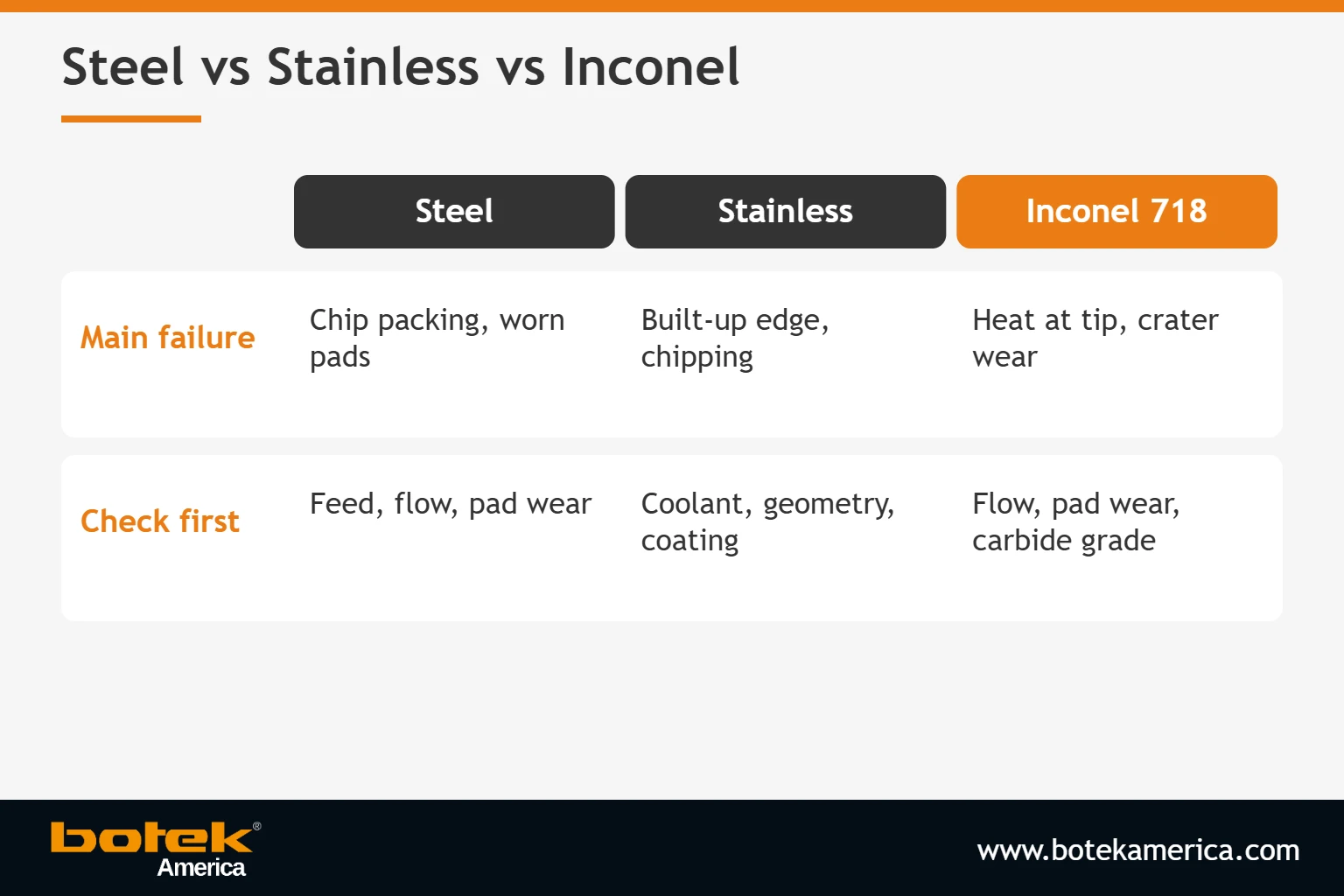
| Material | Main failure mode | Check first |
|---|---|---|
| Carbon and alloy steel | Chip packing, worn pads, feed error | Feed, coolant flow, pad wear |
| Austenitic stainless steel | Built-up edge, adhesive chipping | Coolant delivery, tip geometry, coating |
| Inconel 718 | Heat concentration, crater wear, uneven pads | Coolant flow, pad wear, carbide grade |
How Do You Specify a Gundrill for the Material?
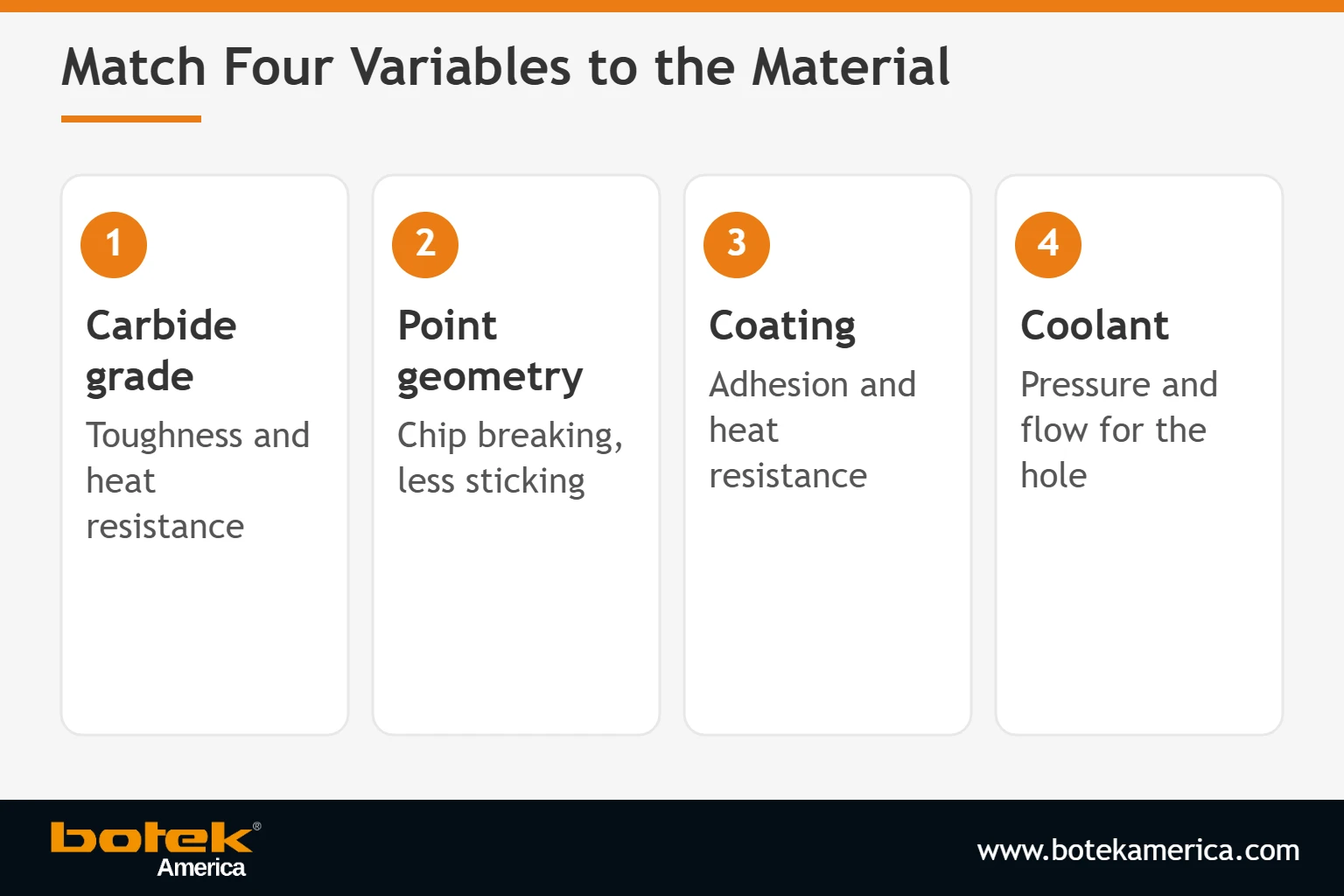
Four variables decide whether a gundrill survives in a hard material. Change one without the others and you usually move the problem instead of solving it.
The Four Variables
- Carbide grade: toughness and heat resistance must fit the material.
- Point geometry: ductile materials need a shape that encourages chip breaking and limits sticking.
- Coating: chosen for adhesion and heat resistance in that alloy.
- Coolant pressure and flow: matched to diameter, depth and material.
Get the geometry right before you touch speed or feed. A tip made for free-machining steel will stick quickly in an austenitic grade. For a full approach to tracking these factors, see deep hole drilling process optimization.
Seeing these failures on your own parts? Send your hole size, material and machine to an application engineer, or compare gundrill types for hard materials.
Frequently Asked Questions
Can I use the same gundrill in carbon steel and stainless steel?
Usually not without changes. Stainless steel tends to need different tip geometry, stronger coolant delivery and a coating chosen for adhesion. Using a steel tool in stainless often leads to early built-up edge.
Why does my gundrill drift more in Inconel than in steel?
Uneven pad wear is a common cause. Heat concentrates at the tool, the pads wear unevenly and the tool leans off line. Check pad wear and coolant flow before you adjust the machine.
At what hardness does a standard carbide gundrill become unreliable?
There is no single number. In nickel alloys such as Inconel 718, heat and work hardening cause trouble well before the bulk hardness looks extreme. Talk to an engineer about your alloy, condition and diameter.
Is Gundrill Failure in Hard Materials Slowing Your Production?
Gundrill failure in hard materials is something you can diagnose. Steel fails through process errors, stainless through built-up edge, and Inconel through heat and a work-hardened layer. The right carbide grade, tip geometry, coating and coolant strategy change the result, and they work together. botek America supports steel, stainless, nickel alloys, titanium and other difficult materials from Roselle, Illinois. Review your application through special solutions or call (630) 893-5300.